For any UK landlord, treating the government's budget as mere political background noise is a surefire way to get into financial trouble. Think of yourself as the captain of a ship—your rental portfolio. The annual budget is the shipping forecast; it warns you of changing tides, shifting currents, and potential storms brewing on the horizon. Ignoring it is like sailing blind.
The way the budget affects landlords isn't just one single hit. It’s a chain reaction. A seemingly small tweak to a tax rule can shrink your net profit almost overnight, while a shift in economic policy can send your mortgage payments soaring. Often, these pressures mount at the same time, creating a tricky financial environment that demands a steady hand.
Why the UK Budget Is a Landlord's Roadmap
The Interconnected Web of Fiscal Policy
Getting your head around the budget isn't about memorising one or two key numbers. It's about seeing how all the different policies link together and pull on the threads of your business. In today's rental market, proactive financial planning isn't just good practice—it's absolutely essential for survival and growth.
There are always a few key areas in play:
- Tax Liabilities: Minor changes to income tax bands or Capital Gains Tax can make a major dent in your annual profit margins.
- Operating Costs: Fiscal policy has a huge influence on inflation, which in turn drives up the costs of everything from maintenance and insurance to essential compliance checks.
- Mortgage Rates: The Bank of England often reacts to budget announcements, and its decisions can lead directly to higher borrowing costs, putting a real squeeze on your cash flow.
- Tenant Affordability: The same economic winds that buffet you are also hitting your tenants, affecting their job security and ability to pay the rent on time.
To help you get a clearer picture, this table breaks down the main ways government decisions can ripple through your rental business.
Key Budget Impact Areas for UK Landlords
| Impact Area | How It Affects Your Rental Business | Real-World Example |
|---|---|---|
| Income Tax | Changes to tax thresholds or rates directly alter your net rental profit. A higher tax bill means less cash in your pocket at the end of the year. | A freeze on the higher-rate income tax threshold means that as rental income increases with inflation, more of it is pushed into the 40% tax bracket. |
| Mortgage Interest Relief | Policies like the phased removal of mortgage interest relief (Section 24) have fundamentally changed how landlords are taxed, increasing the burden for many. | A landlord with a £200,000 mortgage at 5% interest used to be able to deduct the full £10,000 interest cost. Now, they only get a 20% tax credit, significantly raising their taxable income. |
| Capital Gains Tax (CGT) | When you sell a property, any reduction in the annual CGT allowance means you'll pay more tax on your profits, impacting your long-term investment returns. | The CGT annual exempt amount being lowered from £12,300 to £3,000 means a landlord selling a property will pay tax on an extra £9,300 of their gain. |
| Tenant Financial Support | Adjustments to Universal Credit or the Local Housing Allowance (LHA) directly impact your tenants' ability to afford rent, increasing the risk of arrears. | A freeze in LHA rates during a period of high rental inflation means the gap between what tenants receive in benefits and their actual rent widens, putting them under severe financial pressure. |
Understanding these connections is the first step toward building a more resilient rental business.
A landlord's budget is inextricably linked to the national budget. Every decision made in Westminster, from tax thresholds to housing benefits, ultimately sends a ripple that reaches your bank account, shaping your profitability and long-term investment strategy.
This guide is here to break down these complex links into clear, practical insights. We’ll dig into exactly how tax changes hit your bottom line, what you can do to manage rising operational costs, and how to strike the right balance between your mortgage and your tenants' finances.
For more tips on managing your rental business effectively, you can explore additional resources on the Rooms For Let blog. By getting to grips with these dynamics, you'll be far better equipped to protect your investment, keep your cash flow healthy, and adapt to whatever the financial landscape throws at you.
Understanding Tax Changes That Impact Your Rental Profit
For any UK landlord, the tax section of a government budget announcement is usually where the sharpest pains are felt. The language can feel complex and far-removed from your day-to-day, but the impact on your net profit is anything but—it's immediate, direct, and crucial to get your head around if you want to forecast your finances accurately.
Think of your rental income as a full bucket of water. Every new tax policy is like a small hole being drilled into the side. Some are tiny, some are significant, but they all contribute to a lower water level. In recent years, policies like the phased removal of mortgage interest relief—better known as Section 24—have become one of the biggest holes, fundamentally changing how your profits are calculated.
Section 24 is a perfect example of how the budget affects landlords by completely shifting the goalposts. Before it was introduced, you could simply deduct your full mortgage interest costs from your rental income before the taxman took his slice. Now, that's gone. Instead, you can only claim a basic rate tax credit of 20% on your interest payments, a far less generous system that has single-handedly pushed many landlords into higher tax brackets.
The chart below shows how taxes, general costs, and mortgages are the three core areas where budget decisions really squeeze a landlord's financial health.
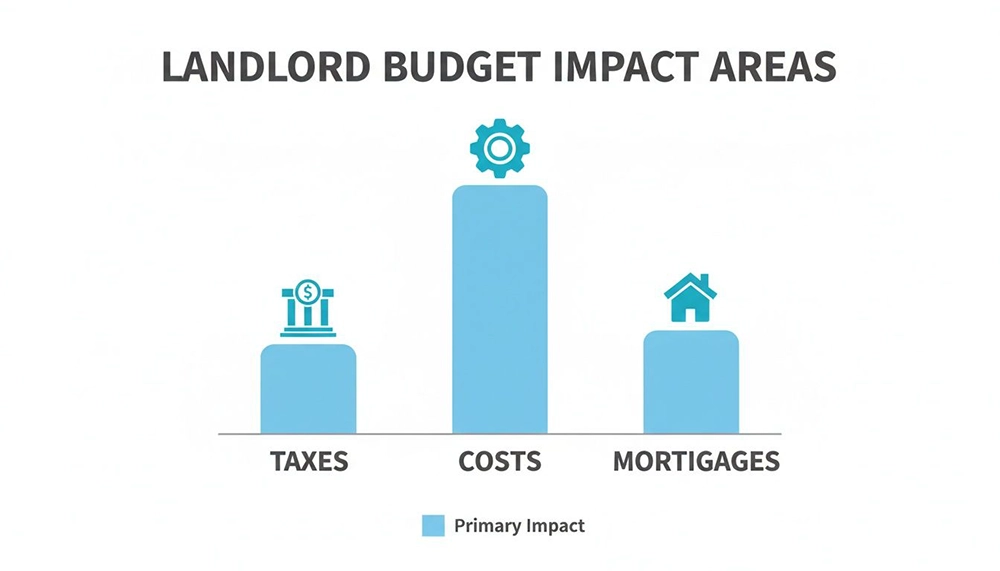
As you can see, while mortgages and taxes are huge pressures, it's often the rising tide of day-to-day operating costs that represents the most substantial drain for landlords today.
The Squeeze on Your Bottom Line
It’s rarely just one single policy causing the pressure. It’s more like a pincer movement, with a combination of changes working together to squeeze your profit margins from multiple angles. Capital Gains Tax (CGT) is another key battleground. When you decide to sell one of your properties, any profit you make on the sale is subject to CGT.
Recent budgets have slashed the annual tax-free allowance for CGT from a pretty generous £12,300 all the way down to just £3,000. That's a massive drop, and it means a much larger portion of your capital gain is now taxable, seriously reducing the net return on your long-term investment.
Let's look at a simple comparison to see the real-world effect:
- Before: A landlord makes a £20,000 capital gain. They use their £12,300 allowance, meaning only £7,700 of the gain is taxable.
- After: The same landlord makes a £20,000 gain. With only a £3,000 allowance, a much larger £17,000 of that gain is now subject to tax.
This shows exactly why your tax bill can climb steeply, even when your property's sale price hasn't changed.
The modern landlord's challenge isn't just about earning rental income, but retaining it. Tax changes have transformed the landscape, making it essential to understand where every pound is going and why your taxable income might be far higher than you expect.
This financial pressure is reflected in national statistics. According to official HMRC figures, total property income for unincorporated landlords recently hit a record £55.53 billion. Yet, allowable expenses also swelled by a massive 27% over four years to reach £29.08 billion, with the average landlord's expenses climbing to £11,500.
Other Taxes to Keep on Your Radar
Beyond the big headlines of Section 24 and CGT, there are plenty of other tax adjustments that can quietly add to your financial burden. If you operate as a business, any changes to National Insurance contributions for the self-employed will directly impact your outgoings.
And, of course, Stamp Duty Land Tax (SDLT) is a constant consideration for anyone looking to expand. While budgets sometimes offer temporary "holidays" to stimulate the market, any increase in SDLT rates makes acquiring new properties more expensive, directly affecting your ability to grow your portfolio.
To get a real grip on how these changes impact your profit, you have to master what you can legally claim back. While UK and US rules differ, a great guide for understanding the core principles is this one on U.S. short term rental tax deductions. It showcases the vital importance of tracking every single allowable expense—from repairs to professional fees—to ensure you aren't overpaying. Ultimately, mastering your tax obligations is the cornerstone of any sustainable and profitable rental business.
Managing the Rising Tide of Operating Costs
Beyond direct taxes, the way a government's budget affects landlords is often felt through the slow, relentless creep of day-to-day running costs. Your real profit isn’t just the rent you collect; it’s what’s left in the pot after paying for everything needed to keep your property safe, legal, and comfortable for your tenants. When economic policies nudge inflation upwards, the cost of materials for a simple repair, a plumber's hourly rate, or your annual insurance premium all start to climb, silently eating away at your margins.
This isn’t just about general market pressures, either. Specific regulations, often linked to wider government goals on safety and energy efficiency, frequently bring new, mandatory expenses. These aren’t optional upgrades but legal duties that can come with hefty price tags, demanding some serious financial planning.
The Growing Burden of Compliance and Maintenance
For UK landlords, the list of essential, non-negotiable costs seems to get longer every year. Getting a firm grip on these expenses is absolutely fundamental to maintaining a healthy cash flow.
Safety certification is a huge area of rising costs. As a landlord, you are legally bound to ensure your properties are safe, and that involves regular, professional checks that you simply cannot afford to skip.
- Gas Safety Certificates (CP12): These annual checks are a legal must-have for any property with gas appliances. The cost for a qualified engineer to carry out the inspection and issue the certificate has been steadily rising.
- Electrical Installation Condition Reports (EICR): Required every five years, these reports involve a deep dive into a property's wiring. If the report flags any necessary remedial work, you have to get it done, often leading to unexpected and significant bills.
On top of this, landlord insurance premiums have shot up. Recent data shows average costs jumped by 9.7% year-on-year, and have climbed an eye-watering 63.1% over the last decade. This reflects the soaring cost of repairs and a general increase in perceived risks.
Your gross rental income is just the starting point. The true measure of your investment's success is your net profit after subtracting the ever-increasing costs of maintenance, insurance, and mandatory safety compliance.
Meeting Energy Efficiency Standards
One of the biggest financial pressures for landlords right now is the constant evolution of energy efficiency standards. The government is pushing hard for a greener housing stock, and that puts the burden of upgrading older, less efficient properties squarely on the owners.
Currently, rental properties in England and Wales need a minimum Energy Performance Certificate (EPC) rating of 'E'. But proposals have been floating around for years to lift this minimum to 'C' for all new tenancies, and eventually for all existing ones. For a landlord with an older property, getting to that 'C' rating can mean a substantial investment.
Common upgrades needed to hit that 'C' rating include:
- Installing loft and cavity wall insulation
- Upgrading to double or even triple-glazed windows
- Replacing an old boiler with a modern, efficient model
- Fitting low-energy lighting throughout the property
These improvements can easily run into thousands of pounds for each property. While they can make a property more appealing to tenants and lower their energy bills, the upfront cash required is a major financial hurdle that needs to be factored into any long-term budget.
Special Considerations for HMO Landlords
If you’re operating Houses in Multiple Occupation (HMOs), the financial squeeze is even tighter. The rules for HMOs are much stricter, and the costs that come with them are proportionally higher.
Licensing fees, which vary wildly from one council to another, are a major and recurring cost. On top of that, HMOs have to meet more rigorous fire safety standards, often requiring investment in sophisticated alarm systems, fire doors, and emergency lighting. The simple fact of having more tenants means more wear and tear, leading to more frequent repairs and redecoration.
With all these costs piling up, it’s absolutely vital to keep void periods to a minimum and your rooms filled. Understanding your marketing options is key, and it’s worth exploring different advertisement price points to find a cost-effective strategy that works for you. By keeping a tight rein on your outgoings and maximising your income, you can better navigate the rising tide of operational expenses.
The Ripple Effect on Mortgages and Tenant Finances
Government budgets don't operate in a vacuum. A decision announced in Westminster can feel a world away, but its effects can ripple outwards, eventually landing squarely on your mortgage statement and your tenants' finances. Think of it like a domino effect: a budget designed to curb inflation might prompt the Bank of England to raise interest rates, and that change quickly finds its way to your buy-to-let mortgage.
Understanding this link between national policy and your own accounts is absolutely crucial for any landlord. If your mortgage is on a variable or tracker rate, an interest rate hike means your monthly payments go up almost instantly, putting a real squeeze on your cash flow. Even if you're on a fixed-rate deal, you’re not immune forever. When it's time to remortgage, you'll likely face a much higher rate than before, forcing a major rethink of your property’s profitability.

The Tenant Affordability Crisis
Here's the critical part: the very same economic pressures driving up your costs are also hitting your tenants, often much harder. Inflation, soaring energy bills, and the general rise in the cost of living mean tenants have less and less disposable income. Their budgets are stretched to the breaking point, making them extremely sensitive to rent increases and, in some cases, pushing them towards rent arrears.
This creates a tricky balancing act for landlords. As your own costs—from mortgage interest to insurance premiums—are climbing, the logical response is to raise the rent to cover them. But if you push it too high, you risk losing good tenants or pricing people out of your property entirely.
A vacant property brings in zero income but continues to drain your finances with council tax, utilities, and mortgage payments. This is why a real understanding of tenant affordability isn't just about being empathetic; it's a vital business strategy for keeping void periods to a minimum and protecting your rental income.
Navigating the Rent Increase Dilemma
This double-sided squeeze is clear across the entire market. The need for landlords to cover their spiralling expenses has driven rents to historic levels. A recent analysis from Rightmove revealed that average advertised rents outside London have hit a 19th consecutive quarterly record at £1,344 per calendar month. In the capital, they’ve rocketed to £2,694 pcm. This isn't happening by chance; it’s a direct consequence of budget measures inflating landlord costs, with essentials like insurance climbing 63.1% over the past decade. You can read the full rental trends report to dig deeper into the data.
This situation forces every landlord to ask a difficult question: how do you cover your rising costs without losing a reliable tenant?
- Do Your Homework: Before you even think about an increase, research what similar properties in your area are renting for. This ensures your new rent is fair and competitive.
- Talk to Your Tenants: An open and honest conversation goes a long way. Explaining why you need to increase the rent (e.g., rising mortgage rates) can help maintain a positive relationship.
- Consider a Phased Approach: Instead of one large jump, a smaller, phased increase might be more manageable for your tenant's budget, giving them time to adjust.
It's all about finding the right balance. A slightly lower rent from a fantastic, long-term tenant is often far more profitable than chasing the absolute maximum rent and facing the cost and stress of a void period.
Ultimately, the way the budget affects landlords is a complex dance between macroeconomic policy and the microeconomics of your tenants' lives. Your lender sets your mortgage costs based on national rates, while your tenants' ability to pay is shaped by the exact same economic climate. To manage your rental business successfully, you have to stay tuned in to both sides of this delicate equation, ensuring you remain financially sound while acknowledging the very real pressures your tenants are under.
Practical Strategies to Safeguard Your Rental Business
Understanding how the national budget affects landlords is one thing, but turning that knowledge into a defensive financial plan is what truly protects your investment. In a climate of rising costs and shifting tax rules, sitting back and waiting is a recipe for disaster. Instead, proactive management can build a resilient rental business capable of weathering any economic storm.
The first step is to stop guessing and start getting granular. This means treating your rental portfolio with the same financial discipline as any other business, starting with a thorough health check of your current finances. From there, you can build a forward-looking strategy that anticipates challenges rather than just reacting to them.
Conduct Regular Financial Health Checks
Just as you’d periodically inspect a property for a leaky roof, you need to regularly examine its financial performance. A financial health check is more than just glancing at your bank balance; it’s a proper deep dive into your income, expenses, and overall profitability.
This process involves pulling up the last 12 months of activity to establish a clear baseline. Calculate your gross yield, net yield, and return on investment for each property. This analysis will quickly highlight which assets are performing well and which might be draining your resources, giving you the hard data needed to make properly informed decisions.
Create a Detailed Annual Budget
An annual budget is your financial roadmap for the year ahead. It forces you to account for every single anticipated cost, from predictable mortgage payments to less certain expenses like repairs and potential void periods. This is where your financial health check becomes invaluable.
Your budget should include line items for:
- Fixed Costs: Mortgage payments, insurance, letting agent fees, and service charges.
- Variable Costs: Maintenance, repairs, and marketing for new tenants.
- Compliance Costs: Annual Gas Safety certificates, EICRs every five years, and any potential licensing fees.
- Tax Provisions: Setting aside a portion of your rental income each month to cover your end-of-year tax bill. This is a non-negotiable.
A well-structured budget is the single most powerful tool for maintaining control over your cash flow. It transforms unknown variables into calculated estimates, giving you foresight and preventing nasty financial surprises.
This detailed planning is the foundation upon which you can build a more secure rental business, allowing you to see exactly how external pressures will squeeze your bottom line.
Build a Robust Contingency Fund
No budget on earth can predict a sudden boiler failure or an unexpected three-month void period. This is where a contingency fund—often called a 'sinking fund'—becomes your financial safety net. This is a separate savings account earmarked exclusively for unforeseen major expenses related to your properties.
A common rule of thumb is to save between 5-10% of your monthly rental income in this fund. Having this cash reserve means you can handle emergencies without derailing your entire budget or, worse, going into debt. It provides peace of mind and ensures you can meet your legal obligations as a landlord to carry out timely repairs. A crucial part of this is implementing effective strategies to market rental properties and fill vacancies fast, as this directly reduces the risk of those costly void periods.
Perform Strategic Rent Reviews and Optimise Your Portfolio
With a clear view of your rising costs, you can conduct rent reviews that are both fair to your tenants and strategic for your business. The goal is to balance the need to cover your expenses with the importance of keeping good tenants. A modest, well-communicated increase is often far better than a huge hike that forces a reliable tenant to leave.
Portfolio optimisation is another key strategy. Your financial health check might reveal a property that consistently underperforms. In this case, selling that asset could release capital to pay down debt on more profitable properties or to invest in upgrading another one. Alternatively, if interest rates are favourable, refinancing could lock in a better mortgage deal, significantly lowering your monthly outgoings.
Keeping your properties occupied is vital. Platforms that help you advertise rooms and find tenants quickly are essential tools in your arsenal. For instance, you can register as a landlord for free to connect with thousands of potential tenants across the UK, helping you minimise vacancies and protect your income stream.
Landlord FAQs: Your Questions Answered
When the government announces a new Budget, or the economic winds shift, it’s natural to wonder what it all means for your property business. It can feel like you need a crystal ball just to keep up. Here are some clear, straightforward answers to the questions we hear most often from landlords trying to make sense of it all.
How Can I Protect My Profits from Tax Changes?
The first line of defence against any tax hike is meticulous record-keeping. Every single allowable expense, from fixing a dripping tap to your letting agent's fees, needs to be logged. Think of it as building a defensive wall around your income; the more legitimate expenses you claim, the less of your profit is exposed to the taxman.
Staying informed is just as critical. Policies like Section 24, which scrapped mortgage interest relief for many, were game-changers for profit calculations. Understanding these shifts as they happen allows you to adjust your financial strategy on the fly. This might mean having a serious chat with a property-savvy tax advisor about options like operating through a limited company—though that comes with its own set of complexities and isn't a silver bullet for everyone.
Finally, you need to be proactive with your budgeting. Don't wait for the shock of a tax bill to figure out what you owe. A smart move is to siphon off a percentage of your rent each month into a separate account, earmarked specifically for tax. This simple habit prevents a cash flow crisis and means you're always prepared.
The most effective way to shield your rental business from tax hikes is through knowledge and discipline. Understand the rules, record everything, and plan ahead. It’s the reactive landlords who see their profits disappear.
What’s the Best Way to Handle Rising Mortgage Costs?
When interest rates climb, your mortgage payment is often the first and biggest expense to swell. The best way to tackle this is to get ahead of the problem. Start reviewing your mortgage options a good six months before your current deal is due to expire. This gives you plenty of breathing room to shop around for the best rates without being rushed into a bad decision.
If you value predictability, locking in a longer-term fixed rate can be a lifesaver. Yes, the rate might be a fraction higher than a variable one today, but it provides stability for years to come, making your financial planning much, much easier. It's also worth remembering that if your property's value has shot up, your loan-to-value (LTV) ratio might be lower, which could unlock more competitive mortgage deals.
But what if remortgaging isn't on the cards? Then it's time to get creative and optimise everything else. Can you shave a few days off your void periods each year? Could you find a more competitive landlord insurance policy? Squeezing small savings from multiple areas can really help to offset the sting of a bigger mortgage payment.
Should I Raise Rent to Cover My Increased Expenses?
Ah, the classic landlord dilemma. While it’s tempting to simply pass on every increased cost to your tenants, this needs a careful, strategic touch. A sudden, steep rent hike can easily push a great tenant to leave, triggering a costly void period that wipes out any gains you might have made.
Before you do anything, you need to do your homework.
- Check the Local Market: What are similar properties in your neighbourhood renting for? If your new proposed rent is way above the local average, you'll struggle to find anyone.
- Think About Your Tenant: Consider your current tenant's situation. A small, well-communicated increase might be perfectly fine, but a huge jump could put them under real financial strain, increasing your risk of late payments.
- Do the Maths: Run the numbers. Compare the extra income from a rent rise against the potential cost of a void period (lost rent, marketing fees, referencing). More often than not, keeping a brilliant tenant at a slightly-below-market rent is the more profitable long-term strategy.
Communication is everything. If you decide an increase is unavoidable, explain your reasons. Mentioning rising mortgage rates or maintenance costs helps them see it as a business necessity, not just a grab for more profit.
How Much Should I Keep in an Emergency Fund?
For any landlord, an emergency fund isn't a "nice-to-have"—it's an absolute necessity. This is your financial buffer against the unexpected, whether that's a boiler on the blink or a sudden eviction process. A common rule of thumb is to have three to six months' worth of rental income tucked away in an easy-access savings account.
For a more tailored figure, do a quick calculation. Add up your essential monthly outgoings for one property:
- Mortgage payment
- Insurance premium
- Council tax (for when it's empty)
- Letting agent fees
- Average utility costs (if any are included in the rent)
Multiply that total by three, and you have your minimum emergency fund target for that property. If you own a portfolio, you'll need a bigger pot, though you might not need to hold a full three months of expenses for every single one. The goal is simple: have enough liquid cash to handle a major repair or a long void period without raiding your personal savings or going into debt. How the budget affects landlords can be unpredictable; this fund is your best defence.
Ready to minimise void periods and keep your properties profitable? At Rooms For Let, we connect you with thousands of potential tenants across the UK every day. Advertise your room for free and find your next great tenant today!