Yes, subletting is legal in the UK. But—and it's a big but—it nearly always hinges on one crucial thing: getting your landlord's written permission first.
Going ahead without that consent is what's known as 'unauthorised subletting', and it can land you in serious hot water, potentially even leading to eviction. It’s a bit like borrowing a friend's car; you simply wouldn't grab the keys and drive off without asking first.
The Foundations of Subletting Law
To get your head around subletting law in the UK, whether a complete property or individual rooms to rent, you need to start with the core concept of consent. When you sign a tenancy agreement, you’re entering into a formal contract with your landlord, and that document almost always lays out what you can and can't do with the property.
Bringing a new person into that arrangement through subletting changes the game, which is exactly why your landlord has to approve it. Without their official nod, you’re breaking the terms of your agreement. Simple as that.
Authorised vs Unauthorised Subletting
The difference between doing it right and doing it wrong is night and day. It really boils down to this:
Authorised Subletting: This is the proper, above-board way of doing things. You’ve checked your tenancy agreement, put in a formal written request to your landlord, and you have their explicit approval in hand before your subtenant even thinks about moving in. This is the only safe and legal path to take.
Unauthorised Subletting: This happens when a tenant rents out some or all of their home without the landlord's permission or even their knowledge. It’s a direct breach of your tenancy contract and opens up both you and the landlord to a world of risk.
A word of warning: don't ever rely on a verbal "okay". For your own protection, you must have a clear, written record of your landlord’s consent. That piece of paper is your golden ticket, proving you've followed the rules.
To give you a quick overview, here’s how the legality breaks down based on your situation.
Subletting Legality at a Glance
This table summarises when subletting is generally permissible in the UK.
| Scenario | Is It Legal? | Key Requirement |
|---|---|---|
| Lease explicitly allows subletting | Yes | Follow any specific procedures outlined in the lease. |
| Lease requires landlord's consent | Yes, with permission | You must obtain the landlord's written consent first. |
| Lease prohibits subletting outright | No | You are contractually forbidden from subletting. |
| No mention of subletting in the lease | Likely yes, with permission | An implied term requires you to seek permission. |
As you can see, the common thread is nearly always the landlord's approval.
The Role of the Tenancy Agreement
Think of your tenancy agreement as the rulebook for your rental. It’s the single most important document you have. While UK law sets the overall framework, it’s worth noting the importance of legal formalities in contracts generally. For instance, in other countries, the question of whether a lease needs to be notarized can be a critical factor for its validity.
In the UK, your signed tenancy agreement carries that same level of authority. It will almost certainly contain a specific clause on subletting. This clause is your starting point—it dictates the exact rules you need to follow, making it essential reading before you go any further.
Decoding Your Tenancy Agreement for Subletting Clauses

When it comes to subletting, your tenancy agreement is the single most important document you have. Think of it as the rulebook for your tenancy; somewhere in those pages, there will almost certainly be a clause that deals directly with subletting. Your first job is to find it and figure out exactly what it means.
This isn't just a box-ticking exercise. You need to read the clause carefully to understand the precise conditions. Does it ban subletting outright, or does it allow it as long as you get your landlord's permission? That distinction changes everything.
Common Subletting Clauses You Might Find
Legal documents can feel a bit dense, but most subletting clauses fall into a couple of common categories. Let’s break down the typical wording you’re likely to see and what it means in the real world.
The Absolute Prohibition Clause: This one is as clear as it gets. It will state firmly that subletting is not allowed, period. You'll see phrases like: "The tenant must not sublet, assign, or part with possession of the property or any part of it." If your agreement says this, then your hands are tied. Subletting would be a direct breach of your contract, so you shouldn't go any further.
The Qualified Prohibition Clause: This is the clause you’ll see most often. It stops you from subletting without getting your landlord’s written consent first. A classic example reads something like this: "The tenant must not sublet the property without first obtaining the landlord's written consent, which shall not be unreasonably withheld." This clause opens the door for a conversation.
That final phrase—"which shall not be unreasonably withheld"—is legally very important. It means your landlord can't just say "no" for no good reason, which we'll get into a bit later.
The Problem of Secret Sublets
Caught between confusing agreements and financial pressures, many tenants decide to just skip telling their landlord altogether. This has led to a huge issue with unauthorised subletting right across the UK.
In fact, a shocking 68% of UK landlords have found tenants secretly subletting, which points to a major breakdown in trust and communication. To try and get a handle on this, 77% of landlords are now making their tenancy agreements much stricter. You can read more about these unauthorised subletting trends from Direct Line.
This is exactly why getting everything down in writing is so vital. A quick chat and a verbal 'yes' won't protect you if things go wrong later on. Always get clear, documented permission.
What if Your Agreement Says Nothing?
It’s rare, but sometimes an older or less formal tenancy agreement might not mention subletting at all. If you find yourself in this boat, the law provides a default position, but the rules change depending on your type of tenancy.
- Fixed-Term Tenancy: If you have a contract for a set period (say, 12 months), the law implies you have a right to sublet. However, you must still get your landlord's permission, and they can't unreasonably refuse your request.
- Periodic (Rolling) Tenancy: If your contract just rolls from month to month, you generally don't need your landlord’s consent unless your agreement specifically says you do.
Even with these default rules, the safest and smartest move is always to ask for written permission. It avoids any future arguments and keeps your relationship with your landlord on solid ground.
When you're looking for a new place or a subtenant, using a platform where you can register as a tenant to find available rooms connects you with real opportunities and landlords who are open to these kinds of arrangements. It’s a proactive way to make sure you start off on the right foot, whether you're moving or subletting.
Becoming a Landlord: The Original Tenant's New Responsibilities
When you decide to sublet your room or property, your role changes in a big way. You're not just a tenant anymore; you effectively step into your landlord's shoes, and the person you sublet to becomes your tenant. This creates a new, sometimes tricky, relationship where you're caught in the middle, accountable to both your original landlord and your new subtenant.
This isn't just a simple change of title—it brings with it a stack of serious legal duties. You are now on the hook for many of the same obligations your landlord has to you. It's a dual role that needs careful handling to make sure you don’t fall foul of the law.
Legally, you are now the 'mesne tenant' or 'intermediate landlord'. Think of yourself as the central link in a chain. If any part of that chain breaks, the responsibility lands squarely on your shoulders.
Your Legal Duties as an Intermediate Landlord
Stepping into the landlord role means you are legally required to provide a safe and habitable home for your subtenant. This isn't just good practice; it’s a non-negotiable part of UK housing law. Your new responsibilities are pretty extensive and basically mirror those of a professional landlord.
These duties include some big ones:
- Gas Safety: You must make sure all gas appliances and flues are safe. This means getting a Gas Safe registered engineer to carry out a safety check every year and giving a copy of that certificate to your subtenant.
- Electrical Safety: It's down to you to ensure the property's electrical system and any appliances you provide are safe. This involves getting an Electrical Installation Condition Report (EICR) done every five years.
- Fire Safety: You need to follow fire safety regulations, which means fitting and regularly testing smoke alarms and, depending on the property, carbon monoxide alarms.
- Repairs and Maintenance: Just as your landlord has to fix things for you, you have to fix things for your subtenant. This covers problems with the building's structure, heating, hot water, and sanitation.
Crucially, you can't just pass these responsibilities up the chain to your own landlord. While you can, of course, ask your landlord to carry out repairs they are responsible for, you are the one legally accountable to the subtenant if things aren't put right.
The Critical Issue of Deposit Protection
One of the most important—and easiest to get wrong—responsibilities is handling the subtenant's deposit. If you take a security deposit from them, you are legally bound to protect it in a government-approved tenancy deposit scheme.
This is a two-step process:
- You must place the deposit into one of the three approved schemes (in England and Wales) within 30 days of receiving the money.
- You then have to give the subtenant the official 'prescribed information', which tells them exactly where their money is being held.
Getting this wrong can lead to some painful penalties. Your subtenant could take you to court, and a judge could order you to repay them up to three times the deposit amount in compensation. It’s a single mistake that can turn your subletting plan into a very expensive legal headache.
You Remain 100 Percent Liable to Your Landlord
Perhaps the most vital thing to get your head around is this: your original tenancy agreement doesn't just vanish. You remain fully responsible to your landlord for everything, even if it's your subtenant who causes the problem.
This means if your subtenant:
- Doesn't pay their rent, you still have to pay the full rent to your landlord on time.
- Damages the property, you're the one on the hook for the repair bills.
- Causes a nuisance or breaks a rule in the tenancy agreement, you are the one who could face eviction proceedings.
It’s a bit like co-signing a loan for someone; if they default, the bank comes after you. Your landlord's contract is with you, and only you. Before you jump in, ask yourself if you're truly prepared for this level of risk and responsibility. If you're ready to take the next step, you can find great tools and guidance when you register as a landlord on a dedicated platform, which helps you manage your tenancies correctly.
Right, let's get straight to it. Subletting without your landlord's clear, written permission isn't just a minor oversight—it's a massive gamble with your home, your finances, and your future renting prospects. This isn't a grey area; it's a serious breach of your tenancy agreement, and the consequences can be incredibly severe.
For the tenant, the most immediate and terrifying outcome is eviction. Unauthorised subletting gives your landlord concrete grounds to start legal proceedings to get their property back. You could be a perfect tenant in every other way, but this one action is often enough to see you lose your home.
The Financial Fallout for Tenants
Beyond the threat of eviction, the financial penalties can be crippling. If you've been making a profit by charging your subtenant more than you pay for that part of the property, your landlord can take you to court to recover every penny of it. This isn't just about paying back the cash; you'll be on the hook for legal costs, and it could easily result in a County Court Judgment (CCJ) against your name.
A CCJ is a huge red flag on your credit file. It will make it incredibly difficult, if not impossible, to:
- Find a new place to rent.
- Get a mortgage or almost any other kind of loan.
- Even pass background checks for certain jobs.
Honestly, the small amount of cash you might make from an illegal sublet just isn't worth the long-term financial headache.
Legal Risks for Landlords
Tenants aren't the only ones playing with fire here. A landlord who has no idea an unauthorised sublet is happening in their property is walking into a legal and financial minefield. One of the biggest dangers? It could completely invalidate your insurance.
Your landlord insurance and buildings insurance policies are calculated based on a known risk—the tenants on the agreement. An unknown person living in the property changes everything. If there’s a fire, a major leak, or serious damage, your insurer could refuse to pay out, leaving you with a bill that could easily spiral into tens of thousands of pounds.
A Stark Reality: Your mortgage agreement almost certainly has a clause forbidding subletting without consent. If your lender finds out, you could be in breach of your mortgage terms. In the worst-case scenario, they could demand you repay the entire loan immediately.
The legal ground is shifting, too. With Section 21 'no-fault' evictions on their way out, landlords will increasingly rely on proving a breach of contract—like unauthorised subletting—to regain possession. At the same time, penalties are getting harsher. Civil penalties for some housing offences can now reach up to £40,000. If you want to get a better handle on these changes, you can explore the latest updates on eviction laws.
The Danger of Breaching HMO Regulations
For landlords with larger properties, the risks get even scarier. An unauthorised sublet can accidentally turn your property into a House in Multiple Occupation (HMO) without you even knowing. If your tenant sublets rooms to enough people to meet your local council's definition, you're suddenly operating an unlicensed HMO.
And that is a criminal offence. The penalties are brutal and can include:
- Unlimited fines from the courts.
- Rent Repayment Orders, where you're forced to pay back up to 12 months' rent.
- A possible ban from letting out properties ever again.
The responsibility for HMO licensing falls squarely on the landlord, even if you were completely unaware of what your tenant was doing. Pleading ignorance won't work. This is why regular, professional property inspections aren't just good practice—they're an absolute necessity to protect yourself.
How to Sublet Your Property the Right Way
So, you’ve checked your tenancy agreement, had a chat with your landlord, and you've got the green light. That’s the first hurdle cleared. But getting permission to sublet is one thing; actually doing it correctly and legally is a whole other challenge. To protect yourself, your landlord, and your future subtenant, you absolutely must follow a clear, methodical process.
Think of it like setting up a small business. You wouldn't just open the doors without getting the right paperwork in order, checking out your partners, and understanding your legal duties. Subletting works the same way. Getting the details right from the start is the only way to avoid serious headaches down the line.
Your Action Plan for Legal Subletting
Following a structured checklist is the best way to make sure you don't miss any critical legal steps. Each stage is designed to build a secure and transparent arrangement that complies with UK law and gives everyone peace of mind.
Get Permission in Writing: That verbal "yes" from your landlord is a good start, but it won’t hold up if things go wrong. You must have their explicit, written consent. This document is your most important piece of evidence, proving you’ve acted with full authorisation and protecting you from any future claims of unauthorised subletting.
Thoroughly Vet Your Subtenant: Don't forget, you are about to become their landlord, which means you're responsible for their actions. Don't just rely on a good feeling. You should conduct proper background checks, including referencing, credit checks, and confirming their Right to Rent in the UK. This isn't about being difficult; it’s about being responsible.
Create a Formal Sub-Tenancy Agreement: A handshake deal simply won't cut it. You need a legally sound sub-tenancy agreement that clearly outlines the rights and responsibilities of both parties. This contract should detail everything: the rent amount, payment dates, the tenancy duration, and any specific rules for the property.
When you're putting an agreement together, looking at a standard lease agreement template can be a huge help to ensure all the essential clauses are covered. It gives your arrangement a professional and legally binding foundation from day one.
Fulfilling Your New Landlord Duties
Once that sub-tenancy agreement is signed, your responsibilities shift into a higher gear. You must now comply with the same core legal duties that your own landlord has towards you, and getting this wrong can lead to significant financial penalties.
A key duty is deposit protection. If you take a deposit from your subtenant, you are legally required to protect it in a government-approved scheme within 30 days. You must also provide the subtenant with the official 'prescribed information' explaining exactly where their money is being held. Failing to do this could land you with a fine of up to three times the deposit amount.
Remember: As the 'intermediate landlord', you are the first point of contact for repairs, safety checks, and any issues your subtenant has. Critically, you remain 100% liable to your original landlord for the entire property, including the full rent and any damage caused.
This infographic lays out the serious risks that tenants and landlords face when subletting is done without proper authorisation.
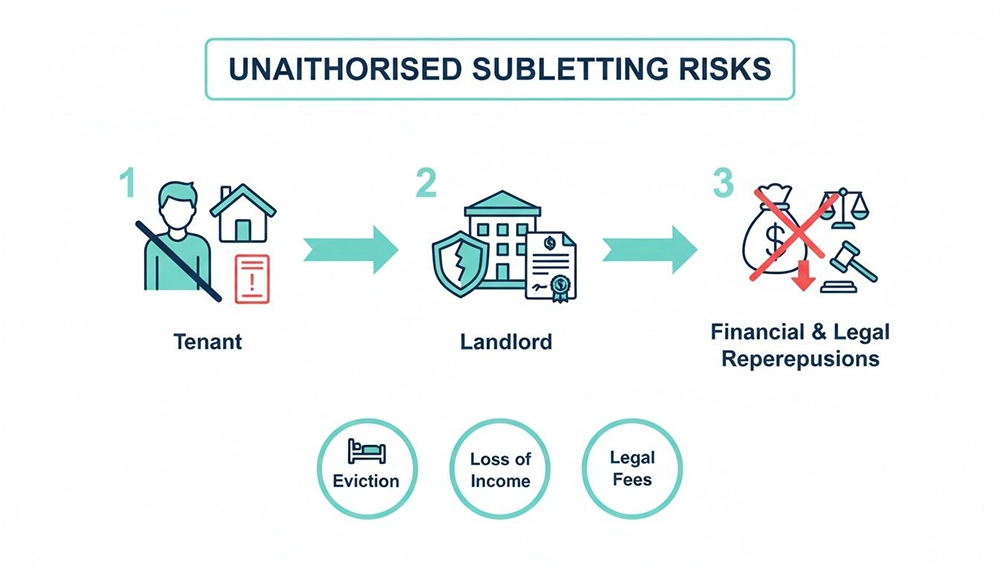
As you can see, a single act of unauthorised subletting can trigger a domino effect of severe consequences for everyone involved, from eviction notices to voided insurance policies. Following the correct process isn’t just about ticking boxes—it's the only way to steer clear of these damaging outcomes.
Understanding Subletting vs Taking in a Lodger
In the world of renting, the terms ‘subtenant’ and ‘lodger’ get thrown around a lot, often as if they mean the same thing. But in the eyes of UK law, they are worlds apart. Getting this distinction wrong isn't just a simple mix-up; it can land you in serious legal trouble, especially when it comes to things like eviction rights and your responsibilities.
It all boils down to one simple question: do you, the original tenant, still live there?
If you rent out a room in your home while you're still living there, the person moving in is a lodger. They share common spaces with you, like the kitchen or bathroom. Because you're a resident landlord, a lodger has fewer rights. Their agreement is a straightforward licence, and ending the arrangement is much less complicated.
On the other hand, if you move out and rent a room—or the whole property—to someone else, they are your subtenant. You've granted them exclusive use of that space, which means you can't just pop in whenever you like without their permission. This creates a formal tenancy, and your subtenant is shielded by the same powerful laws that protect you in your own tenancy agreement.
Subtenant vs Lodger Key Legal Distinctions
Getting your head around the practical differences is absolutely vital before you even think about renting out a room. It dictates the entire legal framework you’ll be working within.
To make it crystal clear, here’s a table breaking down the key distinctions between a subtenant and a lodger.
| Aspect | Subtenant | Lodger |
|---|---|---|
| Legal Status | Has a formal tenancy agreement (e.g., AST). | Has a licence to occupy, not a tenancy. |
| Exclusive Possession | Yes. Has the right to exclude everyone, including you, from their space. | No. Does not have exclusive use of their room; you can enter. |
| Landlord Presence | You (the original tenant) do not live in the property with them. | You (the original tenant) must live in the property as your main home. |
| Legal Protection | Fully protected by landlord-tenant law, including deposit protection schemes and formal eviction procedures. | Has fewer rights. For example, their deposit doesn't need to be protected in a scheme. |
| Eviction Process | Requires serving formal notice (e.g., Section 21 or Section 8) and potentially a court order. | Can be asked to leave with 'reasonable notice', which is typically the rental payment period (e.g., one month). |
As you can see, the legal standing of a subtenant is far more robust than that of a lodger, which has massive implications for you.
The crucial takeaway is this: if you move out and let someone else move in, even temporarily, you are creating a subtenancy. If you stay put and rent out a spare room, you are taking in a lodger.
This isn't just about semantics; it completely changes the game. It affects everything from the paperwork you need to how you can legally end the arrangement if things go wrong.
Imagine you rent out the spare bedroom in your two-bed flat while still living there. That person is your lodger. But if you get a six-month work placement abroad and rent the entire flat to someone in your absence, that person is your subtenant. You’ll have to act as a formal landlord and follow all the associated laws to the letter. Understanding this is the first, most important step in answering the question, "Is subletting legal in the UK?" for your own situation.
Frequently Asked Questions About Subletting
Once you start digging into the rules of subletting, a lot of practical, real-world questions pop up. It’s one thing to know the general principles, but what happens if your tenancy agreement is silent on the issue? Or if you're an HMO landlord worried about your licence?
We get it. The details matter. This section tackles some of the most common queries we see from tenants, landlords, and HMO operators to give you clear, direct answers for handling these situations correctly and with confidence.
Can a Landlord Charge for Sublet Permission?
This is a big one, but the law in England is refreshingly clear. Thanks to the Tenant Fees Act 2019, landlords are not allowed to charge a fee just for giving you the green light to sublet. If they try to, it’s an illegal charge, and you have every right to refuse and challenge it.
However, there's a small catch. They can charge you for their genuine administrative costs. This isn’t a made-up fee; it’s for tangible expenses like running a credit check or referencing your potential subtenant. If they do bill you for this, they must show you receipts to prove the cost is real.
What if the Tenancy Agreement Is Silent on Subletting?
It's not common these days, but you might have an older or more informal agreement that doesn’t mention subletting at all. If you find yourself in this grey area, your rights depend on what kind of tenancy you have.
- Fixed-Term Tenancy: If your contract has a specific end date, the law implies that you still need your landlord's consent. The good news is that they can't unreasonably say no.
- Periodic (Rolling) Tenancy: For those on a month-to-month rolling contract, you generally don't need permission unless the agreement specifically says you do.
Even with these legal defaults, the smartest and safest move is always to ask for your landlord's permission in writing. A simple email can save you from a world of headaches and potential disputes down the line.
How Does Unauthorised Subletting Affect an HMO Licence?
For landlords running a House in Multiple Occupation (HMO), unauthorised subletting is a massive red flag. An HMO licence is granted based on a strict number of occupants. If your tenant decides to sublet their room to someone else, pushing the property over that limit, you, the landlord, are in breach of your licence.
The consequences are no joke. We’re talking about unlimited fines, having your HMO licence revoked, and even being hit with a banning order that stops you from letting out properties altogether. This is precisely why having a rock-solid tenancy agreement with a clear no-subletting clause and carrying out regular inspections are non-negotiable for HMO management. For more deep dives into property management, check out the articles on the Rooms For Let property blog.
Is It Legal to Sublet My Room on Airbnb?
Thinking of making a bit of extra cash by putting your room on Airbnb? Tread very carefully. This is almost certainly a breach of a standard residential tenancy agreement. Most contracts have clauses that explicitly forbid running a business from the property or, increasingly, mention short-term holiday lets by name.
Going ahead without your landlord’s explicit, written permission is just another form of unauthorised subletting. It comes with all the same serious risks, from facing eviction to being taken to court to recover any profits you made from the bookings. It’s simply not worth the gamble.
At Rooms For Let, we connect landlords and tenants across the UK, making it easier to find the right room or the right person for your property. Whether you're a landlord with a spare room or a tenant looking for a new home, start your search with us today at https://www.roomsforlet.co.uk.