A rent increase letter is simply the formal, written notice you send a tenant to let them know their rent for their room will be going up from a specific date. This isn't just a piece of paper; it's a vital part of managing your property professionally, making sure your communication is clear, compliant, and leaves no room for confusion.
How to Approach Rent Reviews in the UK Market
Let's be honest: talking about a rent increase is probably one of the trickiest conversations you'll have as a landlord. It's a balancing act. On one hand, you need to make sure your investment stays profitable, but on the other, you want to keep a good relationship with your tenants.
The current UK market isn't making it any easier. Landlords are juggling rising mortgage rates and maintenance costs, while tenants are feeling the squeeze from the wider cost of living.
This is exactly why a well-written rent increase letter is so much more than a formality. It’s your tool for navigating this process like a pro. Getting it right means you're acting within the law, protecting your income, and – crucially – keeping good tenants. A happy, long-term tenant is always more profitable than dealing with an empty property. For more practical advice on managing your rentals, have a look through the resources on our blog.
Understanding Your Legal Options
Before you even think about writing anything, you need to be crystal clear on the legal routes you can take. The right method depends entirely on what type of tenancy agreement you have in place.
Here’s a quick rundown of the main ways you can legally increase rent in the UK.
Quick Guide to UK Rent Increase Methods
| Method | Best For | Key Requirement |
|---|---|---|
| Section 13 Notice | Periodic (rolling) tenancies | Using the official Form 4 and giving at least one month's notice. |
| Tenancy Agreement Clause | Fixed-term tenancies | A specific 'rent review clause' must already be in the signed agreement. |
| Mutual Agreement | Any tenancy type | Open negotiation and getting the tenant's written consent to the new rent. |
The best approach is often a friendly, open negotiation. It builds goodwill and shows respect, but it does rely on your tenant agreeing to the change. If that doesn't work, or if you prefer a more formal route from the start, you'll need to use either a rent review clause in your agreement or a Section 13 notice.
Knowing these options from the get-go gives you a clear strategy. You can pick the path that best fits your situation, ensuring you stay compliant and minimise the chances of a dispute down the line.
It also helps to have a handle on what's happening in the market. For example, in the 12 months to May 2025, average UK private rents shot up by 7.0% to hit £1,339 per month. While that's a slight dip from the previous year's 7.4% rise, the picture varies hugely by region. Rents in England climbed 7.1%, while Wales saw a much sharper 8.5% increase.
Keeping up with the latest rental price trends from the Office for National Statistics gives you solid data to back up your decision. It helps you propose an increase that's not just fair to you, but also justifiable in the context of the current market.
Navigating the Legal Rules for Increasing Rent
Before you even think about drafting a rent increase letter, you need to get your head around the legal framework. It’s a common tripwire for landlords. Getting this wrong can make your notice completely invalid, which means disputes, delays, and lost income. The right way to do it all boils down to the type of tenancy agreement you have in place.
The UK's private rental market has ballooned over the last couple of decades. Back in 1999, there were around 2 million privately rented homes in England; by 2015, that number had shot up to 4.5 million. With over 1.5 million landlords now in the game, sticking to the correct, compliant procedures isn’t just good practice—it’s essential. If you're interested in the bigger picture, it's worth taking a moment to dive into the history of UK rent prices to see how we got here.
Crucially, the rules aren't one-size-fits-all. They change dramatically depending on whether your tenant has a periodic (rolling) tenancy or a fixed-term contract.
Periodic Tenancies: The Formal Section 13 Notice
This is the one most landlords will deal with. When a fixed-term Assured Shorthold Tenancy (AST) ends and the tenant stays put without signing a new contract, it automatically flips into a periodic tenancy.
In this scenario, you can't just send a friendly email or a quick letter. You have to use the official statutory process, which means serving a Section 13 notice (also known as 'Form 4'). Anything less formal simply won't be legally binding.
There are some hard-and-fast rules you have to follow:
- Frequency: You can only use a Section 13 notice to increase the rent once every 12 months.
- Notice Period: You must give at least one month's notice if rent is paid monthly. If it's a yearly tenancy, that jumps to six months.
- Timing: The increase must kick in at the start of a rental period. For instance, if rent is due on the 5th of each month, the new, higher rent must also start on the 5th.
Getting the dates and details on Form 4 spot-on is absolutely critical. A single mistake could make the whole notice invalid, forcing you to start the process all over again.
Fixed-Term Tenancies: The Power of a Rent Review Clause
Things are very different if your tenant is still within their initial contract period, like a 6 or 12-month AST. You cannot use a Section 13 notice during a fixed term.
The only way you can legally raise the rent is if the tenancy agreement includes a rent review clause.
This clause has to be properly drafted and must clearly set out:
- When the rent can be looked at (e.g., "annually on the anniversary of the tenancy start date").
- How the new rent will be worked out (e.g., it might be linked to an inflation index like RPI or set as a fixed percentage increase).
- The notice period you need to give the tenant before the new amount takes effect.
If your agreement is missing a rent review clause, your hands are tied. You have no legal right to increase the rent until the fixed term is over. The only other path is to try and get your tenant to voluntarily agree to a new rent, but they're under no obligation to say yes.
Key Takeaway: For periodic tenancies, the Section 13 notice is your mandatory legal tool. For fixed-term agreements, a pre-existing rent review clause is your only mechanism for an increase. Without it, you must wait.
This flowchart maps out the main pathways available when you're thinking about a rent increase.
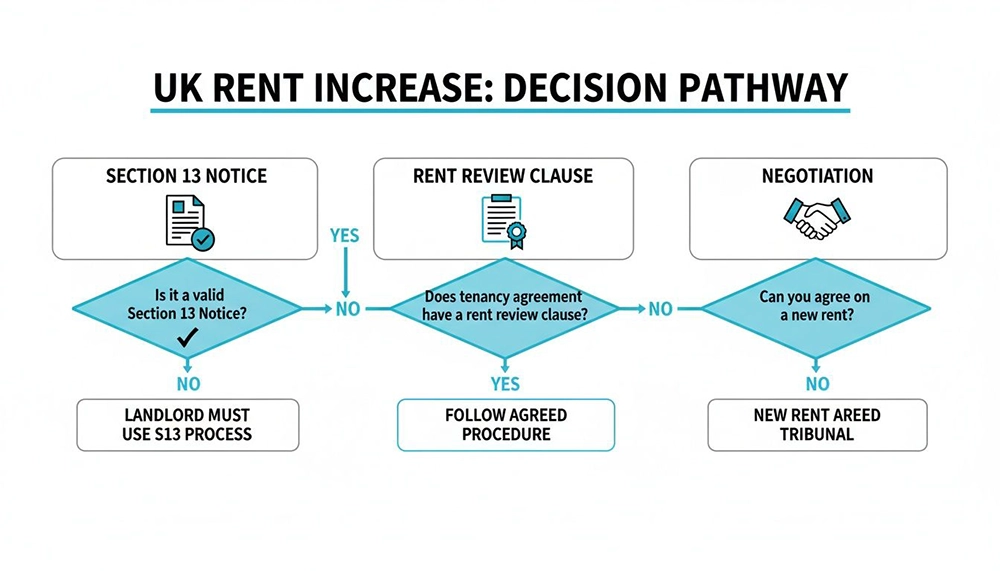
It's a simple decision tree that helps you pick the correct legal method based on your specific tenancy type.
What About Lodger Agreements?
If you have a lodger living with you in your own home, the rules are much more relaxed. A lodger is legally an 'excluded occupier', meaning they don't get the same protections as a tenant with an AST. You don't need to worry about serving a Section 13 notice.
Generally, you just need to give 'reasonable notice' to increase a lodger's rent. This is usually interpreted as one full rental period. So, if your lodger pays you monthly, you should give them at least one month's written notice of the change.
The best approach is always to have a solid lodger agreement from day one that outlines how and when the rent will be reviewed. It just manages everyone's expectations and avoids arguments down the line. While you don't need to be as formal, putting the new rent in writing with a simple letter is always a smart move to keep a clear record.
Setting a Fair and Justifiable Rent Increase
Figuring out the right amount for a rent increase is often the trickiest part of the whole process. You're walking a fine line between covering your own rising costs and keeping a good relationship with your tenants. The aim is to land on a figure that’s not just fair and justifiable, but one that would hold up if it was ever challenged at a tribunal.
When an increase is backed by solid research, it’s far more likely to be accepted without a fuss. That saves everyone time, stress, and prevents potential void periods. This isn't about plucking a number from thin air; it’s about using real data to guide your decision.

Conducting Local Market Research
Your first job is to become an expert on your local rental market. You need to know precisely what similar properties in your immediate neighbourhood are letting for right now. It's amazing how much rental values can differ just a few streets apart.
The best way to do this is to get practical and use the same tools a prospective tenant would. Spend some time digging into the major property portals and specialist platforms for rooms and shared houses.
- Check Online Listings: Get familiar with sites like Rightmove, Zoopla, and SpareRoom. Make sure you filter for properties that are a close match to yours in size, number of bedrooms, general condition, and, of course, location.
- Analyse "Let Agreed" Properties: Don't just look at what landlords are asking for. Pay close attention to properties marked as "Let Agreed"—this is the real gold, as it shows what people are actually willing to pay.
- Compare Like-for-Like: Be brutally honest with your comparisons. If your property is unfurnished, stack it up against other unfurnished lets. If it doesn't have a garden or dedicated parking, you need to account for that in your assessment.
If you're letting out individual rooms or managing an HMO, knowing the going rate per room is absolutely essential. Keeping a close eye on current advertisement prices for rooms gives you a realistic benchmark for your specific area, helping you ensure your new rent is both competitive and fair.
Justifying the Increase with Costs and Improvements
Beyond what the market is doing, your own running costs are a massive part of the equation. A rent increase isn't just about boosting profit; it's about making sure your property stays a viable, well-maintained investment. You need to be able to justify the new rent based on tangible things.
Have you made any significant improvements over the last year? Maybe you've put in a new kitchen, upgraded the boiler, or given the place a full redecoration. These kinds of capital investments add real value for the tenant and can certainly justify a higher rent.
At the same time, keep a record of your rising operational costs. This is especially vital for HMO landlords who often include bills in the rent.
- Utility Bills: Spikes in council tax, gas, electricity, and water rates are direct hits to your bottom line.
- Service Charges: If you own a leasehold property, any increases in ground rent or service charges need to be covered.
- Maintenance & Insurance: The cost of everything from landlord insurance and safety certificates (like gas and electrical checks) to everyday repairs has been climbing steadily.
By getting a clear handle on these figures, you're not just picking a number randomly. You're building a solid business case for the rent increase that is logical, defensible, and transparent.
Benchmarking Against National and Regional Data
While local data is king, it doesn't hurt to reference wider economic trends. Mentioning these in your letter shows the tenant that your increase is part of a broader pattern, not just an arbitrary decision you've made.
A 'fair' increase often tracks with what's happening in the national economy. For example, an annual rise of 3-5% is often seen as reasonable because it generally mirrors inflation and wage growth. To give that some context, recent figures put the Consumer Prices Index (CPIH) at around 4.1% and wage growth near 4.8%.
But remember, local markets can have a life of their own. Some areas, like Newport in Wales, saw huge rental growth of 21.4% before things cooled off. If a tenant feels an increase is excessive and completely out of step with local market rates, they have the right to challenge it at a First-tier Tribunal.
By blending this hyperlocal research with an awareness of the bigger picture, you can confidently set a rent that is both fair to your tenant and makes sound business sense for you.
Right, let's get down to the practical bit: writing the actual rent increase letter. This is where all your research and understanding of the rules come together on paper. It’s more than just a quick note telling your tenant the rent is going up; it's a formal, legally sound document that needs to be clear, professional, and right on the money to avoid any friction.
Get this letter wrong, and you could face disputes, delays, or even find your notice is completely invalid.
The way you structure and word it will hinge entirely on which legal path you're taking. A formal Section 13 notice, for example, is a rigid, fill-in-the-blanks document. On the other hand, a letter suggesting a mutual agreement can be much more conversational. No matter which route you take, the core principles never change: be clear, be accurate, and stay professional.

What Every Rent Increase Notice Must Include
Whatever the situation, there are a few key details that are absolutely non-negotiable. Missing any of these can create confusion and open the door to legal headaches down the line. Treat this as your final checklist before you hit 'send' or drop it in the post.
Every letter must clearly state:
- Tenant and Landlord Details: Full names of everyone on the tenancy agreement, plus your name (or your agent's) and address.
- Full Property Address: The complete address, including the flat number, to leave no room for error.
- The Date of the Letter: This is absolutely critical. It’s what establishes the notice period and proves you’ve followed the rules.
- Clear Statement of the New Rent: Spell out the new monthly amount in pounds and pence. Don't just give a percentage.
- The Effective Date: The exact date the new rent is due. And remember, this must be the first day of a rental period.
Getting these fundamentals right from the start makes everything else so much smoother. A complete and accurate letter shows you’re a professional landlord, which makes tenants far more likely to accept the change without a fuss.
If you're looking for wider tips on structuring formal messages, you can find some useful examples in these property management email templates for tenant communication.
Tailoring Your Letter to the Tenancy Type
Now, let's talk tone and specific content. You wouldn't use the same approach for a formal notice as you would for a friendly proposal to a tenant who is mid-contract. The context is everything.
The Formal Section 13 Notice (Form 4)
If you're dealing with a periodic tenancy, you don't have a choice—you must use the official government Form 4. This isn't a template to play around with; it's a prescribed legal document. You have to fill it out precisely, including your signature and all the required dates.
A good tip is to include a brief, professional cover letter along with Form 4. It just helps to soften the blow of such a formal-looking document. You can explain that you're simply following the required legal process and that you hope they'll continue their tenancy.
For a Tenancy with a Rent Review Clause
When your tenancy agreement already has a rent review clause baked in, you don't use Form 4. Your letter is guided by the terms you both already agreed to.
In this case, you'll write a formal letter that directly references that specific clause. It should clearly state:
- That the rent is being increased in accordance with the rent review clause in their agreement.
- The calculation you used (e.g., "as per the clause, the rent will increase by 4.1%, in line with the latest CPIH figure").
- The new rent and the date it kicks in, making sure you follow the notice period set out in the clause.
This approach shows the tenant the increase isn't just a number you've plucked from thin air. It's based on a pre-agreed term, making it much harder to argue with.
Proposing a Mutual Agreement
What if you want to increase the rent during a fixed term where there's no review clause? Or maybe you just prefer a less formal approach with a periodic tenant. Here, you're not issuing a notice—you're proposing a change, and the tenant is perfectly free to say no.
The tone should be collaborative and respectful. Frame it as a proposal, not a demand. It can help to give some context, maybe mentioning recent property improvements or rising service charges. The goal is to get their written agreement to the new rent, which can be a simple signed letter or a formal addendum to their existing contract. If they refuse, you have to accept it and wait until you can use a formal method, like a Section 13 notice, once the tenancy becomes periodic.
To help pull all this together, the table below summarises the essential information to include.
Essential Components of a Rent Increase Letter
| Component | Purpose | Example Wording |
|---|---|---|
| Clear Subject Line | To ensure the tenant immediately understands the letter's importance. | "Important: Notice of Rent Increase for [Property Address]" |
| New Rent Amount | To state the new rental figure without any ambiguity. | "The new monthly rent will be £950.00." |
| Effective Date | To provide a clear start date for the new payment amount. | "This change will take effect from 1st December 2025." |
| Legal Justification | To ground the increase in a legal or contractual basis. | "This increase is issued in accordance with Section 13 of the Housing Act 1988." or "As per the rent review clause in your tenancy agreement..." |
Making sure these components are clearly and professionally communicated is the key to a straightforward rent review process.
Communicating the Increase and Handling Tenant Negotiations
A legally perfect rent increase letter can fall completely flat without the right delivery. Now that the document is drafted, the focus has to shift to the human side of things—how you communicate the change and manage the conversation that follows.
This is where a professional, empathetic approach makes the difference between a smooth transition and a messy dispute. Honestly, maintaining a positive relationship with your tenant is your most valuable asset. It minimises vacancies, cuts down on administrative headaches, and ultimately protects your investment for the long term. How you handle this conversation is a huge part of that.

Serving the Notice Correctly
Your first step is delivering the notice in a way that’s both professional and legally verifiable. You absolutely need proof that the tenant received the letter on a specific date, as this is what starts the clock on the legal notice period.
Common methods for serving a notice include:
- Hand Delivery: Taking the letter to the property yourself is a direct approach. It's smart to take a witness or fill out a certificate of service form immediately afterwards, noting the exact date and time.
- First-Class Post: Standard post is acceptable, but it offers no definitive proof of delivery. It's a bit of a gamble.
- Recorded or Special Delivery: This seems solid because it provides a signature, but a tenant can simply refuse to sign for it, which just complicates matters.
- Email: Only ever use email if your tenancy agreement explicitly allows for notices to be served this way. Even then, it’s best to pair it with a physical copy.
For something as formal as a Section 13 notice, sending two copies—one by standard first-class post and one delivered by hand—is a really robust strategy. This covers your bases and makes it very difficult for a tenant to claim they never received it.
Framing the Conversation with Your Tenant
Once the notice is served, be ready to talk. A tenant will naturally have questions, and your goal is to be transparent and reasonable. Try to avoid getting defensive; instead, frame the increase as a necessary business adjustment.
When you do speak with them, briefly explain the reasons behind the increase. You don’t need to open up your accounts for them, but giving some context really helps foster understanding.
A good approach is to explain that the increase is necessary to cover rising operational costs and to keep the rent in line with the local market. This reframes the conversation from a personal demand to a standard business practice.
Being proactive and transparent can prevent resentment from building up. For landlords looking to expand their portfolio, successfully managing these interactions is key. You can find more tenants and advertise your property by exploring a landlord registration with Rooms For Let, a platform designed to connect you with suitable renters.
Responding to Pushback and Negotiation
It’s completely normal for a tenant to question the increase or even try to negotiate. How you respond is critical. Listen to their concerns respectfully and be prepared to justify your figure with the market research you conducted earlier.
If a good, long-term tenant proposes a slightly smaller increase, it's often worth considering. Say you proposed a £75 increase and they counter with £50. Just calculate the difference over a year—it's £300. Now, weigh that against the potential cost and hassle of finding a new tenant, which could easily exceed that amount in void periods and fees.
If they refuse to accept a fair and legally served increase, calmly reiterate the process. Explain that if they feel the new rent is above market value, they have the right to challenge it at a First-tier Tribunal. This often underscores that your proposal is reasonable and based on solid evidence, encouraging them to accept the new terms.
Common Questions About UK Rent Increase Rules
Getting your head around the rules for increasing rent can feel like walking through a minefield. To give you a bit more confidence, this final section tackles some of the most common—and often confusing—questions that pop up for landlords. We'll get straight to the point with clear answers to lock in what we've already covered.
Even when you've drafted a perfect rent increase letter, odd situations can arise that leave you second-guessing whether you're on the right side of the law. Let's clear up that uncertainty.
How Often Can I Legally Increase the Rent in the UK?
As a general rule of thumb, you can only increase the rent once every 12 months. But the how and when really depend on the type of tenancy you're dealing with.
With a periodic tenancy (the rolling, month-to-month kind), you have to use a Section 13 notice. You can't issue one of these within the first year of the tenancy, and any future increase has to be at least a full year after the last one kicked in.
If your tenant is on a fixed-term contract, things are different. You can only put the rent up if there’s a 'rent review clause' already in the agreement. That clause should spell out exactly when and how the rent can be changed. If there's no clause, you’ll have to wait until the fixed term is over or get your tenant to agree to the new rent voluntarily.
What Happens if My Tenant Refuses the Increase?
This is a common worry, but what happens next all comes down to whether you followed the correct legal steps. If you've issued a valid Section 13 notice for a periodic tenancy and your proposed increase is fair for the area, the new rent becomes legally binding once the notice period ends.
Should the tenant dig their heels in and keep paying the old amount, they will officially fall into rent arrears.
However, if they genuinely feel the increase is excessive, they have the right to challenge it by applying to the First-tier Tribunal (Property Chamber). The tribunal will then look at your property and the local market to decide what a fair market rent is. Their decision could result in a rent that’s higher, lower, or exactly the same as what you proposed.
For any increase you're just proposing by mutual agreement, the tenant has every right to say no. You can't force it. Your only real option then is to wait until you can use a formal procedure.
Expert Tip: A well-researched, market-aligned increase is your best defence. If a tenant challenges your proposed rent, the tribunal's decision will be based on hard evidence of what similar local properties are letting for, not on your personal costs or mortgage increases.
Do I Need a Special Form for a Rent Increase Letter?
Yes, and this is a critical detail that catches a lot of landlords out. For Assured Shorthold Tenancies (ASTs) on a periodic or rolling basis, you must use the prescribed legal form. This is officially called 'Form 4: Notice of increase of rent under an assured periodic tenancy'.
Just writing your own letter or pinging over an email won't cut it legally in this situation. The notice would be invalid, and you'd have to start the whole process over again.
In other cases, a standard formal letter is usually fine:
- When you're actioning a rent review clause in a fixed-term agreement.
- When you are proposing a mutual agreement with the tenant.
But for the formal statutory process with a periodic tenancy, using Form 4 is completely non-negotiable.
Are the Rules Different for Increasing a Lodger's Rent?
Absolutely. The rules for increasing rent for a lodger are far more flexible. This is because they are an 'excluded occupier' and don't have the same legal protections as a tenant under an AST. You don’t need to use a Section 13 notice or follow any of the rigid procedures.
Generally, you just need to give 'reasonable notice' of the rent increase. This is usually understood to be one full rental period. So, if your lodger pays rent monthly, giving them at least one month's written notice is considered fair play. The best approach is to have this whole process outlined in a lodger agreement from day one to manage expectations and sidestep any arguments later.
Managing your property effectively means staying on top of tenant communication and finding the right people for your rooms. At Rooms For Let, we make it easy to connect with thousands of potential tenants across the UK. Advertise your spare room or HMO property quickly and efficiently on our platform. Find your next great tenant by visiting us at https://www.roomsforlet.co.uk.