A Section 8 notice is the formal, legal document a landlord in the UK uses to start the eviction process when a tenant has broken the terms of their tenancy agreement. It’s known as a 'fault-based' notice because you, the landlord, must state a specific reason – or 'ground' – for wanting your property back.
What a Section 8 Notice Actually Is

Think of a Section 8 notice not just as a piece of paper, but as the starting pistol for legally regaining your property when a tenant breaches their contract. It’s the moment the 'breach clause' in your tenancy agreement comes to life, giving you a structured, lawful path to resolve serious problems.
This notice is the essential first step you have to take before you can even think about applying to the courts for a possession order. It doesn't matter if you're a homeowner with a single lodger, an HMO operator managing multiple occupants, or a portfolio landlord – a Section 8 is your go-to tool for tackling issues like serious rent arrears, property damage, or antisocial behaviour. It formally puts the tenant on notice about their breach and gives them a set timeframe to either fix the problem or leave.
The Purpose of a Fault-Based Notice
Unlike the 'no-fault' Section 21 notice, which lets a landlord regain possession without giving a reason (once a fixed term ends), a Section 8 is tied directly to the tenant's actions. This is a critical distinction. You use a Section 8 because the tenant has failed to meet their obligations.
This fault-based approach means you must have your evidence ready to back up your claim. If the problem is unpaid rent, you'll need a clear, detailed schedule of the arrears. If it’s damage to the property, you’ll need photos and maybe some repair quotes. The notice itself forms the foundation of your legal case, so getting the details right and having solid proof is absolutely vital.
A Section 8 notice creates a clear, evidence-based reason for eviction. It tells both the tenant and, eventually, the court exactly which part of the tenancy agreement has been broken and why you’re seeking to end the tenancy.
When Is It the Right Choice?
While a Section 21 might feel simpler, it isn't always available, especially if you're in the middle of a fixed-term tenancy. A Section 8, on the other hand, can often be used at any point during the tenancy, as long as a valid ground for eviction exists. This makes it an indispensable tool for landlords who can't afford to wait months for a tenancy period to end before taking action.
Figures from the English Private Landlord Survey 2021 show just how important it is. Around 25% of landlords who had to evict tenants used a Section 8 notice. While that’s less than the 67% who used a Section 21, it highlights its role as a necessary legal instrument for dealing with problematic tenancies. You can dig into the numbers yourself by reading the full English Private Landlord Survey 2021 on the UK government's website.
Navigating the Grounds for a Section 8 Notice
When you serve a Section 8 notice, you can't just say you want your property back. You have to state your legal reason, or ‘ground’, for seeking possession. These grounds aren’t all created equal; they fall into two crucial categories that can make or break your case in court.
Getting your head around this difference is fundamental. The two types of grounds are mandatory and discretionary. If you can prove a mandatory ground, the court must grant you a possession order. With discretionary grounds, however, the judge has the final say and will decide if it's reasonable to evict the tenant based on the evidence you both present.
Mandatory Grounds: The Court Must Uphold Them
Think of mandatory grounds as the trump cards of the eviction process. When you use one, you're telling the court that a serious, specific breach has happened, and the law says possession must be returned to you. The judge’s role is simply to check you've followed the right procedure and your evidence is solid.
By far the most common and powerful mandatory ground is Ground 8, which deals with serious rent arrears.
- Ground 8 Explained: This kicks in when the tenant is significantly behind on rent. The exact amount depends on their payment cycle. For a standard monthly tenancy, the tenant must be at least two months in arrears both on the day you serve the notice and on the day of the court hearing.
So, if rent is £1,000 a month and your tenant owes £2,000 or more when you issue the notice, you can cite Ground 8. But here's the crucial bit: that debt must still be at least two months' worth when you get to court. If the tenant pays off a chunk of it, bringing the total owed below that threshold, your mandatory claim on Ground 8 will fail.
Discretionary Grounds: The Court Will Consider Them
Discretionary grounds cover a much wider range of tenancy problems, but they give the court wiggle room. The judge will weigh up everything you present against the tenant's side of the story before deciding if eviction is a reasonable step. This means you need to build a compelling case.
Some of the most common discretionary grounds include:
- Ground 10: Some rent is overdue, but it doesn’t meet the strict two-month threshold for Ground 8.
- Ground 11: The tenant has a consistent history of paying their rent late, even if they aren't seriously in debt at that moment.
- Ground 12: The tenant has broken a term in the tenancy agreement (other than rent). This could be anything from secretly keeping a pet to subletting a room without permission.
- Ground 14: The tenant's behaviour has become a problem, whether that’s antisocial conduct or using the property for illegal purposes.
It’s often a very smart move to cite both mandatory and discretionary grounds if the situation fits. For example, you could use Ground 8 for the serious arrears, but also add Grounds 10 and 11 for the general pattern of late payments. This gives you a fallback position. If the tenant pays just enough to defeat your mandatory claim, the judge can still consider evicting them based on their poor payment history.
To make this clearer, let's break down the key differences in a simple table.
Mandatory vs Discretionary Grounds for Section 8
This table gives you a quick-reference guide to the most common grounds, helping you understand what they mean for you and what the likely outcome in court will be.
| Ground Type | Common Ground(s) | Meaning for Landlords | Court Outcome if Proven |
|---|---|---|---|
| Mandatory | Ground 8: At least two months' of rent arrears. | The breach is serious and leaves no room for debate. Your evidence must be black and white. | The court must grant a possession order. The judge has no choice. |
| Discretionary | Ground 10: Some rent arrears. Ground 11: Persistent late rent payment. Ground 12: Breach of tenancy term. Ground 14: Antisocial behaviour. |
The breach is less severe or requires context. You need to persuade the judge that eviction is a reasonable response. | The court may grant a possession order. The judge decides based on what they feel is reasonable in the circumstances. |
As you can see, the burden of proof and the certainty of the outcome are worlds apart. While mandatory grounds offer a more direct path to possession, discretionary grounds provide a vital tool for managing a wider range of tenancy issues, as long as your evidence is strong and your case is well-argued.
How to Serve a Section 8 Notice Correctly
Serving a Section 8 notice isn’t just about filling in a form. It's a precise legal process where the smallest slip-up can completely torpedo your claim. If you get it wrong, you risk having the case thrown out of court, forcing you to start the whole painful process from scratch.
First things first, you have to use the right paperwork. The official document is called Form 3: Notice seeking possession of a property let on an assured tenancy or an assured agricultural occupancy. Accuracy here is everything. You must include the full, correct names of all tenants, the property address, and the specific grounds you're using, along with a clear, factual explanation for each one. Don't leave any room for doubt – be specific and stick to the facts.
Calculating the Correct Notice Period
This is one of the most common tripwires for landlords. The amount of notice you have to give your tenant can change dramatically depending on the grounds you cite.
For serious rent arrears under the mandatory Ground 8, you only need to give two weeks' notice. But for other grounds, the notice period can be significantly longer, and recent changes have made compliance even tougher. Many non-rent-related grounds now demand four months’ notice, so you absolutely have to factor this into your timeline.
The journey from a tenancy breach to a potential court hearing is a structured one.
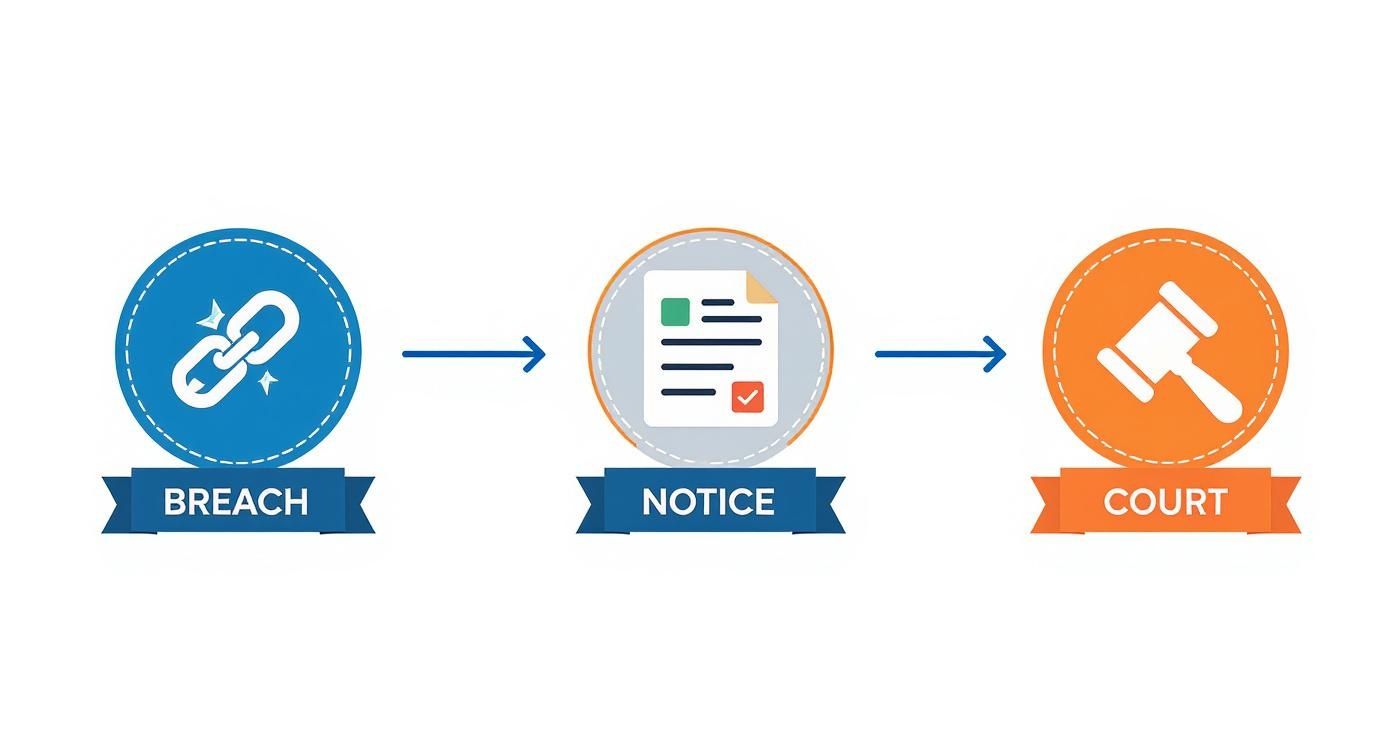
As you can see, serving the notice correctly is the critical link between identifying a problem and being able to seek a legal resolution.
Legally Delivering the Notice
Once the form is perfectly filled out and you've double-checked the notice period, you need to deliver it in a way the law recognises. A quick text or email just won't cut it. The most reliable methods are:
- Personal Delivery: Handing the notice directly to the tenant at the property. It’s a very good idea to bring an independent witness with you who can sign a statement confirming they saw you deliver it.
- First-Class Post: Sending the notice via Royal Mail. Legally, it’s considered served two working days after you post it, so remember to add this extra time to your notice period calculation.
- Leaving at the Property: If you can't hand it to them personally, you can post it through their letterbox. Again, having a witness to confirm the date and time is invaluable.
The most important part of this stage is getting proof of service. This could be a signed witness statement, a completed certificate of service (Form N215), or even a time-stamped photo of you posting the notice through the letterbox. Without this proof, a tenant can simply claim they never received the notice, and your case will likely fall apart.
For landlords managing HMOs or multiple properties, meticulous record-keeping is your best friend. Creating a consistent, repeatable process for serving notices ensures you hit all the legal marks every single time. And to help you find reliable tenants in the first place, consider registering as a landlord on Rooms For Let, a platform built to connect you with the right occupants across the UK.
What Happens After the Notice Period Ends
So, the date on your Section 8 notice has come and gone, but your tenant is still in the property. What now? It’s a common misconception that the notice itself is an eviction order. It isn’t. Think of it as the formal, legal warning shot that unlocks your right to take the next step.
That next step is applying to the county court for a possession order. This is where the legal process to reclaim your property truly begins.
It’s absolutely critical to understand that you cannot take matters into your own hands. Changing the locks, removing the tenant's belongings, or doing anything to physically force them out is an illegal eviction—a serious criminal offence. The only lawful way forward is through the courts, which is precisely why getting every single detail of that initial notice right is so important.
The court application involves filling out specific paperwork, usually the N5 Claim Form and the N119 Particulars of Claim. On these forms, you'll need to clearly state the grounds you used on your Section 8 notice and start laying out the evidence that backs up your claim.
Preparing for the Court Hearing
Once your application is submitted and the fee is paid, the court will set a hearing date. This is the moment your careful preparation will really count. A judge won’t just take your word for it; you need to present a clear, organised case file that proves the grounds for possession beyond any doubt.
Your goal is to build an evidence bundle that is so meticulous and easy to follow that it leaves the judge with no questions.
- The Tenancy Agreement: An absolute must. You'll need a signed copy of the original agreement.
- The Section 8 Notice: A copy of the exact notice you served on the tenant.
- Proof of Service: This is vital. You need your witness statement or a completed Certificate of Service (Form N215) to prove the notice was delivered correctly and on time.
- A Detailed Rent Arrears Schedule: If you’re using rent-related grounds, this is the backbone of your case. It must clearly itemise all payments due, payments received, and the running total of the arrears. Don't just show the final figure.
- Other Evidence: For grounds like antisocial behaviour, your file should include copies of complaint emails, logs of communication, or even witness statements from neighbours who have been affected.
The Court Process and Possible Outcomes
Be prepared for a wait. The court system is under immense strain right now. The Ministry of Justice has reported 29,303 Section 8 possession claims, a record high which is causing significant backlogs. Many landlords are waiting months for a resolution. You can read more about the surge in Section 8 and Section 21 claims on the NRLA's website.
At the hearing, the judge will look at all the evidence and hear from both you (or your legal representative) and the tenant. From there, a few outcomes are possible:
Outright Possession Order: This is the result you're hoping for. If you've used a mandatory ground (like Ground 8 for serious rent arrears) and your evidence is watertight, the judge has no choice but to grant this. The order will give a specific date the tenant must leave by, usually 14 days later.
Suspended Possession Order: This is more common for discretionary grounds. The judge grants you possession, but it's "suspended" as long as the tenant sticks to certain conditions, like paying back the arrears in agreed-upon instalments. If they miss a single payment, you can go back to the court to enforce the order.
If the tenant ignores an outright possession order and still refuses to leave after the deadline, you’re not back to square one. Your final step is to apply for a Warrant of Possession. This authorises court-appointed bailiffs to attend the property and carry out the eviction for you. It's the last, lawful step in getting your property back.
If the whole process feels daunting, remember you're not alone. You can always get in touch with our team at Rooms For Let for support and guidance.
Common Mistakes That Invalidate Your Claim

Serving a Section 8 notice feels like a big step, but it’s the small, avoidable mistakes that cause the biggest headaches. Getting your claim dismissed in court doesn't just send you back to square one; it costs you a small fortune in lost rent and legal fees.
Think of this as your pre-flight checklist. Getting these details right from the very start is the difference between a smooth process and a costly legal mess.
One of the easiest traps to fall into is a simple administrative error on the notice itself. A minor typo in a tenant's name, the wrong property address, or citing an incorrect ground can be enough for a judge to rule your notice invalid. It has to be perfect.
Likewise, miscalculating the notice period is a fatal flaw. While Ground 8 (serious rent arrears) only requires two weeks' notice, other grounds demand much longer. You must double-check the legal requirement for every single ground you are citing.
Evidence and Compliance Failures
Beyond the paperwork, your claim is only as strong as your evidence. A vague or incomplete rent statement just won't cut it. You need a meticulously detailed schedule showing every payment due, every payment received, and the running total of arrears. Without this, your claim for possession will almost certainly fail.
This is especially true for the discretionary grounds. If you're citing antisocial behaviour, you need far more than just your word for it. It's time to build a file.
- Dated logs of every single incident.
- Copies of all communication (emails, letters, texts) with the tenant about the issue.
- Witness statements from affected neighbours, if you can get them.
The most significant compliance failure, however, often happens long before any problem even starts. Failing to correctly protect your tenant’s deposit in a government-approved scheme can invalidate not just a Section 8 notice but a Section 21 as well.
Top Errors to Double-Check
Before you even think about serving that notice, run through this final checklist. Getting these details right builds a legally sound case and dramatically increases your chances of a successful outcome.
- Use the Correct Form: Always, always download the latest version of Form 3 from the government's official website. Using an old version is a guaranteed way to get your claim thrown out.
- Verify All Names: Check that every tenant’s name is spelled exactly as it appears on the tenancy agreement. No nicknames, no assumptions.
- Confirm Deposit Protection: Are you certain the tenant's deposit was protected correctly and they received the prescribed information within the 30-day deadline? If not, you may need to return the deposit in full before you can proceed.
- Get Proof of Service: Never serve a notice without getting undeniable proof it was received. A signed witness statement or a properly completed N215 form is your best defence if the tenant later claims they never got it.
Your Section 8 Notice Questions Answered
Property law can feel like a maze, full of complex terms and fiddly procedures that are easy to get wrong. When you're dealing with something as serious as a Section 8 notice, you need clear, straightforward answers. This section is designed to be your go-to guide for the most common questions we see from landlords.
We'll skip the dense legal jargon and get straight to the practical advice you need. From understanding your rights during a fixed-term tenancy to knowing the potential costs, these insights will help you move forward with confidence.
Can I Use a Section 8 During a Fixed-Term Tenancy?
Yes, you can, but there's a huge catch. Your tenancy agreement must include what's known as a forfeiture clause. Think of this clause as a pre-agreed permission slip that allows you to end the tenancy early if the tenant breaks the terms of the contract.
If that clause isn't in your agreement, you’ll almost certainly have to wait until the fixed term ends before you can take action for possession, even if the tenant is months behind on rent. It’s a classic example of why the wording of your tenancy agreement is so critical.
Even if you have the clause, you can serve the notice, but you usually can't start court proceedings until a minimum period outlined in the agreement has passed. Always check the small print.
What Is the Difference Between Section 8 and Section 21?
The easiest way to get your head around this is to think of it as 'fault' versus 'no-fault'.
A Section 8 notice is fault-based. You’re using it because your tenant has done something wrong—they haven't paid rent, they've damaged the property, or they've breached the agreement in another significant way. To win in court, the burden is on you to prove it.
On the flip side, a Section 21 notice is 'no-fault'. You don't need to give any reason at all for wanting your property back. But, and it’s a big but, Section 21 has its own set of rigid rules. You can't use it during a fixed term, and you must have all your ducks in a row—things like deposit protection and gas safety certificates must be perfect.
The heart of the matter is the reason for possession. Section 8 is for a breach of contract and needs solid evidence. Section 21 is simply for regaining possession at the end of a tenancy, no fault required.
What Happens if I Make a Mistake on the Form?
A small mistake on a Section 8 notice (officially called Form 3) can be a disaster for your case. The courts are incredibly strict on getting the paperwork right, and there is no room for error.
Common slip-ups that will get your notice thrown out include:
- Spelling a tenant's name wrong.
- Getting a detail in the property address incorrect.
- Miscalculating the notice period—even by a single day.
- Citing the wrong grounds or failing to explain them clearly.
If a judge finds your notice is invalid, your possession claim is dead in the water. You'll lose your court fee and have to go right back to the beginning, serving a new, correct notice. This can easily mean months of delays and thousands in lost rent.
How Much Does the Section 8 Process Cost?
The costs can mount up faster than you might think, and they really depend on how your tenant reacts. It's smart to budget for the worst-case scenario before you start.
Just to get the ball rolling, the initial court application fee for a possession claim is currently £355. If the tenant decides to fight the claim, you'll almost certainly need a solicitor, and legal fees can quickly run into hundreds, if not thousands, of pounds.
If you get a possession order from the court and the tenant still won't leave, you have another step. You'll need to apply for a warrant to get the county court bailiffs involved, which costs another £130. And that's all before you account for the rent you're losing every month this drags on. For more landlord tips and legal updates, you can explore the resources on the Rooms For Let blog.
At Rooms For Let, we're dedicated to helping landlords find reliable tenants and manage their properties effectively. List your spare room or HMO property for free and connect with thousands of potential tenants across the UK. Visit https://www.roomsforlet.co.uk to get started.