Serving a Section 21 notice is the formal process landlords use to regain their property without having to prove any fault on the part of the tenant. This also applies to rooms to rent. But it's not as simple as just asking for your keys back. To be valid, you must use the correct legal form, give at least two months' notice, and crucially, have all your legal ducks in a row before you even think about serving it.
Understanding Your Right to Serve a Section 21 Notice
Before you download any forms, it’s vital to get your head around what a Section 21 notice is and when you can actually use it. It's often called a 'no-fault' notice, and its main advantage is its straightforward nature: you don’t need to give a reason for wanting your property back.
This is what makes it so different from a Section 8 notice, which you’d use if a tenant has broken the rules of the tenancy – like falling into serious rent arrears or damaging the property.
While the Section 21 route is the most common way for landlords to end an Assured Shorthold Tenancy (AST), this simplicity comes with a very strict set of conditions. You can only serve a valid Section 21 notice if:
- It's an Assured Shorthold Tenancy (AST): This applies to most private tenancies that started after 28 February 1997.
- The Fixed-Term is Ending: You can't use a Section 21 to kick a tenant out in the middle of their fixed term, unless there's a specific break clause in your tenancy agreement that allows for it. The notice period must end on or after the fixed-term end date.
- The Tenancy is Old Enough: You’re not allowed to serve a Section 21 notice within the first four months of the original tenancy starting.
Section 21 vs Section 8: A Practical Example
Let's put this into a real-world context. Imagine you’re a landlord, Sarah. You’ve been living abroad but have decided it's time to move back into your rental property in the UK. Your tenants have been fantastic – rent always on time, property kept in great shape. A Section 21 notice is the perfect, and correct, tool for this job.
There’s no ‘fault’ here. You're simply exercising your right to reclaim your property when their tenancy comes to a natural end.
Now, let's flip the scenario. If those same tenants had failed to pay rent for three months straight, your go-to would be a Section 8 notice, using the specific grounds for rent arrears.
The key takeaway is this: Section 21 is for ending a tenancy when the contract has run its course. Section 8 is for when the tenant has broken the rules of that contract. Picking the wrong one can get your possession claim thrown out of court, costing you a huge amount of time and money.
The Current Legal Climate
It's impossible to talk about Section 21 without mentioning the elephant in the room: the government has stated its intention to abolish it through the Renters (Reform) Bill. While the bill's future is subject to the political landscape, this announcement has undeniably created a sense of urgency for many property owners.
The data backs this up. In the last year on record, Section 21 notices in England soared to an eight-year high. Over 32,287 households were served with no-fault notices, a 7% increase on the previous year, as landlords moved to act before potential legislative changes. You can dig into the figures from housing charity Crisis UK to see the full picture.
Getting these fundamentals right provides a solid foundation before you take any action. When looking into the specific requirements, it's also worth understanding the wider world of legal notice templates to see how they differ. For landlords wanting to streamline their processes and ensure they're compliant, using a dedicated platform is a smart move. Find out more about how to register as a landlord with Rooms For Let and connect with your next tenants.
The Pre-Service Compliance Checklist You Cannot Ignore
Think of serving a Section 21 notice like building a house. Get the foundations wrong, and the whole thing will come crashing down later. It's exactly the same here; one tiny administrative slip-up from months, or even years ago, can make your notice completely invalid and send you right back to the start.
This pre-service checklist is your foundation. Getting these details right isn’t just a good idea—it’s the only way to make sure your notice will stand up in court. So many landlords get tripped up on these points, so let’s walk through the absolute non-negotiables.
This flowchart breaks down the basic decision of which eviction path to take.
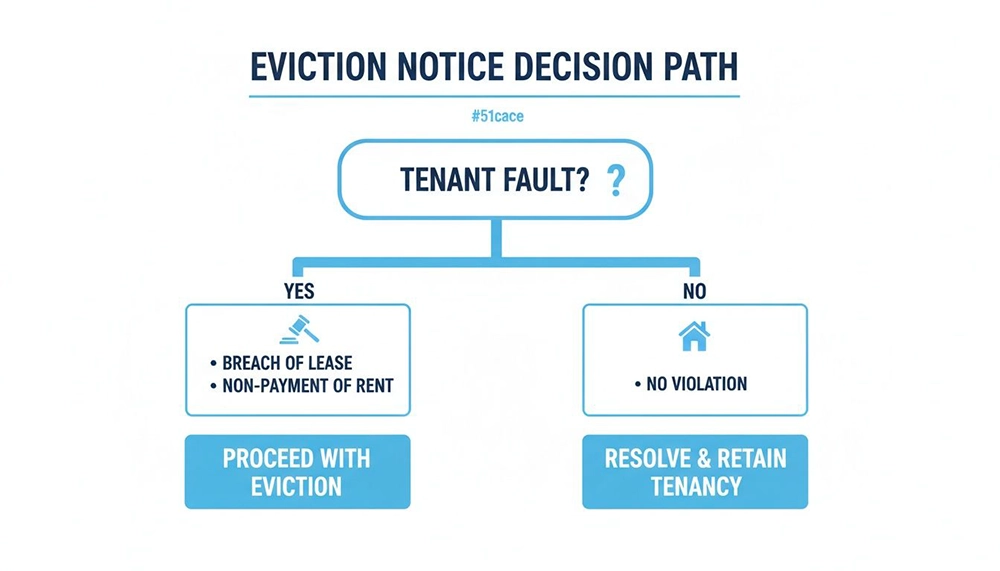
As you can see, the route you choose depends entirely on whether the tenant is at fault. This is why Section 21 is strictly for ‘no-fault’ situations where you simply want your property back.
Secure the Tenancy Deposit Correctly
This is, without a doubt, the most common pitfall for landlords. It’s not enough to just take a deposit. You have a strict legal duty to protect it in one of the three government-approved tenancy deposit schemes (TDPs).
You must protect the deposit within 30 days of receiving the funds from your tenant. Just as importantly, you also have to provide the tenant with the scheme's specific information, known as the Prescribed Information, inside that same 30-day window.
Crucial Tip: A classic mistake is including the Prescribed Information in the tenancy agreement before the deposit has even been paid and protected. Case law has shown this can invalidate the process. The safest bet is to protect the deposit first, then serve the Prescribed Information as a separate, clearly dated document.
If you didn't get this right at the start of the tenancy, you can’t serve a valid Section 21 notice. The only way to fix it is to return the deposit to the tenant in full before you serve the notice.
Provide the Essential Tenancy Documents
From day one of the tenancy, you’re obliged to hand over a set of key documents. If you can’t prove you’ve done this, any Section 21 notice you serve is dead in the water.
This table breaks down the crucial paperwork you must have provided.
Mandatory Documents Checklist for a Valid Section 21 Notice
| Document Name | When to Provide | Consequence of Non-Compliance |
|---|---|---|
| Gas Safety Certificate | Before the tenant moves in, and annually thereafter. | Your Section 21 notice will be invalid. |
| Energy Performance Certificate (EPC) | At the start of the tenancy (must be rated 'E' or higher, unless exempt). | Your Section 21 notice will be invalid. |
| 'How to Rent' Guide | The current version at the start of the tenancy (and on renewal if updated). | Your Section 21 notice will be invalid. |
If you have a sinking feeling you've missed one of these, you must provide it to the tenant before you can serve your Form 6A. Make sure you keep a clear record of doing so—an email with the documents attached is perfect proof that you've rectified the situation.
The 'no-fault' nature of a Section 21 explains why it's so widely used. Recent government research on landlord practices shows that around two-thirds (67%) of landlords who evicted tenants in the last year used Section 21 notices. This preference just underlines how vital it is to get this initial compliance right to keep this option open.
Licensing and Local Authority Notices
Finally, the property itself has to be compliant. If it’s a House in Multiple Occupation (HMO) that needs a licence, you must have a valid one. The same goes for properties in areas subject to selective licensing schemes.
You also can't serve a valid Section 21 notice if the local authority has issued an improvement notice or an emergency remedial action notice on your property within the last six months. This is to stop landlords from issuing a retaliatory eviction after a tenant has raised a legitimate complaint about the property's condition.
By meticulously working through this checklist, you’re not taking a gamble—you’re building a solid, legally sound case. It turns the whole process from a stressful guessing game into a calculated, compliant procedure.
Getting the Form 6A Notice Filled Out and Served Correctly
Right, you’ve done the groundwork and ticked all your compliance boxes. Now for the practical bit: actually filling out and serving the Section 21 notice. In England, this means you must use a specific document called Form 6A. Don't think of it as a mere template; it's the legally required form, and one slip-up can render your entire notice invalid.
This is where attention to detail is everything. I’ve seen countless possession claims thrown out of court because of small, seemingly innocent mistakes, forcing landlords right back to the beginning of the process.
Nailing the Details on Form 6A
Form 6A needs several key pieces of information, and accuracy is paramount. First things first, always download the latest version directly from the official government website. They do update it, and using an old version is a classic rookie error.
Here’s a quick rundown of the critical fields you absolutely have to get right:
- Tenant Names: List every tenant's name exactly as it appears on the tenancy agreement. If someone has changed their name since signing (e.g., after getting married), it’s a smart move to include both names to avoid any doubt, something like "Jane Smith, formerly Jane Doe".
- Property Address: You need the full, correct address of the rental property. If there’s ever been any confusion over how it's described, say 'Ground Floor Flat' versus 'Flat 1', I'd recommend including both descriptions to be safe.
- Your Details: Fill in your own full name and address. If you're using a letting agent to handle this for you, their details will need to go on the form as well.
The part of the form that trips up more landlords than any other is the date. You must state the date after which the tenant is required to leave. Getting this calculation wrong is probably the single biggest reason Section 21 notices fail.
Calculating the Correct Notice Period
The law is crystal clear on this: you must give your tenant at least two full months' notice. A crucial point to remember is that the notice cannot expire before the end of the tenancy's fixed term, unless you have a valid break clause written into the agreement.
A very common mistake is to just add two months from today's date. For example, you send a notice on 15th March asking the tenant to leave on 15th May. Seems simple enough, but it might not be valid. The "date of service" isn't always the day you pop it in the post.
Expert Tip: To be absolutely safe, always give yourself a buffer. Add a few extra days, or even a week, to your notice period. Giving two months and one week, for instance, covers you for any potential postal delays or arguments about when the notice was officially 'received'. This simple step can save you a world of pain and months of delays down the line.
If the tenancy is a contractual periodic one (rolling month-to-month), the notice must also end on the last day of a rental period. This is no longer a strict requirement for statutory periodic tenancies, but honestly, providing plenty of notice is always the safest bet.
Choosing Your Method of Service
Once Form 6A is perfectly filled out and dated, you need to actually serve it. Your objective here isn't just to get the document to your tenant; it's to have undeniable proof that you did so. If it ends up in court and your tenant says, "I never got it," the burden of proof falls squarely on you.
You’ve got a few options for serving a Section 21 notice, each with its own pros and cons.
Common Service Methods
| Service Method | How to Prove It | Pros & Cons |
|---|---|---|
| Personal Hand Delivery | A signed statement from an independent witness or a completed Certificate of Service (Form N215). | Pro: It's delivered instantly. Con: Can be confrontational, and the tenant might refuse to acknowledge you gave it to them. |
| First-Class Post | Proof of postage receipt from the Post Office. | Pro: Simple and cheap. Con: Relies on 'deemed service' rules (usually two business days after posting), which can be challenged. |
| Recorded Delivery | Tracking information that shows delivery. | Pro: Gives you a delivery record. Con: It's a disaster if the tenant refuses to sign for it, as it’s then not legally served. |
| Professional Process Server | A formal statement of service from the server. | Pro: This is the gold standard of proof for a court. Con: It's the most expensive way to do it. |
In my experience, a belt-and-braces approach is best. Hand-deliver the notice with a witness present, and on the same day, send another copy by first-class post (getting proof of postage) and by email, assuming your tenancy agreement allows for electronic service. This multi-layered strategy makes it incredibly difficult for a tenant to argue they were never properly notified.
By meticulously completing the form, calculating the date with a safety margin, and choosing a robust service method, you're building a rock-solid foundation for your possession claim. Remember, this whole process is about procedure and proof.
How to Prove Service and Manage the Notice Period
Serving the notice is one thing, but proving you’ve done it correctly is where many landlords get tripped up. If a dispute winds up in court, a judge won't just take your word for it. A tenant simply saying, "I never received it," can completely derail your possession claim if you’re left without any solid evidence.
This is where creating an undeniable paper trail becomes absolutely critical.

Let’s move beyond just sending the form and focus on how to build a robust evidence package and professionally handle the crucial two-month notice period that follows.
Creating Your Evidence Trail
Your goal is to make the act of serving the Section 21 notice irrefutable. Relying on a single method is a rookie mistake; a multi-pronged approach offers the strongest protection against any future disputes. Imagine you pop the notice through the letterbox yourself, but the tenant later denies you were ever there. Without proof, it's just your word against theirs.
To sidestep that nightmare scenario, here are some practical, real-world strategies I always recommend:
- Bring a Witness: Never serve a notice in person on your own. Take an independent adult with you—someone with no financial stake in the property. They can sign a statement confirming the date, time, and exactly what they witnessed.
- Use a Certificate of Service: This is your formal record. The official court form, Form N215, is designed for this very purpose. It’s simple to fill out and carries significant weight as evidence, detailing exactly how and when the notice was served.
- Capture Photographic Evidence: A picture is worth a thousand words, especially in court. Use your smartphone to take a clear, time-stamped photo of the envelope part-way through the property’s letterbox. Even better, use an app that geotags the image to the property's address.
- Get Proof of Postage: If you're sending it by post, always use First Class and get a free ‘Proof of Postage’ receipt from the Post Office counter. Crucially, avoid ‘Signed For’ or ‘Recorded Delivery’. If the tenant refuses to sign for it, the notice is legally considered not served.
A classic landlord blunder is thinking that expensive recorded delivery offers the best protection. In reality, a simple proof of postage receipt for a First Class letter is far more reliable. The law has 'deemed service' rules that assume it arrived two business days later, bypassing the need for a signature.
Getting your proof of service right is so important that it’s worth comparing the methods side-by-side to see what works best for your situation.
Proof of Service Methods Comparison
| Service Method | How to Prove It | Reliability Score (1-5) | Pro Tip |
|---|---|---|---|
| Personal Delivery (with witness) | A signed and dated witness statement. A completed Form N215. | 5/5 | Your witness should be independent and over 18. They should sign the statement immediately after serving. |
| Posting through Letterbox | Time-stamped and geotagged photograph of the notice in the letterbox. | 4/5 | Make sure the photo clearly shows the property's front door to avoid any doubt about the location. |
| First Class Post | Free 'Proof of Postage' receipt from the Post Office. | 4/5 | The law 'deems' service as the second business day after posting. This is a very reliable and court-accepted method. |
| Process Server | A sworn statement or certificate of service provided by the professional server. | 5/5 | The most robust option, but also the most expensive. It’s virtually impossible for a tenant to dispute. |
| Email (if permitted) | Check the tenancy agreement first. Keep a copy of the sent email with a delivery/read receipt if possible. | 2/5 | This is only valid if the tenant has explicitly agreed to receive notices by email in the tenancy agreement. Risky on its own. |
As you can see, combining a few methods—like personal delivery with a witness who also signs Form N215—creates an evidence trail that’s almost impossible to challenge.
Managing the Two-Month Notice Period
Once the notice is served, the two-month waiting period kicks in. How you conduct yourself during this time is just as important as how you served the notice. Remember, your legal obligations as a landlord don't stop. Maintaining a professional relationship can prevent small issues from escalating into big problems.
During this period, you absolutely must continue to:
- Carry out repairs: All your responsibilities for property maintenance remain firmly in place.
- Collect rent: The tenancy isn't over yet, and the tenant is still legally required to pay rent until the very end.
- Respect the tenant's quiet enjoyment: You must still provide the proper notice before conducting any viewings or inspections, just as outlined in the tenancy agreement.
Communication is key here. It’s always good practice to maintain an open and professional dialogue with your tenant about their plans for moving out. It helps you prepare for the handover and makes the transition much smoother for everyone.
If the relationship has broken down, switch all correspondence to writing (email or letter) to maintain a clear and unemotional record. This period is all about careful management—fulfilling your duties while preparing for what comes next, whether that’s a smooth handover of keys or an application for a possession order.
What to Do When the Section 21 Notice Expires
The two-month notice period has ticked by, and the expiry date on your Form 6A has arrived. This is a critical point where things can go one of two ways. In the best-case scenario, your tenant has found a new place and is ready to hand over the keys.
But what if they don't leave? If they remain in the property, you absolutely must have a clear, lawful plan to move forward.
Let's break down both possibilities so you know exactly what your next steps are, without making any missteps that could cost you time and money.
The Ideal Outcome: The Tenant Moves Out
When your tenant vacates as agreed, the process is pretty straightforward. Still, it needs careful handling to finalise the tenancy properly and head off any future disputes. Your main jobs now are to conduct the check-out inspection and sort out the tenancy deposit.
A thorough check-out is essential. Grab the inventory report you completed at the start of the tenancy and walk through the property, documenting its condition—ideally with the tenant present. Take plenty of photos and detailed notes of any changes that go beyond normal fair wear and tear.
Once you’re happy with the property's condition and have the final meter readings, it's time to return the tenant's deposit. You have 10 days from the tenancy end date to either return it in full or propose any deductions for damages or unpaid rent.
Remember, any deductions you propose must be reasonable and backed up by solid evidence from your check-in and check-out reports. Unjustified claims are a fast track to a deposit dispute, so clear documentation is your best friend here.
The Tenant Stays Put: Applying to the Court
Right, this is the scenario no landlord wants. If the notice period ends and your tenant hasn't moved out, you cannot simply change the locks or try to remove them yourself. Doing so would be an illegal eviction, with serious legal consequences.
Your only lawful option is to apply to the county court for a possession order.
You must start these court proceedings within six months of the date you served the Section 21 notice. If you miss this deadline, the notice expires, and you're back to square one.
You generally have two routes to go down for your court application:
- The Accelerated Possession Procedure: This is the most common path after a Section 21. It's usually quicker because it's a paper-based process that doesn't typically require a court hearing. You can use this route as long as you are not claiming any rent arrears. You'll need to complete Form N5B and send it to the court along with copies of all your evidence.
- The Standard Possession Procedure: You'd use this method if you need to claim rent arrears from the tenant at the same time as you're seeking possession. This process takes longer as it will involve a court hearing that a judge and both parties must attend.
Most landlords opt for the accelerated route for its speed and simplicity. If a tenant stays put after the Section 21 expires, landlords often consult a detailed guide on how to evict a tenant legally to get to grips with the court process.
What to Expect from Court Proceedings
Once you've submitted your application, the court sends the paperwork to your tenant, who then has 14 days to file a defence. If they don't respond, or if their defence has no legal merit, the judge will typically issue an 'Order for Possession'. This is a legal document stating the date by which the tenant must leave—usually 14 days later.
But what if they still refuse to leave after that date? There's one final step. You must apply for a 'Warrant for Possession', which authorises county court bailiffs to go to the property and legally evict the tenant.
This is the only lawful way to physically remove a tenant who will not leave. If you've reached this point and need guidance on your specific situation, it may be time to get some professional advice. You can always get in touch with our team at Rooms For Let for support.
Common Questions About Serving a Section 21 Notice
Even with a detailed guide, the real world of lettings throws up curveballs. It's often the specific, slightly unusual scenarios that cause the most confusion when it comes to serving a Section 21 notice. Landlords frequently run into situations that don't quite fit the standard textbook examples.
Let's tackle some of the most common and pressing questions we hear. Getting these details right is absolutely vital, as a small mistake here can derail the entire process.
Can I Serve a Section 21 During the Fixed Term?
This is a frequent source of confusion, and the short answer is generally no. You can't use a Section 21 notice to ask a tenant to leave before their fixed-term tenancy agreement has officially ended. The notice is specifically designed to end a tenancy after this initial period is over.
There is one major exception, though: a break clause. If your tenancy agreement includes a properly worded 'break clause', it might allow either you or the tenant to end the tenancy early. If you intend to use it, you must stick to its conditions to the letter. Critically, the expiry date on your Section 21 notice cannot be any earlier than the date the break clause allows the tenancy to end.
What Happens If I Forgot to Give My Tenant the How to Rent Guide?
This is a big one. Forgetting to provide the 'How to Rent' guide at the start of the tenancy is a critical error that will invalidate your Section 21 notice instantly.
Thankfully, it's a mistake you can fix. You must give the tenant the most up-to-date version of the guide before you serve the Form 6A notice. The crucial part is proving you've done it. Firing off an email with the guide attached as a PDF is a great way to create a digital paper trail. Even better is getting a signed and dated acknowledgement from the tenant confirming they've received it.
It's worth remembering that you only have to provide the guide at the very start of the first tenancy. If the government issues an updated version halfway through the tenancy, you don't need to provide the new one unless a brand new tenancy agreement is signed.
Is the Section 21 Notice Being Abolished in the UK?
Yes, the plan is to get rid of it. The UK government has confirmed its intention to abolish Section 21 'no-fault' evictions as part of the wide-ranging Renters (Reform) Bill. This is set to be one of the biggest shake-ups to private renting laws in decades.
However, and this is the key point for now, the bill has not yet passed into law. Its provisions are not currently in effect. This means that Section 21 remains a completely legal and valid way to regain possession of your property, provided you've ticked all the other legal boxes.
It is essential for landlords to keep a close eye on the progress of this bill. Once it becomes law, the entire landscape for ending tenancies will shift dramatically. For more analysis and regular updates on landlord responsibilities, have a look through the articles on our Rooms For Let blog.
At Rooms For Let, we've been helping landlords connect with quality tenants since 2000. Advertise your spare room for free and find your next tenant quickly on https://www.roomsforlet.co.uk.