A solid short term rental contract template is the most important tool for any UK landlord, homeowner, or HMO manager. It’s not just a bit of admin; it’s a legally binding document that sets clear expectations, protects your property, and stops disputes before they even start. This guide gives you everything you need to create an agreement that’s both secure and professional.
Your Guide to UK Short Term Rental Contracts

Welcome to your complete resource for putting together a rock-solid short-term rental agreement. For UK landlords, HMO managers, and homeowners with a spare room, a good contract is your first line of defence. It protects your investment, makes responsibilities crystal clear, and prevents arguments down the line.
This guide will walk you through everything, from the crucial differences between a tenancy and a licence to occupy, right down to the specific clauses you really can't afford to miss. We provide a downloadable template and break down exactly why each section matters—whether you're letting a room in Manchester for a few weeks or managing a shared house in London.
First things first, let's clarify which type of agreement you actually need. Getting this right from the start is the foundation for a secure and hassle-free let.
Why Your Contract Matters More Than Ever
The UK's short-term rental market is absolutely flying, which creates huge opportunities but also throws the need for robust legal protection into sharp focus. The sector is projected to hit a staggering $4.68 billion in revenue, with revenue per property jumping by 26%. This incredible growth points to a resilient market, especially in hubs like London where occupancy is reaching 65%.
To get involved with confidence, you need a contract that’s built for the UK's specific legal landscape.
A well-drafted agreement does much more than just state the rent and dates. It's there to:
- Establish Clear Boundaries: Define house rules, occupancy limits, and guest responsibilities from day one.
- Secure Your Finances: Outline payment schedules, deposit details, and cancellation policies to avoid any financial grey areas.
- Ensure Legal Compliance: Keep you on the right side of UK regulations, including Right to Rent checks and deposit protection schemes where they apply.
- Manage Expectations: Give your occupants a clear understanding of their rights and obligations, which always leads to a smoother, more professional relationship.
A great contract is proactive, not reactive. It anticipates potential issues—from minor damages to noise complaints—and provides a clear, agreed-upon framework for sorting them out without things escalating into major disputes.
Navigating Local Rules and Regulations
Before you get your agreement signed, it’s vital to be aware of your local council's rules. Many areas, particularly in big cities, have their own licensing requirements or place restrictions on how many days a year a property can be let on a short-term basis.
To make sure your contract is fully compliant and legally sound, you'll need a solid grasp of navigating local regulations and short-term rental licensing.
This guide is designed to give you the knowledge to create a contract that works for your specific situation. For more practical insights on managing your property effectively, feel free to explore the resources on the Rooms for Let blog.
Right, you've got your template. But a generic document is just the starting point. The real protection for you and your property comes from understanding what each clause actually means. Think of your short term rental contract template as the instruction manual for the let – it needs to be clear, fair, and legally sound here in the UK.
Let’s walk through the essential parts of a solid agreement. I’ll break down the legal jargon into plain English and give you some real-world examples of how to adapt each section for different situations.
Identifying the Parties and the Property
This first section seems simple, but getting the details spot-on is fundamental. It’s where you officially name everyone involved and pin down the exact space being rented.
Parties Involved: Always use the full legal names of the landlord (or licensor) and every adult who will be living there (the tenants or licensees). Don't just write "Jane's flat." It needs to be formal: "This Agreement is made between Jane Elizabeth Smith (the Landlord) and John David Doe (the Tenant)."
Property Description: Include the full postal address, of course. But crucially, you must also specify exactly what the occupant has the right to use. For a self-contained flat, that’s easy. For a room in a shared house or an HMO, you have to be precise: "The room known as 'Bedroom 2' at [Full Address], with shared use of the kitchen, bathroom, and living room."
Getting this right from the outset prevents any arguments later about which areas are private and which are communal. This is especially important in a lodger agreement where you, the landlord, are also living there.
Defining the Term and Rent Payments
This part of the contract nails down the two most important commercial details: how long they’re staying and how much they’re paying.
The "term" of the agreement needs a clear start and end date. For example: "The tenancy shall be for a fixed term of three months, beginning on 1st September 2024 and ending on 30th November 2024."
Next, you need to be crystal clear about the rent payments:
- Rent Amount: State the exact figure, like "£750 per calendar month."
- Payment Due Date: Specify when it's due, such as "on or before the 1st day of each month."
- Payment Method: Tell them how you want to be paid (e.g., bank transfer to a specified account).
- Late Fees: If you plan on charging for late payments, you must state this in the agreement. Be aware that any fee must be a reasonable reflection of the actual costs you've incurred.
Total clarity on payments helps you avoid those awkward conversations and makes sure you get paid on time, every time.
Handling the Security Deposit
The security deposit is a classic source of disputes, so your contract must be absolutely watertight on this point. This clause should explain what the deposit is for and the conditions for getting it back.
First, state the exact amount. Remember, in England, this is legally capped at five weeks' rent for tenancies where the annual rent is under £50,000.
Your contract must also spell out what the deposit can be used for. This typically covers:
- Any unpaid rent left at the end of the tenancy.
- The cost of repairing damage caused by the tenant (anything beyond fair wear and tear).
- Cleaning costs if the property isn't left in the same state it was found.
Key Takeaway: For an Assured Shorthold Tenancy (AST), you are legally required to protect the deposit in a government-approved scheme. You must also give the tenant the official 'prescribed information' within 30 days. Your contract should mention that you'll be doing this. Failing to comply can lead to hefty penalties.
Outlining House Rules and Occupant Responsibilities
This is where you set the ground rules for the day-to-day. Being explicit here prevents misunderstandings and helps keep the peace, especially in shared spaces like HMOs.
Common rules you'll want to include are:
- Noise Levels: Specify quiet hours, for example, "No excessive noise between 10 pm and 8 am."
- Guests: Clarify your policy on overnight guests. Are they allowed? How often? For how long?
- Pets and Smoking: Be unequivocal. "No pets are permitted in the property," or "Smoking is strictly prohibited inside the building."
- Cleaning: For HMOs, you might include a clause about keeping shared areas clean or even attach a cleaning rota.
- Reporting Repairs: Detail the occupant's duty to report any maintenance issues promptly to stop small problems from becoming big ones.
The need for detailed contracts like this is only growing. Recent figures show the UK saw a 10.2% annual surge in guest nights, with key markets like Westminster jumping by 16.7%. This boom just reinforces why having a robust short term rental contract template that covers specific UK laws is so vital for managing lets safely. You can dig into these trends in the official UK government data.
Clarifying Utilities, Repairs, and Landlord Access
Finally, your contract needs to define who pays for what and set boundaries for when you can enter the property.
Utilities: State which bills are included in the rent and which are the occupant's responsibility. For example: "The rent is inclusive of Council Tax, water, and internet. The Tenant is responsible for their own gas and electricity accounts."
Repairs: Outline your legal obligation as a landlord to keep the property in good repair (covering things like the structure, heating, and hot water). The contract should also mention the tenant's duty to act in a "tenant-like manner," which means doing the small jobs like changing lightbulbs or unblocking a sink.
Landlord Access: This is a big one. For tenants on an AST, you must give at least 24 hours' written notice before visiting, and the visit must be at a reasonable time of day (unless it's a genuine emergency). For lodgers, you generally have more flexible rights of access since you share the home, but these should still be set out in the agreement to respect their privacy.
Adapting Your Contract for Different Scenarios
A one-size-fits-all short term rental contract template just won't work in the real world. Think about it: the legal relationship you have with someone in a separate flat is worlds apart from a lodger who shares your kitchen. Getting this distinction right isn't just a bit of admin; it's fundamental to protecting yourself and your property.
Failing to tailor your agreement can land you in serious trouble. For instance, if you mistakenly treat a lodger like a tenant, you might accidentally give them rights you never intended, making it incredibly difficult to end the agreement if things turn sour.
The Lodger Agreement: A Licence to Occupy
When you rent out a room in the home you live in and share spaces like the kitchen or bathroom, you’re not taking on a tenant. You have a lodger. This is a crucial legal difference. The agreement they sign is called a licence to occupy, which is far more flexible for you as a resident landlord.
A proper lodger agreement needs to look quite different from a standard tenancy contract. Here are the key clauses you’ll need to adjust or add:
- No Exclusive Possession: This is the big one. Your agreement must state clearly that the lodger does not have exclusive rights to their room. Include a clause that allows you to enter the room for reasonable purposes (like inspections or cleaning) without the formal 24-hour notice you’d have to give a tenant.
- Shared Spaces: Explicitly list which areas are shared – the kitchen, living room, bathroom, for example. State that these are used in common with you and anyone else in the household.
- Provision of Services: If you provide services like cleaning their room or changing the bed linen, get it in writing. This helps reinforce the legal status as a licence, not a tenancy.
- Termination Clause: You don't need formal Section 21 or Section 8 notices for lodgers. The agreement simply requires 'reasonable notice'. It’s best to define this in the contract, usually linking it to the rent payment cycle (e.g., "one week's notice if rent is paid weekly").
A well-drafted licence to occupy is your best protection as a homeowner. It ensures you keep control over your property and can end the arrangement quickly and legally if the living situation breaks down. This flexibility is the single biggest advantage of having a lodger.
The flowchart below shows the core building blocks of any rental agreement. You'll start with these and then adapt them for specific situations, whether you're taking on a lodger or setting up a shared house.
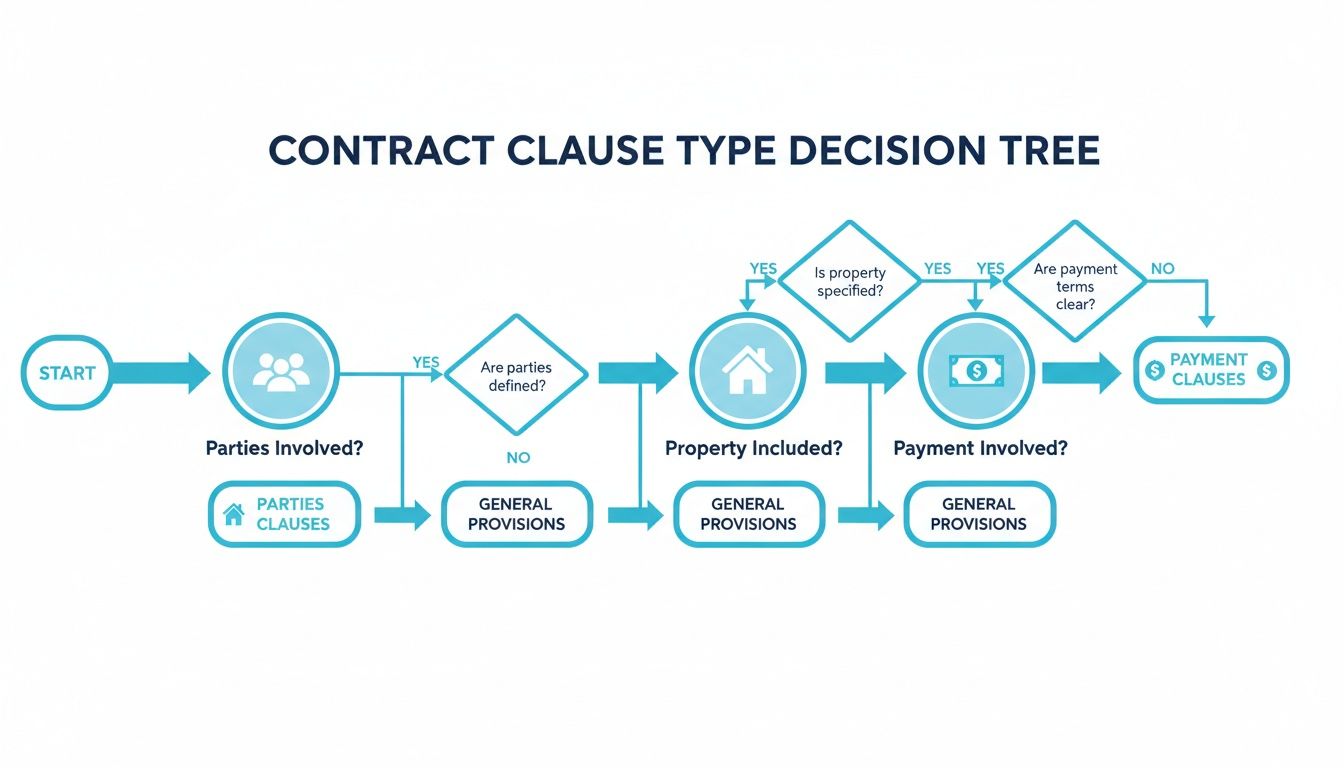
This illustrates the foundation – Parties, Property, and Payment – which has to be solid before you start adding rules for specific living arrangements.
Tailoring Contracts for Houses in Multiple Occupation (HMOs)
Managing a House in Multiple Occupation (HMO) brings a whole new level of complexity. You’re not just creating a contract between you and an occupant; you're setting the ground rules for a small community living under one roof. Your agreement has to anticipate the dynamics of shared living to head off conflict before it starts.
With the UK short-term rental market recently topping 439,000 properties, managing shared spaces well has never been more vital. This boom, especially in hotspots like London and the South West, really underlines the need for airtight contracts that can handle the unique pressures of an HMO. You can dig into more data on the UK's accommodation supply on VisitBritain's corporate site.
Your HMO contract must include specific clauses covering:
- Use of Communal Areas: Don’t just list the shared spaces. Set clear rules for their use. Think about policies on leaving personal belongings in hallways or how the living room is shared.
- Cleaning Rota: Disputes over cleaning are classic HMO flashpoints. The contract should either state that a professional cleaner is provided or include a cleaning rota as an addendum. This leaves no ambiguity about who is responsible for what.
- Guest Policy: In an HMO, one person's overnight guest affects everyone. Your policy must be crystal clear on how often guests can stay and for how long. It's often wise to require housemates to be notified in advance.
- Noise and Anti-Social Behaviour: A clause that prohibits excessive noise and spells out how to resolve disputes is essential for a peaceful house. It should make it clear that behaviour affecting other occupants is a breach of the agreement.
By adapting your short term rental contract template for these distinct situations, you create a document that doesn’t just protect you legally, but also helps create a much more harmonious and well-run property.
Executing the Agreement: From Checks to Signatures

Having a perfectly drafted short-term rental contract template is a great start, but it's only half the battle. Its real power is unlocked when you execute it correctly. This final admin stage is where the agreement becomes a legally binding reality, and missing a step here can undermine all your careful preparation.
This phase is about more than just getting a quick signature. It’s a structured process of verification, financial handling, and documentation. It's also your last chance to ensure you’re fully compliant with UK law, especially the strict rules around a person's immigration status. Rushing this can lead to serious legal and financial headaches, so it's best to treat it as a final, critical checklist.
Let’s walk through the essential tasks that turn your draft into an enforceable contract.
Conducting Right to Rent Checks
Before any ink hits the paper, you have a legal duty to perform a ‘Right to Rent’ check on all adults who will be living in the property. For landlords in England, this is a non-negotiable requirement under the Immigration Act 2014.
The process involves two key stages:
- Obtain Original Documents: You must see the original identification documents for every prospective occupant. Photocopies just won't cut it for the initial check.
- Verify Authenticity: You need to be satisfied that the documents are genuine and that the person presenting them is the rightful owner. This has to be done with you present, either in person or via a live video call.
Once you've done this, take a clear copy of each document and write down the date the check was completed. You need to keep this record securely for the entire tenancy and for one year after it ends. Getting this wrong can result in fines of up to £3,000 per occupier.
Verifying Identity and Financial Standing
Beyond the legal Right to Rent requirement, it’s simply good practice to verify the identity and financial stability of your prospective renter. This protects you from potential fraud and gives you confidence that the person you're letting to is who they say they are and can actually afford the rent.
A few practical steps include:
- Photo ID Confirmation: Cross-reference their passport or driving licence with the person standing in front of you.
- Proof of Address: Ask for a recent utility bill or bank statement to confirm their current address.
- Affordability Checks: You could ask to see recent payslips or an employment contract to confirm their income. This provides reassurance that they can comfortably meet the rental payments.
These checks aren’t about being intrusive; they are a fundamental part of responsible landlording. They build a foundation of trust and security, protecting both your property and your income stream from the outset.
Handling the Deposit Correctly
With the checks complete, the next task is handling the security deposit. The rules here are strict and depend on the type of agreement you're using.
For an Assured Shorthold Tenancy (AST), the law is crystal clear. You must:
- Protect the deposit in a government-approved tenancy deposit scheme (TDP) within 30 days of receiving it.
- Provide the tenant with the official 'Prescribed Information' about the scheme within that same 30-day window.
If you’re using a lodger agreement (a licence to occupy), you are not legally required to use a TDP scheme. However, it's still considered best practice. Doing so shows fairness, gives your lodger confidence that their money is safe, and can help prevent disputes down the line. Your contract should always state exactly where the deposit will be held.
For anyone new to letting, you can find brilliant resources when you register as a landlord with Rooms for Let and explore their guides.
Finalising the Signatures
The final action is getting the contract signed. Whether you do this face-to-face or digitally, the goal is to make sure all parties have a finalised, legally binding copy of the agreement.
- In-Person Signing: The best approach is for everyone to sign two copies of the contract, so each person can walk away with an original. Initialling each page is a good habit to get into, as it confirms all clauses have been seen and acknowledged.
- Digital Signatures: Using a reputable e-signature platform is a secure and highly efficient alternative. These services provide a clear audit trail, confirming who signed and when, which is legally admissible.
As soon as it’s signed, provide a complete, dated copy to your tenant or lodger for their records. This simple act of transparency closes the process professionally and ensures everyone is on the same page.
Managing the Let From Check-In to Check-Out

The contract sets the rules, but it’s the day-to-day management that truly defines a successful let. A signed agreement is your foundation, yet it's the practical steps you take—from the moment an occupant arrives to the day they pack their bags—that prevent friction and disputes down the line.
Getting these details right is all about proactive management. It’s about creating crystal-clear records, setting a welcoming tone from the outset, and having a solid plan for when things don’t go perfectly. Nail the check-in, the stay itself, and the check-out, and you'll not only protect your property but also build a reputation that encourages great reviews and even repeat business.
The Crucial Role of the Inventory Report
Before your occupant even gets the key, your most important job is to draw up a detailed inventory report. Think of this document as your single best defence against deposit disputes. It’s not just a shopping list of items; it’s a comprehensive, time-stamped record of the property's exact condition.
A robust inventory report needs to be thorough. We’re talking about:
- Written Descriptions: Get specific. Don't just write "wall painted magnolia." Instead, note things like "lounge, north wall: magnolia emulsion, good condition, small 2cm scuff mark behind sofa." The more detail, the better.
- Photographic Evidence: A picture is worth a thousand words, especially when it's date-stamped. Take clear, well-lit photos and videos of everything, paying close attention to any existing wear and tear. This proves it was there before they moved in.
- Appliance Checks: A quick note confirming that the oven, washing machine, and other appliances are in good working order can save a lot of headaches later on.
Crucially, both you and the occupant must sign and date this report on move-in day, formally agreeing to its accuracy. Without this shared record, any claim you make against their deposit is just your word against theirs—a battle landlords rarely win.
Creating a Smooth Check-In and Check-Out Process
A well-organised check-in doesn't just tick boxes; it sets a professional and welcoming tone for the whole stay. This is your chance to walk them through the property, explain how the heating works, and clear up any initial questions.
During the check-in, you should:
- Hand over the keys and run through any alarm codes or security systems.
- Go over the signed inventory report together, allowing them to add any notes if they spot something you missed.
- Provide a simple welcome pack. This should contain essential info like the Wi-Fi password, emergency contacts, and bin collection days.
The check-out process needs to be just as structured. Arrange a specific time to meet the occupant before they leave. Walk through the property together, with the original inventory in hand, to inspect for any new damage beyond fair wear and tear. This immediate, joint inspection is the best way to agree on any potential deposit deductions on the spot, preventing drawn-out disagreements after they've left.
A seamless check-in and check-out process does more than just protect your property. It demonstrates professionalism and respect for your occupant, which often encourages them to take better care of the space during their stay.
Handling Issues During the Tenancy
Even with the best occupants, things can go wrong. A tap might start dripping, or a disagreement might flare up in a shared house. Your short term rental contract template should spell out how to report repairs, but it's your response that really counts.
For minor repairs, act fast and keep the occupant in the loop about when it'll be fixed. Quick, clear communication shows you're a responsible landlord.
In a shared house or HMO, disagreements between housemates can be tricky. Your role isn't to be a judge, but to gently refer everyone back to the house rules they all signed up to. By acting as a neutral mediator who simply enforces the agreed-upon contract, you can de-escalate many situations before they become serious problems. If you're looking for new occupants, you'll find great guidance when you register as a tenant with Rooms For Let and explore their resources.
Ending the Agreement and Returning the Deposit
When it's time to part ways, everything must follow the terms laid out in your contract. This means sticking to the correct notice period, whether that’s the legally defined period for an AST or what's considered 'reasonable notice' for a lodger.
Once the occupant has moved out and the final inspection is done, the last step is to handle the deposit. If there are no damages or unpaid rent, you should return the full amount promptly.
If you do need to make deductions, you must give the occupant a clear, itemised list explaining each cost. This needs to be backed up by the evidence from your check-in and check-out inventory reports. Following this procedure to the letter keeps the process fair, transparent, and legally sound.
Your Short-Term Rental Contract Questions Answered
When you're dealing with short-term lets, it’s natural for questions to pop up, especially around the legal paperwork. Let's tackle some of the most common queries we see from landlords, homeowners, and HMO managers across the UK. Here are some clear, straightforward answers to give you a bit more confidence.
What Is the Difference Between a Tenant and a Lodger?
Getting this right is probably the single most important distinction in UK property letting. It dictates everything that follows.
A tenant has what's called 'exclusive possession' of a property or a room. This is a crucial legal concept that means they can stop you, the landlord, from entering their space without proper notice. Their agreement is usually an Assured Shorthold Tenancy (AST), which gives them significant rights and protections under the Landlord and Tenant Act 1985.
A lodger is completely different. They rent a room in the same property where the landlord lives, sharing common areas like the kitchen or living room with you. They don't have a tenancy but a ‘licence to occupy’. This is a much less formal arrangement with fewer rights, allowing you to end the agreement with just 'reasonable notice,' often without needing to go to court. Using the correct agreement from the start isn't just good practice; it's a legal necessity.
Do I Legally Need a Written Contract for a Short-Term Let?
While you can have a verbal agreement, relying on one is a massive gamble that leaves you incredibly exposed. A written contract is your safety net. It’s the definitive proof of what you both agreed to, protecting you and your occupant by clearly setting out all the terms.
Think about it – it covers everything from rent payment dates and deposit rules to house rules and how the let will end. It cuts out the guesswork and provides a clear path to follow if a dispute pops up. For an Assured Shorthold Tenancy, you’re legally required to provide certain information in writing anyway, so a solid written agreement is the only sensible way forward.
Your contract is basically the instruction manual for the let. Without it, everyone is just making up the rules as they go along, which is a perfect recipe for conflict and stress. A clear, signed document is your best protection.
How Much Notice Do I Need to Give to End the Let?
The notice period you have to give is completely dependent on the type of agreement you have. The rules for tenants and lodgers are worlds apart.
For an AST (Tenant): The notice period is set by law. You'll need to issue a formal notice, usually a Section 21 or a Section 8 notice, each with its own specific timeframes. A Section 21 'no-fault' notice, for instance, typically requires a minimum of two months' notice.
For a Licence to Occupy (Lodger): The legal bar is much lower – you just need to give 'reasonable notice.' This isn't strictly defined in law, but it’s widely accepted to mean the same length as the rental payment period. So, if your lodger pays rent weekly, you give one week's notice.
Whatever you agree, make sure your short term rental contract template spells out the notice period explicitly to prevent any confusion down the line.
Can I Include a No Pets Clause in My Contract?
Yes, you can absolutely include a 'no pets' clause. However, you need to be mindful that the political and legal mood is shifting on this. The government has made it clear it wants to stop landlords from unreasonably refusing a tenant's request to keep a pet.
While this isn’t fully enshrined in law just yet, the direction of travel is towards making rentals more pet-friendly. You can still say no, but you’ll need reasonable grounds, like the property being too small or unsuitable. For lodgers living in your own home, you have far more freedom to set your own rules. In any scenario, the best approach is to be crystal clear about your pet policy in the written agreement from day one.
Ready to find the perfect occupant for your room? Rooms For Let makes it simple and free to advertise your spare room, house share, or HMO. List your room today and connect with thousands of potential tenants across the UK.