If you're a property investor, imagine an asset class that isn't at the mercy of unpredictable economic mood swings. That’s the real appeal of the UK student accommodation market. It's a world away from the volatility of traditional residential property, anchored instead by the steady, reliable rhythm of the academic year.
Why Invest in UK Student Accommodation

The UK’s world-class universities are a global magnet, pulling in a fresh wave of students from home and abroad every single autumn. This creates a relentless demand for good quality housing that, in many key cities, consistently outstrips what's available. The result? High occupancy rates and very attractive rental yields for savvy investors.
This isn't about chasing fleeting trends. It's about tapping into a fundamental, non-negotiable need. Every year, a new cohort arrives, and they all need a place to live. It’s this predictable, cyclical demand that makes student property such a compelling proposition.
The Pillars of a Strong Investment
So, what makes this market so uniquely stable and rewarding? It really boils down to a few core strengths that every investor should understand before diving in.
- Consistent Demand: The academic calendar gives you a built-in tenancy cycle. Forget the guesswork of the general rental market; you know precisely when students will be looking for rooms, which dramatically cuts down on those dreaded void periods.
- Higher Rental Yields: Renting out rooms individually in a property, like a House in Multiple Occupation (HMO), almost always generates a much higher income than letting the same property to a single family. It’s simple maths.
- Market Resilience: People go to university in good times and bad. In fact, many people choose to upskill during economic downturns, making student lets a remarkably defensive asset to have in your portfolio.
The numbers back this up. In 2025, the UK student accommodation market has proven to be an exceptionally solid performer. Many investors are seeing net yields between 6% and 8%—figures that often leave traditional buy-to-lets in the dust. This is all built on the foundation of a UK student population that’s now over 2.8 million strong and occupancy rates that stubbornly stay above 95% in the top university cities.
Investing in student property is less about simply buying a house and more about providing a high-demand service. You are meeting a fundamental need for a large, consistent demographic, which is the bedrock of any sound investment.
Of course, it’s not without its own unique challenges. It pays to get familiar with the specific risks and rewards of renting to students. Getting to grips with the management side of things is also key to your success, and our own landlord advice blog is packed with valuable insights to help you on your way: https://www.roomsforlet.co.uk/blog/
Ultimately, the combination of steady cash flow and market resilience makes student property a powerful addition to any forward-thinking investment strategy.
Understanding the Student Property Market Dynamics
To get anywhere with a student accommodation investment in the UK, you first need to understand the engine driving its value. It’s a classic, powerful imbalance between supply and demand. This isn’t just a passing trend; it’s a deep-rooted feature of the UK’s higher education system that creates a fantastic, long-term opportunity for property investors.
Picture a popular concert where thousands more tickets are sold than there are seats. That’s pretty much the situation in many of the UK's top university cities. Each year, universities welcome a huge wave of new students, but the construction of good quality, suitable housing just can't keep up. This gap is the bedrock of the entire investment case.
This constant shortfall means that well-kept properties in the right locations are always in high demand. For landlords, that translates directly into fewer empty rooms (void periods) and a steady upward pressure on rent. The result is a reliable income stream that’s often far more resilient than the general residential market.
Key Forces Shaping the Market
Several forces are constantly feeding this supply-demand gap. Getting your head around them helps you figure out a city’s long-term potential and spot both opportunities and risks on the horizon.
- Growing Student Numbers: Even with all the talk about international student policies, the overall demand for a UK university education is incredibly strong. UCAS, the university admissions service, is forecasting that total applications could climb significantly by 2030. That means even more students will be scrambling for a limited pool of housing.
- University Expansion Plans: Many of the best universities are actively growing their student numbers to fund more research and development. The problem is, their ability to build new halls of residence is often capped, pushing thousands of second and third-year students out into the private rental sector.
- Shifting Student Expectations: Today’s students are savvy customers. They want more than just a basic room; they’re looking for modern amenities, fast Wi-Fi, and safe, well-managed properties. This rise in standards is a great opportunity for investors who can offer a better product, as it allows them to charge a premium.
Of course, these dynamics aren't the same everywhere. A city with a prestigious Russell Group university and a buzzing local economy will have a completely different investment profile to a smaller town where students tend to leave after graduation.
The real art of student property investment is finding those markets where the gap between student population growth and new housing supply is at its widest. That’s where you’ll find the biggest potential for both rental growth and your property’s value to increase.
Market Performance and Investment Flows
You can see the strength of these fundamentals in the market activity. The UK Purpose-Built Student Accommodation (PBSA) market alone saw transactions worth around £2.8 billion in just the first nine months of 2025. This shows huge investor confidence, even with challenges like a 30.8% drop in student visa issuances in 2024. Encouragingly, 2025 showed signs of a comeback, with an expected 7% growth in visa issuances.
It's also interesting to see how rental growth differed. University-owned accommodation rents went up by 4.44%, while the private sector saw a much smaller rise of 1.16%. You can dig into the full analysis in the UK student accommodation market report from cushmanwakefield.com.
All this activity really highlights the market's resilience. For some inspiration and to see how others have made it work on a larger scale, it’s worth checking out some real-world examples of scaling student housing portfolios. Understanding these big success stories can offer valuable lessons, no matter the size of your own ambitions.
And if you're looking for tenants right now, a quick browse through our Rooms For Let wanted ads can give you a direct, real-time view of tenant demand in your area.
Choosing Your Investment Model: HMO vs PBSA
When you decide to jump into the UK student accommodation market, you'll quickly come to a fork in the road. This isn't just about buying a property; it's about picking a business model that fits you. The two main paths are the classic House in Multiple Occupation (HMO) and the more modern Purpose-Built Student Accommodation (PBSA).
Think of an HMO as running your own small business. You're the one in charge, directly managing the property, the students living there, and all the regulations that come with it. It's a hands-on route that often brings in higher rental yields, but it absolutely demands more of your time and energy.
PBSA, on the other hand, is more like owning shares in a big, professionally run company. It’s a passive, hands-off approach. Your flat or studio is just one part of a huge, managed block, and someone else handles all the day-to-day work. The returns are usually more stable and predictable, but you’re swapping the potential for those top-tier yields for sheer convenience.
Your choice here will define your entire investment journey. It all comes down to your personal situation, what you want to achieve financially, and—most importantly—how much of your own time you’re willing to put in.
The Hands-On Approach: Houses in Multiple Occupation (HMO)
An HMO is what most of us picture when we think of a "student house"—a typical residential home where individual rooms are rented out to different people who share the kitchen and living spaces. This model is a massive hit with students, especially those in their second or third year who are keen to live with their mates, away from the first-year halls.
For investors, the main draw is the cash flow. By letting a property room by room, your total rental income is almost always much higher than if you let the same house to a single family. In the top university cities, a well-run HMO can hit gross yields of up to 15.5%, which leaves the average buy-to-let in the dust.
But that bigger return comes with a much bigger management headache. As an HMO landlord, you’re on the hook for:
- Finding Tenants: You've got to fill several rooms, and you'll likely be doing it every single academic year.
- Managing Bills: HMO rents are usually all-inclusive. That means you’re the one sorting out and paying for utilities, council tax, and broadband.
- Stricter Regulations: HMOs are governed by tough safety standards and licensing rules from the local council, which can be a maze to navigate and expensive to get right.
For landlords who are ready to roll up their sleeves, the rewards are definitely there. Using a platform to find tenants is a game-changer, and it's easy to get started when you register as a landlord to advertise your rooms and get in front of students looking for a place.
The Passive Path: Purpose-Built Student Accommodation (PBSA)
PBSA refers to those big, modern blocks of flats and studio apartments designed and built just for students. You'll usually find them in prime city-centre spots, right near the university campuses, and they come loaded with amenities like gyms, cinemas, common rooms, and super-fast Wi-Fi.
Investing here usually means buying a single flat or a "pod" inside one of these huge developments. The whole building is looked after by a professional management company. They handle everything—finding tenants, collecting rent, maintenance, security, the lot.
PBSA offers a truly passive investment. You just sit back and receive a net rental income after all the management fees and running costs have been taken out, without any of the daily landlord dramas.
This 'set it and forget it' style makes PBSA a great choice for investors who don't have the time or the local knowledge for active management, or for those investing from overseas. While the yields are generally a bit lower than with HMOs, they are often more secure, with total returns for the PBSA sector hitting 9.8% in the year to September 2024. The trade-off is simple: you get less direct control and a smaller slice of the rental pie because of the management fees.
This chart gives you a simple way to see which path might be the right fit for you.
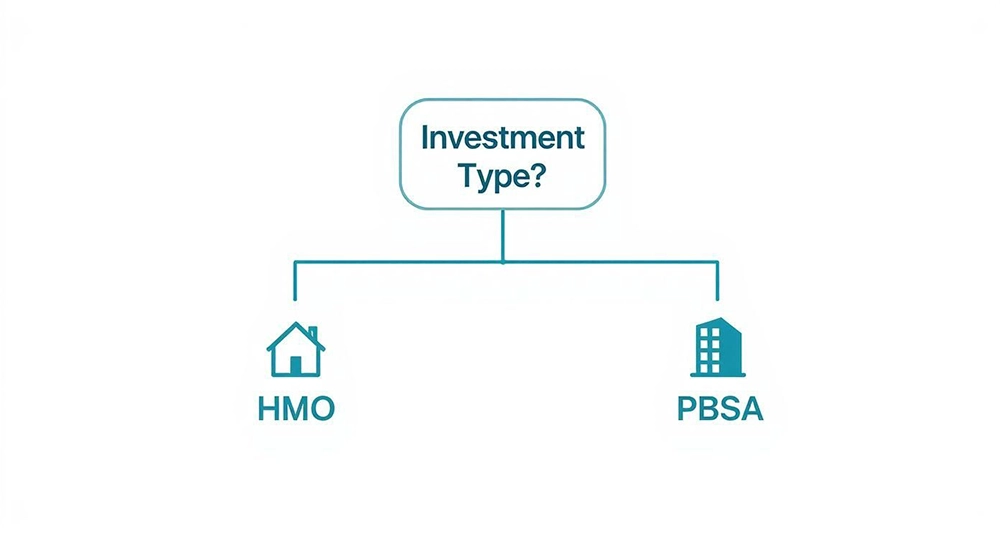
As you can see, it clearly separates the active, high-yield potential of HMOs from the passive, stable-return nature of PBSA, helping you line up your investment style with your personal goals.
HMO vs PBSA Investment At a Glance
To make the choice even clearer, let’s break down the key differences side-by-side. Think of this as your cheat sheet for deciding which student property investment model aligns with your resources, risk appetite, and lifestyle.
| Feature | HMO (House in Multiple Occupation) | PBSA (Purpose-Built Student Accommodation) |
|---|---|---|
| Management Style | Active & Hands-On. You're the manager. | Passive & Hands-Off. Managed by a third-party company. |
| Typical Yields | Higher. Potential for 8-15.5% gross yields. | Lower but Stable. Typically 4-9.8% net returns. |
| Initial Cost | Lower entry point. A standard residential house. | Varies. Can be higher for prime city locations. |
| Tenant Sourcing | Your responsibility. Annual task to fill all rooms. | Handled by the management company. |
| Regulations | Complex. Strict local council licensing and safety rules. | Simpler for the investor. The operator handles compliance. |
| Control | Full control over the property, tenants, and rent. | Limited control. You own the unit, not the building. |
| Best For | Investors who want to maximise cash flow and have time to manage. | Investors seeking a simple, low-effort asset with predictable income. |
Ultimately, there's no single "best" option—only the best option for you. An HMO can be a hugely rewarding, cash-generating machine if you're prepared for the work. A PBSA unit offers a straightforward, almost armchair investment that provides steady returns without demanding your time.
Finding the Top UK Cities for Student Investment
Location, location, location. You’ve heard it a thousand times, but in student property, it’s not just a cliché—it’s the golden rule. Simply picking a city with a university campus and hoping for the best is a rookie mistake. The most successful investors I know are borderline obsessive about data, drilling down into the numbers to find spots where the fundamentals are overwhelmingly stacked in their favour.
This is about moving beyond those generic "Top 10" lists you see online. Think of it as a health check for a city's student rental scene. We’re looking for the vital signs: strong, relentless demand, a supply that just can't keep up, and a positive forecast for future growth.
Core Metrics for Vetting a University City
To uncover the real hotspots, you need to look at how a few key factors intertwine. No single metric tells the whole story, but when you see them all pointing in the same direction, you know you’re onto something good.
- Student-to-Bed Ratio: This is the big one. It’s a straightforward comparison between the total number of full-time students and the number of beds available in university halls and purpose-built blocks (PBSA). A high ratio is a glaring signal of a supply shortfall, forcing thousands of students into the private rental sector—your future HMO tenants.
- University Prestige and Expansion: Cities with prestigious 'Russell Group' universities are magnets for talent. These institutions pull in a steady, deep pool of both UK and international students year after year. It's also smart to dig into a university’s strategic plans. Are they actively trying to boost student intake over the next five years? More students mean more demand.
- Local Economic Strength: What happens after graduation day? A city with a buzzing local economy and a high graduate retention rate is a massive bonus. It opens up the possibility of year-round tenancies as students stay on for work, which can slash those dreaded summer void periods and give you a more diverse group of potential tenants.
Profiling the Investment Hotspots
Certain cities pop up time and time again in investment reports for a simple reason: they smash it across all these metrics. Places like Manchester, Bristol, and Birmingham are the classic examples—world-class universities, thriving local economies, and a chronic, undeniable shortage of student housing.
The goal is to find cities where multiple universities are all competing for a limited housing stock. This creates a powerful, sustained rental demand that protects your investment and drives rental growth year after year.
Take Manchester. It has one of the largest student populations in the whole of Europe, yet the supply of decent accommodation has always struggled to keep pace. Bristol is another great example; its combination of top-tier universities and a booming tech scene makes it an incredibly appealing place for students to study and then stick around, creating a seriously dynamic rental market.
The National Picture: A Persistent Shortfall
This isn't just a few isolated pockets of demand; it’s a nationwide trend that underpins the entire investment case for student property. The UK is facing a huge and growing gap between the number of students who need a place to live and the number of beds available.
By 2026, it's projected there will be around 2.2 million students looking for accommodation, but the country is facing a national shortfall of about 620,000 beds. This gap is only set to get worse. UCAS forecasts that student applications could hit the 1 million mark by 2030. This is precisely why savvy investors remain laser-focused on cities with severe accommodation shortages—like London, Birmingham, Manchester, and Bristol. You can read more about these trends in the UK's student accommodation market.
By using this data-driven lens, you can cut through the noise and pinpoint the locations with rock-solid fundamentals for long-term growth and reliable returns on your student property investment.
Navigating Finances and Legal Obligations
Once you’ve pinpointed a location and an investment model, it’s time to get into the nuts and bolts of making it happen. This is where the paperwork starts, and getting your head around the financial and legal duties is completely non-negotiable for a successful student property investment.
Getting this stuff right from day one is what separates the pros from the amateurs. It saves you from costly headaches down the line and keeps your business compliant, professional, and profitable.
First up, securing the right funding is your biggest hurdle. It’s absolutely crucial to realise that you can’t just use a standard buy-to-let (BTL) mortgage for a House in Multiple Occupation (HMO). Most lenders see HMOs as a higher-risk venture and will insist on a specialised mortgage product.
Think of it like this: a standard BTL mortgage is like a loan for a normal family car—predictable and simple. An HMO mortgage, on the other hand, is more like financing a minibus. It's a commercial-style vehicle with more passengers, more potential wear and tear, and a totally different risk profile. Lenders will scrutinise the deal far more closely and will likely ask for a bigger deposit or proof you've got landlord experience under your belt.
Securing the Right Type of Funding
The financing route you take will be completely different depending on whether you're buying an HMO or diving into PBSA. Both have unique requirements you need to prepare for before you even think about approaching a lender.
- HMO Mortgages: These are specifically designed for properties let to multiple tenants who aren't from the same family unit. Lenders won't just look at your personal finances; they'll assess the property's potential rental income on a room-by-room basis. Be prepared for higher interest rates and fees compared to vanilla BTL products.
- PBSA & Commercial Loans: If you're buying a single PBSA unit or an entire block, you’re moving into the realm of commercial finance. This is a far more bespoke lending arrangement. The bank will assess the investment primarily as a business, focusing heavily on the projected cash flow, the operator's track record, and the strength of the business plan.
Understanding Your Legal Duties as a Landlord
Beyond the money, your legal responsibilities as a student landlord are extensive, especially if you're running an HMO. These rules are there to ensure student safety and well-being, and failing to comply can lead to eye-watering fines or even prosecution.
It’s best to see these regulations not as bureaucratic hurdles, but as the essential framework for running a professional and ethical lettings business.
Your core legal obligations include:
- HMO Licensing: If your property is rented to five or more people from more than one household, it’s classed as a large HMO and needs a mandatory licence from your local council. Be warned, some councils have even stricter 'additional' licensing schemes that apply to smaller HMOs, so you must check the specific rules in your area.
- Safety Certificates: You are legally required to provide an annual Gas Safety Certificate, an Electrical Installation Condition Report (EICR) every five years, and ensure all furniture meets fire safety standards. Working smoke alarms and carbon monoxide detectors are also mandatory.
- Tenancy Deposit Protection: You must place your tenants' deposits into a government-approved protection scheme within 30 days of receiving the money. If you fail to do this, a court can order you to repay up to three times the deposit amount to the tenant.
Running a student property, especially an HMO, is not a passive investment. You are legally responsible for providing a safe, well-maintained home, and the regulations are designed to enforce a high standard of care.
Getting to Grips with Tax
Finally, a crystal-clear understanding of your tax liabilities is vital for accurately calculating your net returns. A profitable student property investment is one that has properly accounted for the key taxes that will hit your bottom line.
- Stamp Duty Land Tax (SDLT): When you buy an investment property in England or Northern Ireland, you will pay a higher rate of Stamp Duty. This surcharge applies to all second homes and buy-to-let properties.
- Income Tax: The rental profit you make is taxable income. The good news is you can deduct allowable expenses (like mortgage interest, maintenance, and letting agent fees) from your rental income before the tax is calculated.
- Capital Gains Tax (CGT): If you eventually sell the property for more than you paid for it, you will be liable for Capital Gains Tax on the profit.
Your Step-by-Step Investment Action Plan

Right, this is where the theory stops and the action begins. Think of this as your pre-flight checklist before you launch your first student accommodation investment in the UK. We're going to walk through the essential stages, turning all that knowledge into confident, practical steps.
This isn't just a conclusion; it's a blueprint designed to take the guesswork out of the process. By breaking it all down, you can move forward with a clear head and turn that ambition into a tangible, income-producing asset.
Stage 1: Define Your Strategy and Research
Before you even glance at a property listing, you need a solid plan. Seriously. Start by figuring out what success actually looks like for you. Are you chasing the best possible monthly cash flow, or is long-term capital growth the main prize? Your answer here will shape every single decision you make next.
Then, it's time to get nerdy with the data. Shortlist two or three university cities based on the metrics we've already covered. Pay close attention to that student-to-bed ratio and check out the university's growth plans. This groundwork is, without a doubt, the most important part of managing your risk.
- Set Clear Goals: Decide on your target yield, your total budget, and whether you’re up for an active role (HMO) or prefer a more passive investment (PBSA).
- Conduct Market Analysis: Zero in on specific postcodes in your chosen cities. Find out the going rate for student rooms and get to grips with the local HMO licensing rules.
- Secure Financing in Principle: Chat with a mortgage broker who specialises in HMO or buy-to-let finance to get an Agreement in Principle (AIP). This simple document shows sellers you're a serious buyer, not just a window shopper.
Stage 2: Sourcing and Due Diligence
With your finances lined up, the property hunt begins. Set up alerts on the big property portals, of course, but don't stop there. Get on the phone and build relationships with local estate agents who really know the student market. When you spot a contender, your analysis needs to be rigorous and totally unsentimental.
Due diligence is your safety net. This covers everything from the physical condition of the property to verifying its rental history and legal status. Never, ever skip this stage, no matter how amazing the deal seems on paper.
A successful investment is bought on the numbers. Your due diligence phase is where you confirm those numbers are accurate and the property's potential is real, not just theoretical.
This means getting a proper building survey, letting your solicitor conduct all the necessary searches, and making absolutely sure the property can be legally used as a student let or HMO.
Stage 3: Financial Forecasting and Finalising the Deal
Okay, let's bring this to life with a sample forecast. This is exactly how you'll crunch the numbers to calculate your potential return and confirm the investment stacks up before you commit.
Sample HMO Financial Forecast (5-Bed Property)
| Income & Expenses | Calculation | Annual Figure |
|---|---|---|
| Gross Rental Income | 5 rooms @ £550/month x 12 | £33,000 |
| Less Operating Costs | --- | --- |
| Mortgage Interest (5% on £225k) | -£11,250 | |
| Utilities & Broadband | £300/month x 12 | -£3,600 |
| Insurance | -£500 | |
| Council Tax (if liable) | -£2,000 | |
| Voids (5% contingency) | 5% of gross rent | -£1,650 |
| Maintenance (8% contingency) | 8% of gross rent | -£2,640 |
| Total Operating Costs | -£21,640 | |
| Net Operating Income (NOI) | Gross Rent - Costs | £11,360 |
Based on these figures, your key performance indicators look like this:
- Net Yield: (NOI / Purchase Price) = (£11,360 / £300,000) = 3.78%
- Return on Investment (ROI): (NOI / Cash Invested) = (£11,360 / £75,000 Deposit) = 15.15%
Once you're happy with the numbers and all your checks are complete, you give your solicitor the green light to proceed with the purchase. After completion, the final job is to get the property ready, secure all the necessary safety certificates, and start advertising for your first tenants.
Got Questions? We’ve Got Answers
Stepping into a new investment market always brings up a few questions. It’s only natural. Let's tackle some of the most common ones landlords have when they first look at the UK student accommodation sector.
Is Student Accommodation Still a Good Investment?
In a word, yes. The core dynamic that makes this market so attractive is simple and powerful: there are far more students needing homes than there are available beds. It’s a classic case of demand outstripping supply.
Looking ahead, UCAS predicts student applications could jump by 31% by 2030, and the national bed shortage is forecast to hit a staggering 620,000 by 2026. This isn't a short-term trend; it's a deep, structural imbalance that keeps occupancy rates sky-high and supports steady, reliable rental growth year after year.
What Are the Biggest Risks Involved?
No investment is without risk, but in student property, the main challenges are well-understood and manageable. The big three you need to have on your radar are:
- Shifting Regulations: Local councils have the power to change HMO licensing rules. This can sometimes mean new costs or more compliance hoops to jump through, so it's vital to stay on top of local policies.
- Property Wear and Tear: Let's be honest, students can be hard on a property. The turnover is high and the usage is intense, which often means your maintenance budget needs to be a bit more generous than it would for a standard family let.
- The Summer Void: The traditional headache for student landlords is the empty period over July and August. However, savvy landlords have largely solved this. Most now secure tenants for the next academic year months in advance, often signing them up with summer retainers or even full rent to guarantee the property is theirs come September.
How Much Deposit Do I Need for a Student Property?
This really hinges on the type of property you're buying. If you're going for a classic student HMO, you'll find most lenders will ask for a deposit of at least 25% of the purchase price. For individual PBSA units, the requirements can be a bit more varied, but budgeting for a similar 25% is a sensible starting point. The single best piece of advice here is to talk to a mortgage broker who really knows the student let market inside and out.
A classic rookie error is just focusing on the deposit. The actual cash you'll need upfront is always more. You absolutely must factor in Stamp Duty, all the legal fees, and the initial outlay for furnishing the property and getting it fully compliant with all the necessary safety regulations.
Ready to fill your student property and get those tenancies signed? Rooms For Let is the simple way to advertise your rooms and connect directly with thousands of students across the UK. Find your next tenant quickly and without the fuss.