An HMO licence is a special permit that landlords in the UK need if they rent out rooms in a property as a House in Multiple Occupation (HMO). It's essentially the council's seal of approval, certifying that both the property and the landlord meet higher safety and management standards designed for shared living.
This isn't just red tape; it's about ensuring the well-being of multiple tenants living together under one roof.
Understanding the HMO Licence
Think of it like the difference between a standard driving licence and the one you'd need to drive a bus. Both let you drive, but the bus licence demands a higher level of skill and adherence to stricter safety rules because you're responsible for many passengers. An HMO licence works the same way for landlords.
Renting to a single family is like driving a car. But when you manage a property with several separate households, things get more complex, and the risks increase. The HMO licence is the local authority's way of making sure you’re equipped to handle that extra responsibility and your property is safe for everyone inside.
Is Your Property an HMO?
So, what actually tips a standard rental over into being an HMO? The official definition can sound a bit technical, but it really just boils down to a couple of key ingredients.
At its core, a property becomes an HMO if it's rented out to at least three people who aren't from the same ‘household’ (like a family) but share facilities like a kitchen or bathroom.
This is the classic setup for:
- Houses shared by groups of students.
- Young professionals living together as flatmates.
- Properties where individual rooms are let on separate contracts.
It's a common mistake to think HMO rules are just for massive student digs. The reality is that even a small flat shared by three unrelated friends could be classed as an HMO. Whether it needs a licence often comes down to your local council’s specific rules.
To figure out where your property stands, have a look at the checklist below. It’s a great starting point, but always remember that your local council might have additional requirements. For more in-depth landlord advice, the Rooms For Let blog is packed with useful articles on property management.
Quick HMO Property Checklist
Use this table to quickly assess if your property might be considered a House in Multiple Occupation (HMO) and require a licence.
| HMO Criteria | Description |
|---|---|
| Number of Tenants | The property is rented to three or more tenants. |
| Household Composition | The tenants form more than one household (i.e., they are not all part of the same family unit). |
| Shared Facilities | Tenants share essential facilities like a kitchen, bathroom, or toilet. |
If you've ticked all three boxes, there's a good chance your property is an HMO. The next step is to find out if it requires a licence from your local council.
Of course. Here is the rewritten section, crafted to sound natural and human-written, following the provided style guide.
Why HMO Licensing Exists in the UK
When you first hear about HMO licensing, it’s easy to dismiss it as just another piece of bureaucratic red tape for landlords. More paperwork, more costs, more hassle. But if you dig a little deeper, you’ll find the entire system is built on one simple, crucial principle: keeping people safe.
Think about it. A shared house is fundamentally different from a single-family home. The risks are higher. A small kitchen fire becomes far more dangerous when you have five separate tenants on different schedules needing to escape. Overcrowding isn’t just uncomfortable; it can be a genuine health hazard.
HMO licensing is the official response to these increased risks. It’s how the government and local councils create a clear, enforceable set of minimum standards for safety and living conditions, ensuring every tenant in a shared property has a secure and properly maintained place to call home.
A Proactive Approach to Tenant Safety
Imagine a top-floor flat with no working smoke alarm, or a house where ten people are queuing to use a single bathroom. These aren't just unpleasant scenarios; they’re outright dangerous. The introduction of mandatory HMO licensing was a huge step forward in property regulation, forcing landlords to get their house in order before tenants move in. You can learn more about the history of these regulations and their impact on the private rental sector from ast-assistance.com.
At its heart, the system is about being proactive rather than reactive. Instead of waiting for a tragedy to prompt action, licensing makes sure the essential safeguards are in place from day one.
The rules really zero in on the big risks:
- Fire Safety: This means proper, mains-powered smoke alarms, clear escape routes, and often fire doors where needed.
- Overcrowding: Legal minimum room sizes are enforced to stop landlords from squeezing too many people into a small space.
- Decent Facilities: The rules ensure there are enough kitchens and bathrooms for the number of people living there. No more endless queues for the shower.
- Gas and Electrical Safety: Regular, certified checks on all installations are non-negotiable.
Think of an HMO licence less as a bureaucratic hurdle and more as a mark of a responsible landlord. It publicly demonstrates a commitment to tenant welfare and distinguishes your property as a safe, professional, and well-managed home in a competitive rental market.
Building a Reputable Rental Business
While the main focus is protecting tenants, there are some serious upsides for landlords who get on board. A licensed property is, by definition, a better and safer asset. It naturally attracts higher-quality tenants—people who are happy to pay for the peace of mind that comes with knowing their home is up to scratch and legally compliant.
It’s also about protecting your investment. Sticking to the licensing conditions massively reduces the risk of property damage and helps you sidestep the eye-watering fines and legal headaches that come with breaking the rules. In the long run, seeing licensing as a core part of your business strategy isn't just about compliance; it's about building a sustainable, reputable, and profitable rental portfolio. It’s the difference between just collecting rent and providing a quality service.
Figuring Out if Your Property Needs a Licence
Working out whether your rental property needs a licence can feel a bit like navigating a maze. While there are some clear-cut national rules, the final say often comes down to your specific local council. Grasping this distinction is crucial, because what’s perfectly fine in one town might require a special permit just a few miles down the road.
To get to grips with it, you need to understand the three different tiers of property licensing in England: Mandatory, Additional, and Selective. Each one has its own rules and purpose, and your property could fall under any of them depending on its size, location, and who lives there. Let's break down what each one actually means for you.
The National Rule: Mandatory HMO Licensing
First up is the baseline standard that applies everywhere in England, no exceptions. This is called Mandatory HMO Licensing, and it’s the government’s non-negotiable requirement for larger shared houses where the potential risks are considered highest.
Your property absolutely requires a mandatory HMO licence if it ticks these two boxes:
- It's home to five or more people.
- These people form two or more separate households.
This rule applies whether your property is in Penzance or Preston. If you’ve got a house share with five students or a group of five young professionals who aren't related, you are legally required to have a mandatory HMO licence.
Local Council Powers: Additional and Selective Licensing
This is where things get more local—and where many landlords get caught out. Councils have the power to bring in their own, stricter licensing schemes to tackle specific issues in their area. This creates two more types of licensing you need to have on your radar.
1. Additional Licensing
This scheme essentially lets councils lower the bar for what counts as a licensable HMO. A local authority can decide that even smaller shared houses—say, those with only three or four tenants—must be licensed. You’ll often see this in areas with lots of students or young professionals, where the council wants to make sure all shared properties meet safety standards, not just the biggest ones.
2. Selective Licensing
This is the widest-reaching type of licensing. With a selective licensing scheme, a council can demand that all privately rented properties in a designated area get a licence, even if they aren't HMOs at all. A standard family home rented to a single family could need a selective licence simply because of the street or ward it’s in. Councils usually use this power to improve poor property conditions or clamp down on anti-social behaviour in a specific neighbourhood.
Before we dive into some examples, here's a quick comparison of the three schemes to help clarify things.
Comparing UK Property Licensing Schemes
| Licensing Type | Who It Applies To | Governing Body | Common Example |
|---|---|---|---|
| Mandatory HMO | Properties with 5+ people from 2+ households. | Central Government (applies nationwide) | A five-bedroom house rented to five unrelated university students. |
| Additional HMO | Smaller HMOs (often 3 or 4 people) defined by the council. | Local Council (applies in specific boroughs/cities) | A three-bedroom flat rented to three young professionals in a city centre. |
| Selective | All private rental properties within a designated area. | Local Council (applies in specific streets or wards) | A two-bedroom house rented to a single family on a designated street. |
As you can see, the national rules are just the beginning. It's the local council's specific schemes that really define a landlord's full responsibilities.
The single most important takeaway is this: always check your local council’s website. The national rules are just the starting point. It’s the council’s specific Additional or Selective licensing schemes that determine the full extent of your legal duties.
The reason for all this is simple: shared homes come with higher risks. More people mean more potential for fire, more wear and tear, and a greater need for robust management.
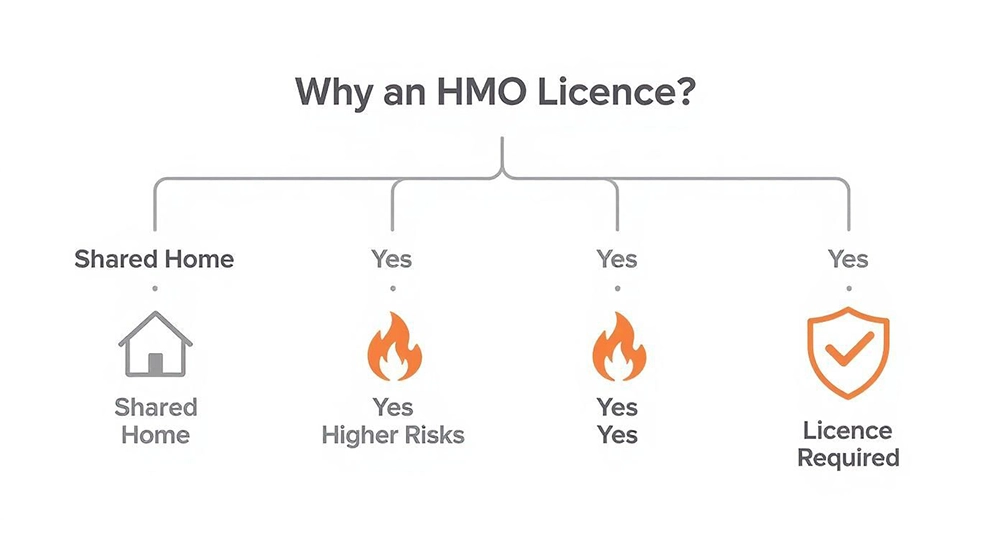
This visual shows why a licence is needed—it's all about ensuring tenant safety in higher-occupancy properties.
To see how this works in the real world, let's look at a few common scenarios.
Example Scenario 1: The Student House
You rent a five-bedroom house to five unrelated university students in Manchester.
- Verdict: This property needs a Mandatory HMO Licence. It has five tenants from more than one household, hitting the national criteria bang-on.
Example Scenario 2: The Young Professionals Flat
You own a three-bedroom flat in Bristol that you let to three young professionals, each on a separate contract.
- Verdict: This property likely needs an Additional HMO Licence. It doesn’t meet the mandatory threshold of five people, but Bristol City Council runs an additional licensing scheme that covers all HMOs.
Example Scenario 3: The Family Let
You rent a two-bedroom terraced house to a couple with a child in a specific ward of Nottingham.
- Verdict: This property may need a Selective Licence. It isn't an HMO, but if it falls within an area designated for selective licensing by Nottingham City Council, it must be licensed regardless.
Meeting Your HMO Safety and Management Duties
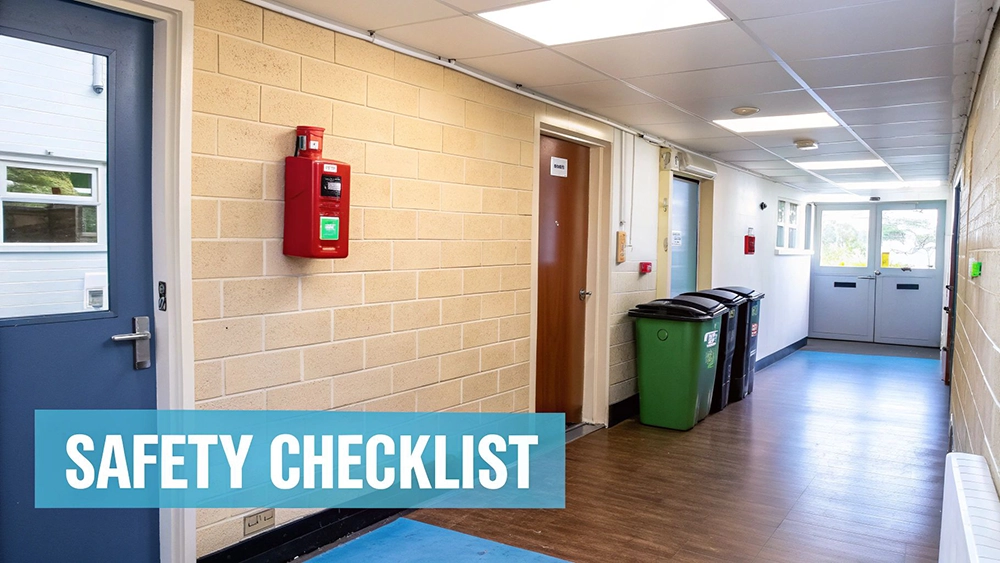
Knowing your property needs an HMO licence is just the starting line. The real work is in understanding and meeting the standards that come with it. Getting that licence isn't a simple case of paying a fee; it's a firm promise you make to your tenants and the local council that your property is safe, professionally managed, and fit for purpose.
These duties aren't just random bits of red tape. They directly tackle the higher risks that come with shared living. Think of your HMO licence conditions as the essential blueprint for a secure and functional home, covering everything from fire safety and room sizes to bin collections and keeping the kitchen clean.
Getting these details right is completely non-negotiable. Councils take these conditions very seriously, and any failure to meet them can put your licence at risk and land you with some hefty penalties. Let’s break down what you’re responsible for into clear, manageable chunks.
Fire Safety: Your Top Priority
In a shared house, nothing is more critical than fire safety. A fire can tear through a property in minutes, and with several unrelated people living there, escape routes can quickly become confusing or blocked. You can bet your council will be scrutinising your fire safety measures with a fine-tooth comb.
Key requirements almost always include:
- Interlinked Smoke Alarms: These must be wired into the mains with a battery backup. The key here is ‘interlinked’ – when one sounds, they all sound. This ensures everyone is alerted instantly, no matter where they are in the house.
- Heat Detectors: You’ll usually need these in high-risk spots like the kitchen, where a normal smoke alarm could be constantly set off by burnt toast.
- Fire Doors: Properly fitted, self-closing fire doors are often mandatory for kitchens and other doors along escape routes. They are designed to contain a fire, buying your tenants precious time to get out safely.
- Emergency Lighting: For larger HMOs, the council may require emergency lighting in corridors and stairwells to light the way out if the power fails.
- Clear Escape Routes: This one is simple but vital. All hallways, stairs, and exits must be kept completely clear of clutter. No bikes, no boxes, no bags of rubbish.
Protecting tenants from unseen threats is just as important. You can learn more about identifying common carbon monoxide and gas leak issues that inspectors often discover. A valid gas safety certificate is a legal must-have for any rental, but its importance is magnified in an HMO.
Space and Amenity Standards
Overcrowding is a major health and safety risk, and it’s something councils are keen to stamp out. To tackle this, the government has laid down mandatory minimum room sizes for any room used for sleeping in a licensed HMO in England.
Mandatory National Minimum Room Sizes:
- For one person over 10 years old: 6.51 square metres
- For two people over 10 years old: 10.22 square metres
- For one child under 10 years old: 4.64 square metres
Be warned: local councils can, and frequently do, set their own larger minimum sizes, so you absolutely must check their specific rules. Any room smaller than 4.64 square metres is a definite no-go and cannot be used for sleeping, period.
It’s not just about bedroom space, either. You have to provide enough shared facilities for the number of people living there. The council will have a set ratio of kitchens, bathrooms, and toilets to tenants. For instance, a five-person house might need at least one kitchen, one full bathroom, and a separate WC. And of course, all these facilities have to be clean, in good working order, and fit for purpose.
Essential Management Duties
Holding an HMO licence means you’re signing up for ongoing management duties. You can’t just get the tenants in and then disappear. The council expects you to be a hands-on manager, making sure the property stays a safe and pleasant place to live.
This includes:
- Waste Management: You must provide enough bins for rubbish and recycling and have a clear plan for their storage and collection. No letting them pile up and block the path.
- Maintaining Common Areas: All the shared bits – kitchens, living rooms, hallways, gardens – have to be kept clean and in a decent state of repair.
- Tenant Issues: You are the person responsible for dealing with any anti-social behaviour from your tenants.
- Providing Contact Details: Your name, address, and phone number must be clearly displayed somewhere obvious, like a noticeboard in the hall.
Staying on top of these duties creates a much better living environment, which naturally attracts better tenants. Many people looking for a room are actively searching for well-managed homes, often heading to platforms to find landlords who advertise rooms in compliant, professionally run properties. Ultimately, keeping your house in great shape isn’t just about ticking legal boxes—it’s a smart business move that reduces hassle and protects your investment.
Navigating the HMO Licence Application Process
Knowing your property needs an HMO licence is one thing; actually getting one is the next big hurdle. The thought of dealing with council paperwork is enough to make many landlords nervous, but it doesn't have to be a nightmare.
Think of it as a logical, step-by-step journey. If you break it down and get everything in order beforehand, you can turn a potentially stressful task into a straightforward bit of admin. The absolute key to a smooth application is preparation. Rushing in without the right documents is just asking for delays and headaches.
Gathering Your Essential Documents
Before you even think about opening your local council’s application portal, your first job is to get all the required paperwork together in one place. It’s like getting your ingredients ready before you start cooking – it just makes the whole thing flow better.
Councils need to see hard evidence that your property is safe and up to scratch before they’ll even consider granting you a licence.
Here’s your pre-application checklist:
- A Valid Gas Safety Certificate: This needs to be current and issued by a Gas Safe registered engineer. No exceptions.
- An Electrical Installation Condition Report (EICR): A qualified electrician must have completed this report within the last five years.
- Proof of Fire Safety Measures: This isn't just about having alarms. You'll need records of their installation and servicing, plus details of things like fire doors or emergency lighting.
- Floor Plans: You’ll need to provide clear, detailed plans that show room sizes, the property layout, and where all the kitchens and bathrooms are located.
With this little pile of documents ready to go, you're in a great position to start the official application.
Understanding the Application and Costs
These days, almost every council uses an online portal for HMO applications. You'll have to create an account and fill out a detailed form that covers everything from your personal details to the nitty-gritty of the property's management and facilities. Honesty and accuracy are non-negotiable here.
Of course, one of the first questions on every landlord's mind is "How much will this cost me?". The fees for HMO licences vary wildly across the UK, typically ranging from £500 to over £1,500 per property for a five-year licence. To get a real sense of how much costs can differ between councils, you can discover more insights about licensing fees on The Independent Landlord.
Remember, the application fee is non-refundable, even if your application gets rejected. This is exactly why doing your homework and preparing thoroughly is so crucial—it gives you the best possible shot at getting it right the first time.
The fee is usually split into two parts. You pay the first chunk when you submit the application to cover the council's admin time, and the second is due once they’ve given your licence the green light.
Passing the Fit and Proper Person Test
A massive part of the process is the ‘fit and proper person’ test. This isn’t about your property; it’s about you. The council needs to be confident that the person managing the HMO is a responsible and trustworthy individual.
They will be looking for:
- Any criminal record, especially anything related to fraud, dishonesty, or violence.
- Any history of breaking landlord and tenant laws.
- Any evidence of discrimination in your business practices.
This test applies to you as the landlord and anyone you bring in to manage the property for you. If you have a complex situation or any worries about this part, it's a good idea to get some professional advice. For expert guidance on property management and compliance, feel free to contact our team at Rooms For Let for support. Passing this test is an absolute must.
The High Cost of HMO Non-Compliance

Knowing the rules for an HMO licence is one thing. But truly understanding the consequences of getting it wrong is what separates a successful landlord from one facing financial ruin.
Ignoring your legal duties isn't a minor slip-up; it's a high-stakes gamble. The penalties can devastate your finances and tarnish your reputation as a landlord for good. Many assume the worst they’ll face is a simple fine, but that’s a dangerous misconception. Local councils have a whole arsenal of enforcement powers, and they’re not afraid to use them.
This isn’t about scaremongering. It's about giving you a clear-eyed view of the very real risks. Treating HMO licensing as a top priority isn’t just about ticking boxes—it’s fundamental to running a serious, sustainable property business.
The Financial Penalties
The most direct hit from operating an unlicensed HMO is to your bank balance. Councils can slap you with a civil penalty for breaching licensing rules, with fines reaching up to £30,000 per offence. Yes, per offence.
If the breach is particularly bad, they might skip the fine and go straight to prosecution, which can lead to an unlimited fine from the courts.
And these penalties aren't just for rogue landlords with death-trap properties. You can be fined simply for failing to apply for a licence on time or for breaching one of its conditions. Forgetting to provide a valid Gas Safety Certificate or allowing overcrowding could each trigger a separate, eye-watering penalty.
Rent Repayment Orders: A Tenant’s Power
This is the one that really stings. A Rent Repayment Order (RRO) is a powerful legal tool that allows your tenants to reclaim rent they paid you while the property was unlicensed.
An RRO can force you to repay up to 12 months' worth of rent to your tenants. For a five-person HMO, this could easily run into tens of thousands of pounds, wiping out an entire year’s profit in one go.
Tenants can apply for an RRO themselves, or the local council can do it for them. This means that even if you have a brilliant relationship with your tenants, you're still completely exposed to a claim if you've failed to get the property licensed correctly.
Banning Orders and Criminal Records
The fallout from non-compliance can go far beyond money, threatening your ability to ever be a landlord again. For serious or repeat offenders, a council can apply for a banning order.
This is the nuclear option. It can prevent you from:
- Letting out any property in England.
- Working as a letting agent or property manager.
- Being involved with a company that does either of the above.
A banning order lasts for a minimum of 12 months, and your name gets added to a national database of rogue landlords. On top of that, a successful prosecution for housing offences lands you with a criminal record. This can haunt your personal and professional life for years, affecting everything from future job prospects to your ability to travel.
Common Questions About HMO Licensing
We’ve covered the nuts and bolts of what an HMO licence is, why you need one, and what happens if you don't. But from experience, we know that’s when the specific, real-world questions start popping up. It's only natural to have a few "what if" scenarios running through your head.
Think of this final section as a quick-fire round, tackling the tricky situations and common queries we hear from landlords all the time. Let's clear up any lingering confusion.
Does a Property with Three Tenants Always Need a Licence?
Not automatically under the national rules, but it’s a definite "maybe." The mandatory government scheme only kicks in for properties with five or more people. However, this is where your local knowledge becomes absolutely vital.
Your local council has the power to bring in an 'Additional Licensing' scheme. This gives them the authority to demand a licence for smaller HMOs, very often those with just three or four tenants. It’s a common tactic in areas with a lot of shared housing, so you must jump on your local council's website and check their specific rules. Never assume the national standard applies.
Can I Get an HMO Licence if I Live Overseas?
Yes, you certainly can, but there's a big string attached. You are legally required to appoint a competent, UK-based person or managing agent to be officially responsible for the property while you're away.
The council will need to be completely satisfied that this person is reliable and up to the job. Their details and experience will be a core part of the 'fit and proper person' check during your application. The goal is to ensure there’s always someone on the ground to handle day-to-day management and any emergencies that crop up.
What Happens if a Council Refuses My Application?
If your application is turned down, the council can't just say no. They are legally required to give you the exact reasons for the refusal in writing. It’s not necessarily the end of the line, as you will usually have the right to appeal the decision.
The most common reasons for a refusal are:
- The property itself failing to meet the required safety and amenity standards.
- The applicant (or their appointed manager) not passing the 'fit and proper person' test, perhaps due to a past conviction or a history of breaching landlord law.
In many cases, you can fix the problems that caused the refusal—like upgrading the fire alarm system or improving kitchen facilities—and then reapply with a much stronger, compliant application.
Is an HMO Licence Transferable if I Sell?
This one’s a straightforward and absolute no. An HMO licence cannot be transferred from one owner to another. The licence is tied specifically to the person who holds it and the property at the time it was issued.
This means that if you sell your licensed HMO, the new owner can't just inherit your licence. They must apply for a brand new one from the council if they want to keep running the property as a House in Multiple Occupation. This is a critical detail for both sellers and buyers to get their heads around during the sales process.
Finding the right people for your shared property is just as important as getting the licence sorted. Rooms For Let makes it easy to advertise your spare rooms for free, connecting you with thousands of potential tenants across the UK. Visit https://www.roomsforlet.co.uk to list your room today and fill your vacancy faster.