A periodic tenancy agreement is essentially a rolling rental contract that comes with no fixed end date. It just keeps renewing itself for a set period—usually month-to-month or week-to-week—until either the landlord or the tenant decides to end it by giving the proper legal notice.
Your Guide to Understanding a Periodic Tenancy

Think of it less like a rigid, 12-month phone contract and more like a flexible subscription service, like Netflix. You keep it for as long as it suits you and can cancel by giving the right amount of notice. That’s the core idea behind a periodic tenancy agreement, often simply called a "rolling tenancy."
This setup offers a level of adaptability that you just don't get with fixed-term contracts. It's incredibly common across the UK, providing a practical solution for tenants who need flexibility and for landlords who want to keep good tenants without the hassle of constant renewal paperwork. But how do these agreements actually begin?
The Two Paths to a Periodic Tenancy
A rolling tenancy doesn't just happen by chance; it comes into being in one of two distinct ways. Getting your head around these pathways is key to managing your rental situation, whether you're a landlord or a tenant.
Statutory Periodic Tenancy: This is the most common route by far. It happens automatically when a fixed-term Assured Shorthold Tenancy (AST) runs out, but the tenant stays put and keeps paying rent, which the landlord accepts. At this point, the law (specifically the Housing Act 1988) steps in and creates a new ‘statutory’ periodic tenancy. The agreement then rolls on, typically month-by-month, keeping all the same terms as the original contract.
Contractual Periodic Tenancy: This type is agreed upon from the very beginning. The landlord and tenant sign an agreement that clearly states the tenancy will run on a rolling basis from day one, with no initial fixed term. This is often a great choice for situations where both parties know from the outset that they need a more flexible arrangement.
A periodic tenancy agreement is a rolling rental contract without a definite end date, continuing until one party gives proper notice. While fixed-term agreements have long been the standard, periodic tenancies are about to take centre stage. The upcoming Renters (Reform) Bill is set to convert all standard tenancies into periodic ones, making this the new default for the UK rental market.
This major legislative change makes it more important than ever for landlords and tenants to get to grips with this tenancy type. Historically, fixed-term contracts have dominated the private rental scene. The shift towards periodic tenancies signals a fundamental change in rental law, aiming to give tenants more security while still offering flexibility. You can keep up with how these upcoming changes will affect landlords by reading the latest updates on our blog.
Here is the rewritten section, crafted to sound completely human-written and natural, following the specified style guide.
How a Periodic Tenancy Begins
A periodic tenancy doesn’t just materialise out of thin air. It comes into being through one of two clear pathways, each with its own legal footing and real-world consequences for both landlords and tenants. Getting your head around these two routes is the first step to truly understanding how a periodic tenancy agreement works on the ground.
Whether a tenancy rolls over is never left to chance; it’s a predictable outcome based on either the law stepping in or a mutual agreement made from the outset. These two methods ensure the switch from a fixed-term commitment to a more flexible setup is both clear and legally solid. Let's break down how each one happens.
The Automatic Path: Statutory Periodic Tenancy
By far the most common way a periodic tenancy starts is automatically, thanks to the law. This is known as a statutory periodic tenancy. It kicks in when a fixed-term Assured Shorthold Tenancy (AST) runs out, and the tenant simply stays put in the property, continuing to pay rent which the landlord accepts.
At this point, the Housing Act 1988 steps in and creates a new rolling tenancy all by itself. No new paperwork needs to be signed. The law essentially copies and pastes the important terms from the original fixed-term contract—like the rent amount, payment date, and everyone’s responsibilities—into the new, more flexible arrangement.
Key Takeaway: A statutory periodic tenancy isn't a choice; it's the legal default. If a fixed-term AST ends and the tenant remains in the property paying rent, a rolling contract is born.
Imagine a couple signs a 12-month AST for their first flat. When the year is up, they love the place and want to stay, but aren't sure if they can commit to another full year. They just keep paying their monthly rent, and the landlord is happy to accept it. In that moment, their agreement becomes a statutory monthly periodic tenancy, carrying on under the original terms.
This automatic switch provides a seamless way to continue the tenancy without the hassle of negotiating and signing a whole new contract. It offers instant flexibility once that initial commitment is over.
The Agreed-Upon Path: Contractual Periodic Tenancy
The second route is a contractual periodic tenancy, which is set up by mutual agreement from day one. Unlike its statutory cousin, this isn't an automatic process but a conscious decision made by the landlord and tenant when they first sign on the dotted line.
In this situation, the initial tenancy agreement will clearly state that there is no fixed term. Instead, it will specify that the tenancy runs on a rolling basis—for example, month-to-month—right from the start.
This approach is perfect for situations where both sides know they need flexibility from the get-go. It does away with the need for an initial fixed-term period altogether, providing an adaptable rental solution from the beginning.
Think about these two different scenarios:
- Statutory Example: A young family’s 12-month fixed-term AST ends. They stay on, and their tenancy automatically rolls into a monthly agreement.
- Contractual Example: A landlord lets a room to a consultant on a temporary work project. Knowing the tenant's plans could change, they sign a contractual periodic tenancy, creating a month-to-month arrangement immediately.
Deciding between these two paths really boils down to whether you prioritise initial security or long-term flexibility, and that choice shapes the entire landlord-tenant relationship.
Your Rights and Responsibilities Under a Rolling Tenancy

Just because a tenancy has rolled into a more flexible periodic arrangement, it doesn't mean the rulebook gets thrown out. Far from it. Both landlords and tenants still have a clear set of legal rights and duties that are vital for keeping everything running smoothly and lawfully. Getting a firm grip on these obligations is the best way to sidestep any potential disagreements later on.
The great thing about a periodic tenancy agreement is that it almost always carries over all the terms from the original fixed-term contract. This means the core duties for both sides stay exactly the same, giving you a solid, consistent framework even when the tenancy itself becomes more open-ended.
Let's break down what's expected of everyone involved.
Landlord Obligations in a Rolling Tenancy
As a landlord, your fundamental legal duties don't change one bit when a tenancy becomes periodic. Your main job is to provide a safe, secure, and liveable home for your tenants. These aren’t just suggestions; they’re strict legal requirements.
Your key duties include:
- Property Maintenance and Repairs: You are legally on the hook for keeping the property's structure and exterior in good shape. This covers everything from the roof and drains to gutters and external pipes.
- Essential Services: You have to make sure the supply of water, gas, electricity, and heating is always safe and in working order. This also extends to sanitation facilities like basins, sinks, and toilets.
- Gas and Electrical Safety: It’s your responsibility to get a Gas Safe registered engineer to carry out a gas safety check every year. You must also have all electrical installations inspected and tested by a qualified professional at least every five years.
- Deposit Protection: Any deposit you took from the tenant must stay protected in a government-approved tenancy deposit scheme for the entire time the tenancy is rolling.
Staying on top of these duties isn't just about avoiding legal trouble; it helps build a positive, professional relationship with your tenants.
Tenant Responsibilities Explained
Of course, it’s a two-way street. Tenants have their own clear responsibilities to uphold, which helps keep the property in good condition and ensures the whole arrangement is fair to the landlord.
The main responsibilities for tenants are:
- Paying Rent on Time: This is the big one. Rent must be paid in full and on the date you both agreed on. No exceptions.
- Reporting Repairs Promptly: If something breaks or needs fixing, tenants must let the landlord know as soon as possible. This stops small issues from turning into major, expensive problems.
- Property Care: You’re expected to look after the property in a ‘tenant-like’ manner. Think of it as basic day-to-day upkeep: changing light bulbs, testing smoke alarms, and keeping the place reasonably clean and tidy.
- Respecting the Terms: All the original rules from the tenancy agreement still apply. If it said no pets or no subletting then, it still means that now.
A periodic tenancy thrives on mutual trust and good communication. While the contract is more flexible, the core duties of looking after the property and paying rent on time form the bedrock of a successful landlord-tenant relationship.
How to End a Periodic Tenancy Correctly
One of the most important things to get right with a periodic tenancy is how to end it legally. The notice periods are different from fixed-term contracts and you have to follow them to the letter to avoid any legal headaches.
For a tenant, it's pretty straightforward. If you pay rent monthly, you usually need to give at least one month's written notice. Crucially, this notice has to line up with your rental period. For example, if your rent is due on the 1st of the month, your notice should end on the last day of a month.
For landlords, the process is more formal. You must give tenants at least two months' written notice. This is typically done with a Section 21 notice for a 'no-fault' repossession. If the tenant has broken the terms of the agreement (like falling into serious rent arrears), you might use a Section 8 notice instead.
To make things crystal clear, here’s a simple breakdown of the minimum notice periods.
Notice Periods Explained: Landlord vs. Tenant
This table outlines the minimum legal notice periods for both landlords and tenants in a standard monthly rolling tenancy, helping to clarify who needs to do what.
| Party Giving Notice | Required Notice Period (Monthly Tenancy) | Legal Form (If Applicable) |
|---|---|---|
| Landlord | At least 2 months' written notice. | Section 21 or Section 8 |
| Tenant | At least 1 month's written notice. | Written notice (e.g., email) |
Following these guidelines ensures that the tenancy is ended fairly and legally, protecting both you and the other party from disputes.
Managing Rent Increases Lawfully
Yes, landlords can increase the rent during a periodic tenancy, but you can't just pluck a new figure out of thin air. There's a proper legal process to follow.
The most common way to do this is by using a Section 13 notice. This is a formal document that officially tells the tenant about the proposed rent increase.
Here are the key rules:
- The rent can only be increased once every 12 months.
- You must give at least one month's notice for a monthly tenancy.
- The proposed new rent must be fair and realistic, meaning it’s in line with similar properties in the local area.
If a tenant feels the suggested increase is unreasonable, they have the right to challenge it at a First-tier Tribunal. This system makes sure that any rent adjustments are transparent and fair, protecting everyone's interests.
The Pros and Cons of a Periodic Tenancy
Is a periodic tenancy the right move for you? It really boils down to a trade-off between flexibility and stability. For both landlords and tenants, this rolling arrangement comes with its own unique set of benefits and drawbacks.
A periodic tenancy can be the perfect fit for someone whose life is in flux, but it might feel too uncertain for those who crave long-term security. Likewise, for a landlord, it can mean keeping a fantastic tenant without endless paperwork, or it could lead to unexpected vacancies. It’s a classic case of weighing up the positives against the negatives.
Advantages for Tenants
For tenants, the biggest draw is undoubtedly the freedom. A periodic tenancy offers a level of flexibility that fixed-term contracts simply can’t compete with, which is a massive advantage in certain situations.
Key benefits include:
- Ability to Move Quickly: If your circumstances change out of the blue—a new job in another city, a family matter, or you just find a better place—you can give your one month's notice and move on without any penalty.
- No Long-Term Commitment: You’re not locked into a 12-month contract, which is ideal if you’re unsure about your long-term plans or are only living in an area temporarily.
- Simplicity: There’s no need to renegotiate or sign a brand-new tenancy agreement every year. This saves time and avoids potential letting agent fees for contract renewals.
Think about a recent graduate on a short-term work contract. A rolling tenancy would be perfect for them. It allows them to live comfortably without committing to a full year, giving them the freedom to move if the contract isn't extended.
Disadvantages for Tenants
But that flexibility is a double-edged sword. The same freedom the tenant enjoys is also available to the landlord, which can introduce a real element of instability.
The main drawback is the lack of long-term security. A landlord can end the tenancy by giving just two months' notice, usually with a Section 21 notice. This can leave you scrambling to find a new home on a relatively short deadline, creating a lot of stress and uncertainty.
On top of that, landlords can propose rent increases once a year using a Section 13 notice. While tenants can challenge this, the possibility of regular rent reviews adds another layer of unpredictability that you just don't have with a fixed-term agreement, where the rent is set for the entire period.
Advantages for Landlords
From a landlord’s point of view, a periodic tenancy has its own compelling benefits, mostly centred around simplicity and keeping good tenants happy.
Key benefits include:
- Less Admin: You get to skip the recurring hassle and cost of drawing up and signing new fixed-term contracts every 6 or 12 months.
- Retaining Good Tenants: If you have reliable, long-term tenants who look after the property, a rolling tenancy lets them stay for as long as they wish without any fuss.
- Flexibility to Regain Possession: If your own situation changes and you need to sell the property or move back in, you can get it back relatively quickly by providing the correct two months' notice.
A landlord who manages their own property might really value this simplicity. It allows them to maintain a stable, long-term rental income from a trusted tenant without the constant cycle of renewal paperwork.
Disadvantages for Landlords
The main risk for landlords is the potential for unpredictable income and more frequent vacancies. Because a tenant can leave with just one month's notice, you could face empty periods more often than with a fixed-term tenancy.
This can lead to patchy cash flow and the recurring costs of finding new tenants, like advertising, referencing, and inventory checks. With the government planning to make periodic tenancies the default in the UK, many landlords are looking at similar models for clues on what to expect. Scotland's shift to open-ended tenancies in 2017 is a great example. There, tenants can leave with just 28 days' notice, which has definitely shaken up the rental market, with some landlords choosing to sell up rather than manage the increased uncertainty. You can learn more from the deep dive into periodic tenancies from the National Residential Landlords Association.
Ultimately, the choice comes down to a simple question: what do you value more, flexibility or security? Your answer will point you towards whether a periodic tenancy is the right path for you.
How Periodic Tenancies Play Out in Different Rental Situations
A periodic tenancy isn't a one-size-fits-all tool; its real-world application shifts dramatically depending on the type of rental you're managing. The flexibility of a rolling contract means one thing in a bustling house share, and something entirely different in a quiet lodger arrangement. For any landlord with a varied portfolio, getting to grips with these distinctions is essential.
While the core principles of rolling periods and notice requirements are consistent, the context is everything. Your approach needs to adapt whether you're dealing with a group on a joint tenancy in an HMO, a single lodger in your own home, or students used to a fixed academic calendar.
Periodic Tenancies in HMOs and House Shares
This is where things can get tricky, especially when you have a joint tenancy. In a typical house share, a group of friends might sign a single Assured Shorthold Tenancy (AST) together. This makes them all ‘jointly and severally liable’ – a fancy way of saying they are all responsible, both as a group and individually, for the rent and the property.
When their initial fixed term ends and the agreement rolls into a statutory periodic tenancy, that joint liability continues. But here’s the kicker: in a joint periodic tenancy, a valid notice to quit from just one of those tenants can legally terminate the tenancy for everyone.
This is a huge risk for the tenants who want to stay, as they could suddenly find themselves having to leave or negotiate a whole new contract.
Landlord Insight: To sidestep this potential chaos, many experienced HMO landlords use individual, room-only tenancy agreements from the outset. This way, each person has their own separate contract. If one tenant decides to leave, it has zero legal impact on the others.
This simple change in strategy provides far more stability and control for both the landlord and the remaining housemates.
Lodger Agreements and Rolling Arrangements
When you rent out a spare room in your own home, you're dealing with a lodger, not a tenant. The legal footing is completely different. Lodgers are classed as excluded occupiers, which means they have fewer legal rights, and the whole arrangement is designed to be much more flexible.
In fact, most lodger agreements are periodic right from day one. There’s rarely an initial fixed term, and the notice periods are much shorter. The key differences are:
- Shorter Notice: You only need to give a lodger ‘reasonable notice’ to leave, which is usually tied to how often they pay rent (e.g., one week's notice if they pay weekly, one month's notice if they pay monthly).
- No Court Order Needed: A homeowner doesn’t need to go to court to evict a lodger after the notice period is up.
- Deposit Protection: You are not legally required to protect a lodger's deposit in a government-backed scheme, although doing so is still considered good practice.
To get a better handle on the different rental models, it's helpful to understand the distinction between long-term and short-term rentals, which helps clarify why the lodger setup works so well with flexible, rolling terms.
The Impact on the Student Rental Market
The student rental market has always danced to a different beat. It’s traditionally built around 12-month fixed-term contracts that line up perfectly with the academic year. This model has long given landlords a guaranteed income stream and students the security of knowing their accommodation is sorted for their studies.
However, the UK's rental sector is on the brink of a major shake-up. The private rental market has ballooned from just 6-7% of households to nearly 20% today, a growth largely fuelled by the fixed-term Assured Shorthold Tenancy introduced back in 1988. The upcoming Renters (Reform) Bill is set to scrap fixed-term tenancies for private rentals, making periodic agreements the new normal for everyone.
This change will force a complete rethink in the student market, as the default 12-month guarantee will soon be a thing of the past.
How to Manage a Periodic Tenancy Effectively
Getting the hang of managing a periodic tenancy really boils down to two things: clear communication and knowing the legal ropes. Just because you're on a flexible rolling contract doesn't mean you can afford to be casual about the rules. A professional approach from the start will stop small hiccups from turning into major headaches.
Your best move is to plan for this flexibility right from day one. When you're putting together the initial fixed-term agreement, it's wise to include clauses that pave the way for a smooth switch to a periodic tenancy later on. This makes sure all the original terms—like who’s responsible for what and the general house rules—carry over without any confusion.
Communication and Legal Notices
Good, proactive communication is your most valuable asset. Keeping a documented record of regular contact for things like inspections or repairs doesn't just show you're a responsible landlord; it builds a foundation of trust. But when it comes to the official stuff, like rent increases or ending the tenancy, you absolutely have to follow the letter of the law.
There's no getting around it: you must understand how to use legal notices correctly. These forms aren't just bits of administrative paper; they are legally binding documents that protect both you and your tenant.
The diagram below shows how periodic tenancies can work across different types of rentals, whether it's an HMO, a lodger in your own home, or student accommodation.
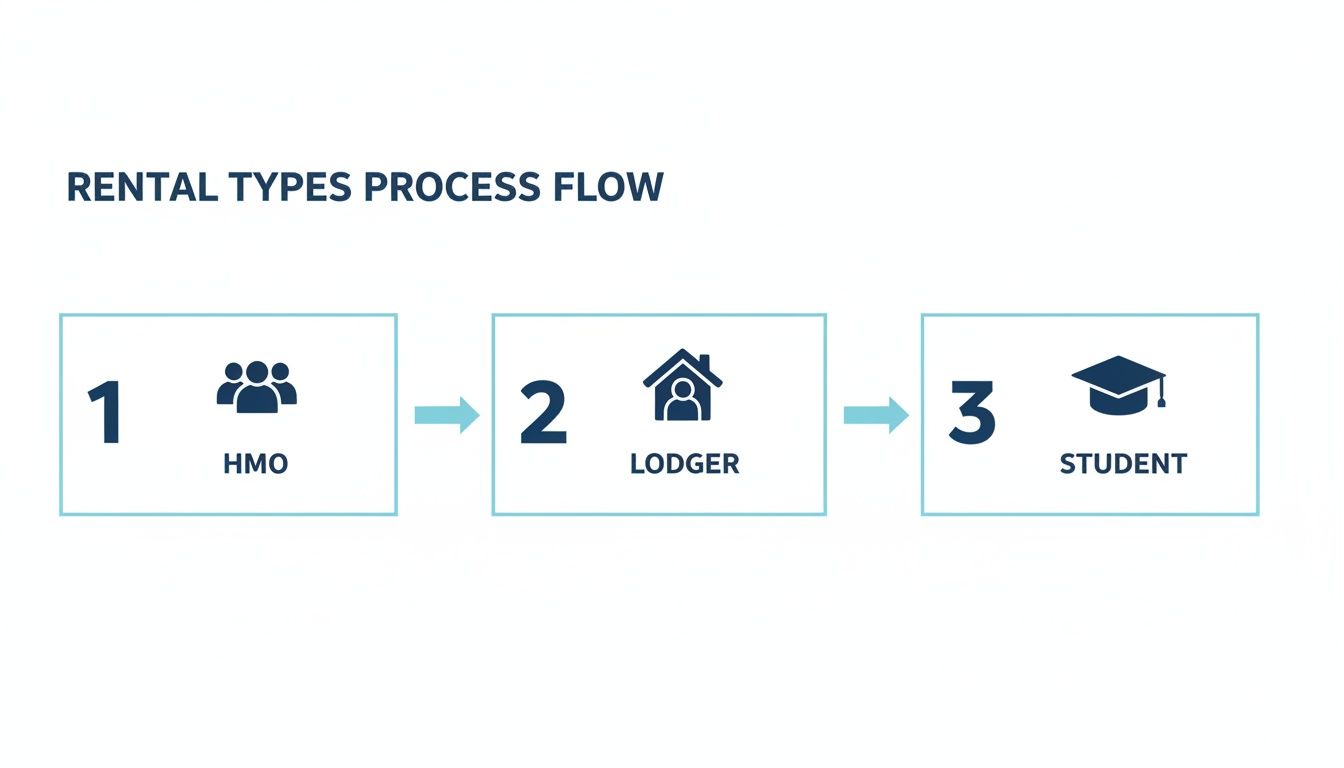
As you can see, the flexibility of a periodic tenancy makes it suitable for all sorts of living situations, but each one might need a slightly different touch when it comes to management.
Key Procedures for Landlords
To keep everything running smoothly, there are two critical processes you need to master: how to increase the rent and how to end the tenancy. A misstep here can land you in legal trouble and cause significant delays.
Increasing Rent with a Section 13 Notice: During a periodic tenancy, you can generally only increase the rent once every 12 months. The proper way to do this is by serving a Section 13 notice, which gives the tenant at least one month's notice of the change. The new rent must be realistic and in line with what similar properties are going for locally.
Ending a Tenancy with a Section 21 or Section 8 Notice: If you need to regain possession of your property for any reason (a 'no-fault' eviction), you’ll serve a Section 21 notice, giving the tenant at least two months' notice. However, if the tenant has broken the terms of their agreement—for example, by falling into rent arrears—a Section 8 notice might be the better route, and it often comes with a shorter notice period.
Crucial Takeaway: Using the correct legal forms and sticking to the statutory notice periods isn’t optional. If you get it wrong, your notice could be invalid, and you'll have to start the whole process from scratch.
These procedures create a clear, legal framework for managing any changes that come up. For landlords looking to advertise their properties and find great tenants, you can register as a landlord and list your rooms for free. Mastering these steps is the key to managing your rental professionally, protecting your investment, and maintaining a fair and positive relationship with your tenants.
Common Questions About Periodic Tenancies
The world of periodic tenancies can feel a bit fuzzy, often leaving both landlords and tenants with a few lingering questions. To help you handle these flexible agreements with confidence, we’ve tackled some of the most common queries we come across.
Think of this as your go-to guide for those "what if" moments that pop up when you're dealing with a rolling contract.
Can a Landlord Refuse a Periodic Tenancy?
Yes, a landlord can prevent a statutory periodic tenancy from starting, but the key is to act before the original fixed term ends. The most straightforward way is to serve a valid Section 21 notice, giving the tenant at least two months' notice to leave by the end of the fixed term.
Alternatively, if both the landlord and tenant agree to sign a new fixed-term contract, this also stops a periodic tenancy from beginning. However, once that fixed term expires and the tenant pays rent for the next period—which the landlord accepts—a statutory periodic tenancy is automatically created. At that point, it’s too late to refuse.
What Happens to My Deposit?
Don’t worry, your tenancy deposit remains protected even when your agreement becomes periodic. The landlord has a legal duty to keep the deposit secured in a government-approved scheme for the entire time you live there, whether it's a fixed-term or a rolling tenancy.
All the original terms and conditions regarding the deposit simply carry over. This means the reasons a landlord can make deductions, like for rent arrears or damage to the property, stay exactly the same. When you eventually move out, the process for getting your deposit back follows the normal procedure.
Key Reminder: A periodic tenancy is a continuation, not a whole new agreement. All your original protections, including deposit security, roll over seamlessly from the fixed-term contract.
Can Agreement Terms Be Changed?
Changing the terms of a periodic tenancy is possible, but it has to be a two-way street. A landlord can't just decide to impose new rules, like adding a "no pets" clause if there wasn't one before. It requires agreement from both sides.
Any changes need to be consented to in writing, usually with a document called a tenancy addendum that both parties sign. The only major term a landlord can change without the tenant's direct agreement is the rent, and even then, they must follow the strict legal process of issuing a Section 13 notice.
For any other tricky situations or specific questions, it's always a good idea to get in touch for professional advice.