A joint tenancy agreement is simply a single contract that two or more people sign to rent a property together in the UK. Think of everyone on the agreement as being part of one team. This means all the tenants share equal rights to the property and, most importantly, equal responsibility for looking after it and paying the rent. It’s the go-to setup for most shared housing, from student digs to professional house shares.
The Foundations of a Joint Tenancy Agreement
Imagine a group of friends deciding to share a single Netflix account. They all sign up together, everyone gets full access, and the monthly bill is just one charge. If one person forgets to chip in their share, Netflix doesn’t chase them individually – they just want the full payment for the account to keep it active.
That’s pretty much how a joint tenancy works in the eyes of a landlord. All tenants are on one contract, making them a single, unified legal entity. This collective arrangement has some really significant consequences, both legally and practically, for everyone who signs on the dotted line.
Key Concepts You Need to Know
To get your head around a joint tenancy, you need to grasp two fundamental principles that dictate how it works, both day-to-day and if things go wrong.
Joint and Several Liability: This is the big one. It’s a legal term that means all tenants are responsible for the entire rent, both as a group (jointly) and as individuals (severally). If one housemate falls behind on their share, the landlord has the legal right to ask any of the other tenants for the full outstanding amount. It’s a safety net for landlords, but a huge point of trust for tenants.
Right of Survivorship: While this is more common when buying a property, it’s a defining feature. In property ownership, it means if one joint owner dies, their share automatically passes to the surviving owners, no matter what their will says. It highlights the all-in-together nature of a joint tenancy.
The power of these concepts makes a joint tenancy totally different from other ways of renting. It’s a cornerstone of the UK rental market, and not just in the private sector. In the UK social housing sector, 13% of new lettings were joint tenancies where the tenancy type was known. This just goes to show how common this shared approach to renting is. You can find out more about social housing statistics on the GOV.UK website.
At a Glance Comparing UK Tenancy Agreements
To figure out if a joint tenancy is the right fit for your situation, it’s really useful to see how it stacks up against the other common agreements. The main differences come down to how rent is paid, the flexibility tenants have to come and go, and who is ultimately on the hook for what.
Here's a quick comparison to help you see the key distinctions.
| Feature | Joint Tenancy Agreement | Tenancy in Common | Individual Tenancy (Room Let) |
|---|---|---|---|
| Contract Type | One single agreement for all tenants | Separate agreements defining shares | Individual contract for each tenant |
| Rent Liability | All tenants responsible for the total rent | Each tenant responsible for their share only | Each tenant responsible for their room's rent |
| Ownership | All tenants own 100% of the tenancy together | Tenants own distinct, separate shares | Tenant only has rights to their specific room |
| Ending Tenancy | One tenant's notice can end it for everyone | A tenant can end their own share's tenancy | One tenant can leave without affecting others |
Ultimately, the best agreement depends entirely on the relationship between the tenants and the level of security the landlord is looking for. A joint tenancy is built on trust, while individual tenancies offer more independence.
The Legal DNA of a Joint Tenancy: The Four Unities & Right of Survivorship
To really get to grips with a joint tenancy, you need to look under the bonnet at its legal engine. For a joint tenancy to even exist, it has to meet four specific conditions, known in the legal world as the four unities.
Think of them like the four legs of a table – if one is missing, the whole thing collapses. These principles ensure every tenant is on a perfectly equal footing, sharing the tenancy as a single, indivisible unit rather than as separate people with their own little chunks of ownership.
Let’s break down what this actually means when you’re signing on the dotted line.
What Are the Four Unities in Practice?
Imagine four friends—Alex, Ben, Chloe, and Dan—teaming up to rent a house. The single tenancy agreement they all sign is what creates these four unities, legally tying them together.
Unity of Possession: This one's the easiest to picture. It means every single tenant has the right to access and use the entire property. Alex can’t put a padlock on the living room door, and Chloe can't declare the kitchen a "Chloe-only zone" on weekends. Everyone has an equal and unrestricted right to every square inch of the home.
Unity of Interest: All tenants must have the exact same type of interest in the property, lasting for the same amount of time. In a typical rental, this means they’re all named as tenants on the same Assured Shorthold Tenancy (AST) for a 12-month fixed term. One person can’t have a longer lease or different rights than anyone else.
Unity of Title: This simply means all the joint tenants get their rights from the very same document. For renters, that document is the tenancy agreement itself. Alex, Ben, Chloe, and Dan all put their signatures on one contract with the landlord, which granted them their rights to live there.
Unity of Time: The tenancy for all joint tenants must kick off at the exact same moment. The four friends all started their tenancy on the 1st of September when their agreement went live. You couldn't have a situation where one friend's tenancy starts a month later under the same joint contract.
When these four conditions are met, they create a seamless, indivisible tenancy. It’s a subtle but crucial point: it’s not that each of the four friends owns 25% of the tenancy. Instead, all four of them collectively own 100% of it, together. This idea of collective ownership is what leads us to the most powerful feature of a joint tenancy.
The Right of Survivorship: What Happens When a Tenant Passes Away?
The single most defining—and legally powerful—consequence of a joint tenancy is the right of survivorship. While it’s especially important in property ownership, it has major implications for renters too.
In simple terms, the right of survivorship means that if one joint tenant dies, their interest in the tenancy automatically passes to the surviving joint tenants. It happens instantly, by operation of law, and completely bypasses anything written in a will.
Key Takeaway: The right of survivorship trumps a will. The last person standing becomes the sole owner of the tenancy, no matter what the deceased person’s will might say.
Let’s go back to our four friends. If Chloe were to pass away unexpectedly during the tenancy, her "share" wouldn't go to her family or an heir she named in her will. Instead, Alex, Ben, and Dan would instantly and automatically absorb her interest. The three of them would simply carry on as the legal joint tenants.
For a landlord, this provides certainty and a clear continuation of the tenancy with the remaining tenants. For tenants—especially partners or family members buying a home—it guarantees a smooth, automatic transfer of ownership without getting tangled up in the long and often expensive probate process. It’s the ultimate legal expression of "all for one, and one for all."
Understanding Joint and Several Liability
When you sign a joint tenancy agreement, you’re also signing up for one of its most critical legal features: joint and several liability. It might sound like complicated legal jargon, but the concept is actually pretty simple and has massive, real-world consequences for every single person on that contract.
Honestly, it's probably the most important clause for both landlords and tenants to get their heads around before anyone signs on the dotted line.
Think of it like this: you and your housemates go out for a big celebratory dinner. At the end of the meal, the waiter brings over a single bill for the whole table. As a group, you're all responsible for paying that bill (this is the ‘joint’ part).
But what if one friend suddenly decides to do a runner without paying their share? The restaurant doesn't really care. They can legally ask anyone else at the table to cover the entire remaining amount (that's the ‘several’ part).
This is exactly how joint and several liability works in a tenancy. The landlord is the restaurant, and the rent is the bill. Everyone on the agreement is collectively on the hook for the total rent and any damages, but the landlord can also chase any single tenant for the full amount if things go wrong.
What This Means in Practice for Tenants
This shared responsibility can create a huge financial risk if you haven't chosen your housemates wisely. If one person doesn't pay their portion of the rent, the landlord isn't required to chase them down individually. Instead, they have the legal right to demand the full outstanding amount from any of the other tenants.
Let's walk through a common scenario:
- The Problem: A tenant in a four-person house share loses their job and can't pay their £500 share of the £2,000 monthly rent.
- The Consequence: The landlord can legally pursue the other three tenants for the full £2,000. They don't just ask for the missing £500; they can demand the entire rent payment from any one of the remaining housemates.
- The Same Rule Applies to Damages: If one tenant causes £800 worth of damage and refuses to pay up, the landlord can simply deduct that full amount from the deposit. And since the deposit belongs to everyone collectively, you all lose out. If the deposit doesn't cover it, the landlord can seek the rest from any of you.
This collective responsibility really highlights how important trust is among housemates. You are, for all intents and purposes, financially tied to each other for the entire tenancy.
How Tenants Can Protect Themselves
Given the risks, it's a smart move for tenants to create their own internal rules to manage money and responsibilities. While this doesn't change your legal contract with the landlord, it can save a lot of arguments and fallouts down the line.
A separate roommate agreement is a brilliant tool for tenants in a joint tenancy. It’s a simple contract between yourselves that outlines how rent, bills, and other duties will be split. While the landlord can't enforce it, it's solid proof of your internal arrangements if a dispute ever ends up in small claims court.
You can create a straightforward document that covers:
- How much rent each person will pay.
- A clear breakdown of how utility bills will be divided and who pays them.
- Agreed-upon rules for cleaning, maintenance, and looking after shared spaces.
- A plan for what happens if someone needs to move out early.
Advice for Landlords Enforcing This Clause
For landlords, joint and several liability is a vital safety net. It provides a strong guarantee that the rent will be paid in full each month, even if one tenant's circumstances change. When someone defaults, you have a clear legal path to get the money you're owed without the hassle of chasing multiple people for small sums.
That said, good communication is everything. If rent arrears start to build up, it's always best to let all the tenants know what's happening right away. This transparency gives the group a chance to sort the problem out themselves before it escalates.
When an issue arises, send a written notice addressed to all named tenants. Gently remind them of their shared obligations under the agreement. This reinforces that the responsibility is collective and encourages them to find a solution together.
Comparing Joint Tenancies with Other Rental Agreements
Choosing the right rental agreement can feel like navigating a maze. Each path comes with different rules, responsibilities, and outcomes for both landlords and tenants. The decision between signing everyone onto a single joint contract or using multiple individual ones isn't just about paperwork—it fundamentally changes the entire landlord-tenant relationship.
To cut through the confusion, let's put a joint tenancy agreement head-to-head with the two other most common setups in shared living: individual tenancies (often called room-let agreements) and lodger agreements. Getting your head around these distinctions is the key to protecting your interests, whether you're letting out a property or finding a new place to call home.
Joint Tenancy vs. Individual Tenancy
The most popular alternative to a joint tenancy, especially in a House in Multiple Occupation (HMO), is the individual tenancy.
Let’s imagine a group of four young professionals wanting to rent a four-bedroom house. The landlord has two main ways to play it:
Option 1: The Joint Tenancy: The landlord issues one Assured Shorthold Tenancy (AST) that all four tenants sign. They're now treated as a single unit in the eyes of the law, sharing responsibility for the entire property and the total rent.
Option 2: The Individual Tenancy: The landlord gives each professional their own separate AST for their specific bedroom, plus shared access to common areas like the kitchen and living room. Here, each person is only responsible for their own portion of the rent.
This choice has massive real-world consequences. For instance, if one tenant in the individual tenancy setup stops paying their rent, it becomes the landlord's problem to chase. The other tenants have no legal obligation to cover the shortfall.
But under a joint tenancy? Thanks to 'joint and several liability', the remaining housemates would be legally on the hook for the missing rent.
When you're dealing with certain rental arrangements, particularly a licensed HMO, fully understanding the knock-on effects of each tenancy type is vital for both compliance and smooth management.
A Landlord's Take: A joint tenancy offers a bigger financial safety net, as the risk of someone not paying is spread across the whole group. On the other hand, individual tenancies offer more flexibility. One tenant can move out at the end of their term without disrupting the others, making it much easier to manage the natural turnover of tenants.
Joint Tenancy vs. Lodger Agreement
Another very common setup, especially for homeowners letting out a spare room, is a lodger agreement. This is a completely different beast from a tenancy and offers far fewer protections for the person moving in.
A person is considered a lodger if they rent a room in their landlord's main home and share living spaces like the kitchen or bathroom with them. The landlord must live in the property.
The differences are stark:
- Legal Status: Tenants have ‘exclusive possession’ of their space and are protected by housing laws. Lodgers are simply ‘licensees’—they only have permission to be there, which gives the live-in landlord much more control.
- Eviction: A landlord must go through a formal court process to evict a tenant. To remove a lodger, a landlord just needs to give 'reasonable notice' (usually the length of a rental period, like one month) and doesn't need a court order.
- Deposit Protection: By law, landlords must protect a tenant's deposit in a government-approved scheme. This legal safety net doesn't apply to lodger agreements.
This distinction is crucial. A group of friends renting a whole house from a landlord who lives elsewhere are tenants. A single person renting a spare room from the homeowner they live with is a lodger.
Choosing Your Tenancy Type: Key Differences
To see these differences at a glance, this table breaks down the core aspects of each agreement and how they play out in the real world.
| Aspect | Joint Tenancy | Individual Tenancy (HMO) | Lodger Agreement |
|---|---|---|---|
| The Contract | One single agreement that everyone signs. | A separate agreement for each individual tenant. | A simple licence agreement, not a formal tenancy. |
| Rent Liability | All tenants are responsible for the total rent, together. | Each tenant is only responsible for their own room's rent. | The lodger is only responsible for their room's rent. |
| Ending the Agreement | Notice from just one tenant can end the agreement for everyone. | One tenant can leave without affecting the others. | The landlord can end it with 'reasonable notice'. |
| Landlord Access | Landlord must give 24 hours' notice before entering. | Same notice required for communal areas and individual rooms. | Landlord can enter the room without prior notice. |
| Deposit Protection | Mandatory protection in a government scheme. | Mandatory for each separate deposit. | Not legally required. |
So, what's the verdict? It all comes down to the situation. For a tight-knit group of students or professionals who already know and trust each other, a joint tenancy is often the simplest and most cost-effective solution. For a landlord managing a property with tenants who are strangers to one another, individual tenancies provide far better control. And for a homeowner with a spare room, a lodger agreement offers maximum flexibility and peace of mind.
How to Create and End a Joint Tenancy
Knowing how to properly kick off and wrap up a joint tenancy is crucial for everyone involved. For both landlords and tenants, getting the roadmap clear from the very beginning helps avoid arguments down the line, and understanding the rules for ending the agreement ensures a smooth exit when it’s time to move on.
The whole process is about more than just getting a signature on a document; it’s about setting clear expectations and putting legal safeguards in place. And when it comes to leaving, it’s not always as simple as packing your bags, especially when several people’s commitments are tied together.
Setting Up a Watertight Joint Tenancy Agreement
A solid joint tenancy agreement is the bedrock of a successful houseshare. The aim is to create a clear, legally-sound document that doesn't leave any room for guesswork. A well-written agreement not only protects the landlord's property but also gives all the tenants a crystal-clear picture of their shared responsibilities.
For landlords, using a professionally drafted Assured Shorthold Tenancy (AST) agreement is non-negotiable. While you can find templates online, it's vital to make sure they're up to date with the latest UK housing laws. The contract must explicitly state that it's a ‘joint tenancy’ and contain a few key clauses to be effective.
Here’s what it absolutely must include:
- Full Names of All Tenants: Every single person living in the property as a joint tenant has to be named on the one agreement.
- Property Address: The full, correct address of the rental property.
- Tenancy Term: Clear start and end dates for the fixed term (e.g., 12 months).
- Total Rent Amount: The total monthly rent for the property as a whole, not broken down into individual shares.
- Deposit Information: The total deposit paid and the details of the government-approved scheme where it’s being protected.
- Joint and Several Liability Clause: This is the big one. This clause confirms that all tenants are responsible together, and individually, for the entire rent and any damages.
Trying to figure out the best setup for your tenants? This decision tree can help you visualise whether a joint tenancy for a group or individual agreements for separate renters is the way to go.
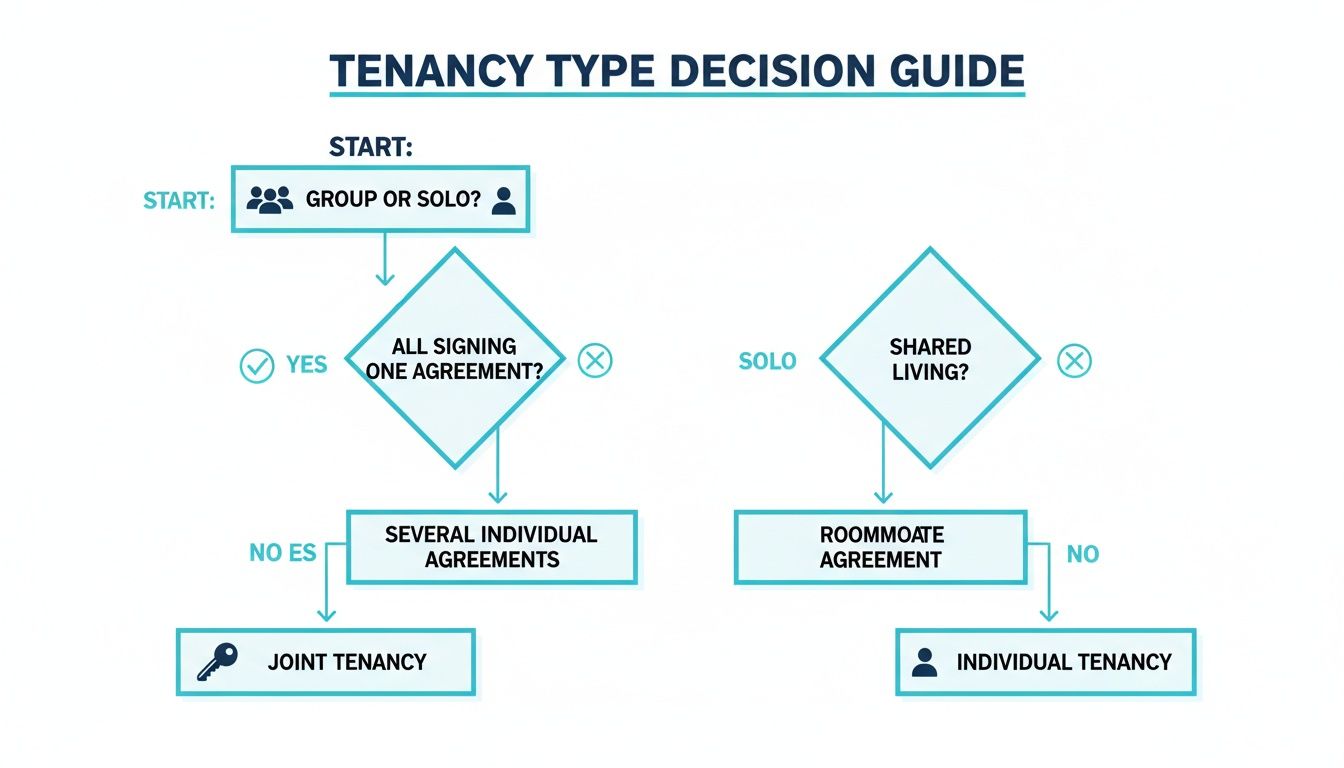
As the flowchart shows, if you're letting to a group of friends who are moving in together, a joint agreement is usually the most straightforward option. It simplifies everything from rent collection to assigning responsibility.
Navigating the End of a Joint Tenancy
A joint tenancy can come to an end in a few different ways, and the process changes depending on whether everyone is leaving at once or just one person wants out. This is where the ‘all for one, one for all’ nature of the agreement really shows its teeth.
If all tenants want to leave at the end of the fixed term, it’s pretty simple. They just need to give the landlord the notice period stated in their agreement (usually one month). Once that period is up and they’ve moved out, the tenancy is officially over.
Things get a lot trickier when only one tenant decides to leave.
A ‘Notice to Quit’ from a single joint tenant is legally powerful enough to end the entire tenancy for everyone. This applies once the fixed term is over and the tenancy rolls into a periodic (month-to-month) one. It’s a detail that catches many tenants by surprise.
When one person serves notice, the landlord can legally expect all tenants to leave the property when the notice period ends. The remaining tenants have no automatic right to stay. If they want to continue living there, they’ll have to try and negotiate a completely new tenancy agreement with the landlord, who has no obligation to agree to it. For landlords wanting to stay on top of their properties, our platform can help you find your next reliable tenants. You can get started when you register as a landlord with Rooms For Let.
If tenants breach the agreement—by not paying rent, for instance—the landlord can start eviction proceedings. This means serving a Section 8 or Section 21 notice, which must be addressed to all named tenants, and then following the correct legal process through the courts if they don't leave.
Making a Joint Tenancy Work in the Real World
Knowing the legal theory behind a joint tenancy is one thing, but making it run smoothly day-to-day is another challenge entirely. Success really boils down to two things: clear communication and proactive management from everyone involved. Putting some simple, practical systems in place from the start is the best way to head off common arguments over bills, cleaning rotas, and missed messages.
For landlords, a happy joint tenancy begins with smart vetting. You’re not just assessing a handful of individuals; you're trying to get a feel for their group dynamic. Have they lived together before? What’s their plan for splitting bills and chores? Asking these kinds of questions upfront can tell you a lot about how reliable they'll be as a single unit.
For tenants, it’s crucial to remember you’re essentially entering a financial partnership. You should choose your housemates with the same care you’d use for a business partner. Trust, reliability, and an ability to talk things through are absolutely non-negotiable.
Tips for Landlords
Managing a group of people under a single contract is a bit different from dealing with a solo tenant. The key is to streamline your processes to avoid confusion and make sure everyone is on the same page. A few simple tactics can make all the difference.
- Appoint a Lead Tenant: While all tenants are still legally on the hook, asking the group to nominate one person as the main point of contact for routine stuff can simplify your life immensely. It stops you from getting five different texts about a leaky tap.
- Handle the Deposit Correctly: You’ll be taking a single deposit for the entire tenancy. This must be protected in a government-approved tenancy deposit scheme, with all the tenants’ names listed. When the tenancy ends, you return the deposit as one lump sum and leave it to them to figure out who gets what.
- Be Firm on Tenant Changes: If one person wants to leave part-way through the tenancy, you need a clear and consistent process. To make the change official and legally sound, a new tenancy agreement (often a 'deed of assignment') must be drawn up and signed by everyone—the remaining tenants, the departing tenant, and the new person moving in.
Guidance for Tenants
Living together happily under a joint tenancy is all about organisation and mutual respect. The biggest rows are rarely about the legal contract itself; they’re about the everyday grind of sharing a home and splitting costs. Your best weapon against future fallouts is a roommate agreement.
A roommate agreement is a private contract just between the tenants that sets out the 'house rules.' It can cover everything from how bills are split and when they get paid, to establishing a cleaning rota and setting boundaries for guests or noise. While it isn't legally binding on your landlord, it's a vital tool for keeping the peace.
Before you sign anything, it’s absolutely essential that everyone understands what they’re committing to. To make sure you’ve caught all the important details in the tenancy agreement, it’s worth looking into tips for Mastering Contract Review to avoid nasty surprises down the line. This simple step ensures everyone is clear on their responsibilities from day one.
And if you’re at the beginning of this journey, looking for the right people to share with or a room in an existing houseshare, you can browse listings or post an ad on our Rooms For Let wanted section.
Frequently Asked Questions
When you're dealing with shared living, the theory of a joint tenancy agreement can sometimes clash with the messiness of real life. It’s only natural for questions to pop up. Here are our answers to some of the most common queries we get from landlords and tenants across the UK.
What Happens If One Tenant Wants to Leave During the Fixed Term?
This is a classic house-sharing dilemma. If one tenant wants to move out before the fixed term is over, things can get a bit tricky for everyone involved. Legally speaking, they are still tied to that contract until it ends or a suitable replacement is found and agreed upon. They can’t just pack their bags, give notice, and disappear from the agreement.
The best and most common way forward is to find a new tenant who everyone—the landlord and the remaining housemates—is happy with. To make it all official, this usually involves a deed of assignment. This is a legal document that formally transfers the outgoing tenant's responsibilities to the newcomer, effectively removing them from the contract for good.
Can a Landlord Add a New Tenant to an Existing Agreement?
Yes, but it's not a unilateral decision. A landlord can bring a new person into the house, but only with the full consent of all existing tenants. To do it properly, a brand-new tenancy agreement needs to be drafted that includes the new tenant's name. This ensures everyone is on the same legal footing and bound by the same terms.
It's so important to handle this formally. Just letting someone new move in and start paying rent without updating the paperwork creates a legal grey area that can cause huge headaches for everyone down the line.
How Does a Joint Tenancy Affect My Council Tax?
Under a joint tenancy, everyone is responsible for the council tax bill. This is another area where joint and several liability comes into play. It means the local council has the right to chase any single tenant for the full amount if the bill isn't paid. You can learn more about managing shared responsibilities by exploring our other guides on the Rooms For Let blog.
Finding the right tenants or the perfect room is the first step to a successful tenancy. Rooms For Let makes it easy to advertise your spare room or find your next home in a shared property across the UK. Join thousands of landlords and tenants today at https://www.roomsforlet.co.uk.