Moving into a shared house is one of life's great experiences, but sorting out how to split the bills can quickly turn harmony into hassle. The process boils down to four simple steps: choosing a fair method, setting up a payment system, communicating openly, and obtaining your agreement in writing. Nailing this from day one saves a world of stress and keeps the peace.
Why You Need a Bill Splitting Plan Today
Figuring out who pays for what isn't just a bit of admin; it's the very foundation of a happy houseshare. When you move in with friends, your partner, or people you've just met, unspoken ideas about money can quickly fester into resentment and awkward stand-offs. A clear, agreed-upon plan gets rid of all that guesswork.
So many people fall into the "we'll just figure it out as we go" trap. This casual approach usually crumbles the first time a massive winter energy bill lands on the doormat, or when one person starts to feel they're paying more than their fair share. Arguments over money are one of the biggest causes of conflict in shared homes, but they are almost entirely avoidable.
The Perks of Getting Organised
Taking an hour at the start of your tenancy to decide on a system will save you countless hours of stress down the line. It just makes sure everyone is on the same page and, crucially, feels the setup is fair.
A structured approach has some huge advantages:
- Transparency: Everyone knows exactly what they owe and when it's due. This builds trust and accountability.
- Fairness: By chatting about the options upfront, you can pick a system that feels right for everyone, whether that's splitting everything equally or basing it on room size.
- Conflict Prevention: A proper plan means no more guessing games, which dramatically cuts the risk of arguments over cash.
- Financial Predictability: Housemates can budget their own money far better when they know roughly what their monthly bills will be.
The goal isn't just about paying the bills on time—it's about keeping a great relationship with the people you live with. A good system makes money a simple transaction, not a source of tension.
First Steps in Organising Your Bills
Before you start getting lost in spreadsheets or downloading apps, kick things off with a simple house meeting. This first chat sets the tone for open and honest communication for the rest of your tenancy. Talk about your financial habits, what you expect, and any worries you might have. For example, if one of you works from home full-time, they might be happy to chip in a bit more for the electricity and gas.
Once you’ve had that initial conversation, it's time to look at the different ways to actually divide the costs. To help you get started, we've put together a simple comparison table outlining the most common methods used in UK house shares. This gives you a quick overview of which approach might be the best fit for your household.
For more tips on managing every aspect of your tenancy, you can explore other guides on the Rooms for Let blog.
Quick Comparison of Bill Splitting Methods
Here’s a quick rundown of the most common ways to divide household bills, along with their pros, cons, and who they’re best suited for.
| Method | How It Works | Best For | Potential Pitfall |
|---|---|---|---|
| Equal Split | The total of all bills is divided equally among all housemates. | Households where everyone has similar incomes and usage patterns. | Can feel unfair if one person uses significantly more resources. |
| Per Room | Bills are divided based on room size or desirability, with larger rooms paying a higher share. | Properties with rooms of varying sizes, especially master bedrooms with en-suites. | Can be complicated to assign fair percentages to each room. |
| Usage-Based | Utilities like electricity are tracked per person (e.g., using sub-meters). | Sharers with vastly different lifestyles (e.g., one works from home, another travels often). | Requires extra technology and effort to track individual consumption. |
Choosing the right method is all about finding a balance that everyone in the house feels is fair and reasonable. Take your time with this decision, as it will shape your financial relationship for the tenancy ahead.
Finding the Fairest Way to Divide Household Costs
Figuring out how to split the bills is often the most awkward chat you'll have when setting up a shared home. There's no single right answer; the best method is simply the one everyone agrees on. It’s not just about the maths, but about being fair to everyone’s financial situation, lifestyle, and even the size of their room.
This conversation is especially important in the UK, where soaring costs can quickly put a strain on any budget. For a typical three-bed houseshare, a monthly energy bill could easily hit £174, and that adds up fast. It's always a good idea to chat through the different ways of fairly splitting household bills before the first direct debit goes out.
The Straightforward Equal Split
This is the go-to method for a reason. It’s simple, clean, and keeps the admin to a minimum. You just add up all the shared monthly costs and divide the total by the number of people in the house.
An equal split works a treat when everyone's in a similar boat—think students or young professionals with comparable incomes, similar-sized rooms, and routines that don’t vary wildly.
- Worked Example: For a £174 energy bill shared between three housemates, the maths is easy.
- Calculation: £174 ÷ 3 housemates = £58 per person.
The trouble starts when lifestyles are very different. If one person works from home all week while another is barely there, the equal split can quickly feel unfair to the person using less.
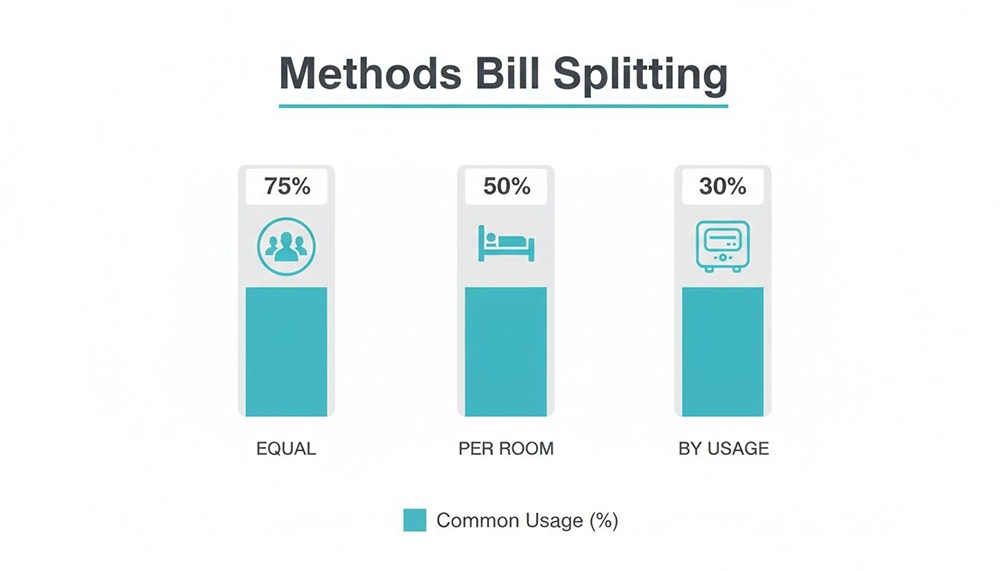
While the equal split is popular for its simplicity, other methods can create a much fairer outcome depending on your specific living situation.
The Logical Per-Room Division
What happens when one person has the massive master bedroom with an en-suite, and another is in the tiny box room? Splitting costs based on room size or quality can be a much better way to handle things. This approach simply acknowledges that not all space is created equal.
The idea is to assign a percentage of the bills to each room. The master bedroom might get 40% of the costs, a standard double 35%, and the small single 25%. This is common for rent, but it’s a great system for bills too, as long as everyone’s on board.
- Worked Example: With that £174 energy bill, the split would look something like this:
- Housemate A (Master Room): £174 x 40% = £69.60
- Housemate B (Double Room): £174 x 35% = £60.90
- Housemate C (Box Room): £174 x 25% = £43.50
You’ll need an honest, upfront chat to agree on the percentages, but doing it early can prevent resentment from building up later on.
The Granular Usage-Based Split
For bills like gas and electricity, splitting by usage is the most precise and arguably the fairest way to go. It's the perfect solution for households with very different schedules, like a mix of students who are out all day and professionals working from home.
Tracking individual usage takes a bit more effort, but it completely removes any arguments about who’s using more heating or leaving lights on. It’s the ultimate solution for fairness if your housemates have very different habits.
Putting this into practice can be as simple as agreeing on a higher share for the person who’s home most often. Or, you could get more technical with energy-monitoring smart plugs to track specific appliances.
- Worked Example: Let's say you agree the housemate working from home uses about 50% more energy. You can assign them a 1.5x share.
- Shares: Housemate A (1.5), Housemate B (1), Housemate C (1) = 3.5 total shares.
- Housemate A (WFH): (£174 ÷ 3.5) x 1.5 = £74.57
- Housemates B & C: (£174 ÷ 3.5) x 1 = £49.71 each
The Considerate Income-Proportional Method
In some homes, especially in big cities, there can be a big difference in what people earn. A recent graduate on an entry-level salary might be sharing with a senior manager. In this case, splitting bills based on income can make the house share more sustainable for the lower earner.
With this method, each housemate pays a percentage of the bills that mirrors their share of the total household income. This is a sensitive topic and requires a lot of trust and openness. But with bills being a significant chunk of anyone’s outgoings, it can be a really thoughtful approach.
Worked Example: For a £174 bill, imagine these different salaries:
- Housemate A: £50,000 salary
- Housemate B: £35,000 salary
- Housemate C: £25,000 salary
- Total Household Income: £110,000
Calculations:
- Housemate A's Share: (£50k ÷ £110k) = 45.5%. Payment = £174 x 45.5% = £79.17
- Housemate B's Share: (£35k ÷ £110k) = 31.8%. Payment = £174 x 31.8% = £55.33
- Housemate C's Share: (£25k ÷ £110k) = 22.7%. Payment = £174 x 22.7% = £39.50
Building a Modern System to Track and Pay Bills
Once you’ve settled on a fair way to divide costs, the next hurdle is purely practical: how do you actually manage the money? An agreed-upon method is useless without a reliable system to track who’s paid what and make sure bills are actually settled on time.
This is where you can move beyond awkward reminders and chasing people for cash. With a bit of initial setup, you can build a process that pretty much runs itself.
The Bill Administrator vs. The Joint Account
First, you need a central point for all the money to flow through. There are two main ways to tackle this, each with its own pros and cons.
Appointing one person as the bill administrator is a very common approach. This housemate puts all the utility accounts in their name, receives the bills, and is responsible for collecting everyone's share. It’s simple, but it places a huge amount of responsibility—and credit risk—on that one individual.
A joint household bank account, on the other hand, spreads the load. All housemates open a new account together, purely for bills. Everyone sets up a standing order to pay their share into this central pot, and all the household Direct Debits are paid from there.
Here’s a quick comparison to help you decide which is right for your house:
| Feature | Bill Administrator | Joint Household Account |
|---|---|---|
| Setup | Quick and simple; only one person needs to act. | Takes more effort, as all housemates need to open the account together. |
| Risk | High for the administrator, whose credit score is on the line. | Risk is shared, but it does create a financial link between housemates. |
| Transparency | Relies on the admin sharing bills and proof of payment. | Fully transparent; everyone can view the account's transactions online. |
| Best For | Short-term lets or houses with a clear ‘lead’ tenant. | Long-term house shares with a stable, trusting group of people. |
For many, a joint account feels like a more grown-up and equitable commitment. It ensures no single person is left chasing late payments or having to cover a shortfall if someone is slow to pay up.
Automate Everything for a Quiet Life
Whichever account setup you go for, automation is your best friend. The goal here is to minimise the monthly admin and completely eliminate those dreaded "have you paid me yet?" conversations.
The cornerstone of a peaceful bill-paying life is the standing order. Once set up, it’s a simple, recurring monthly payment from each person's personal bank account into the central bills pot.
First, calculate each person's monthly share based on your agreed splitting method. It’s a smart move to slightly overestimate to build a small buffer for fluctuating bills like gas and electricity. Then, each housemate should time their standing order to land a few days before the Direct Debits are due to go out.
Finally, ensure all household bills—energy, water, broadband, council tax—are paid by Direct Debit from the main account. This not only guarantees you’ll never miss a payment but can often unlock small discounts from suppliers, too.
This 'set it and forget it' method means the money moves automatically. The only job left is a quick monthly check-in to make sure the incoming payments cover the outgoing bills, and to adjust things if needed.
Using Apps to Manage Expenses and IOUs
While automation handles the big, recurring bills, what about the small, one-off costs? Think cleaning supplies, a shared takeaway, or that emergency bottle of milk. This is where modern bill-splitting apps come into their own, acting as a digital IOU ledger for your household.
To get a clear picture of how to divide different costs fairly, a shared expense calculator can be a great starting point, but dedicated apps make tracking these daily expenses effortless.
These apps are brilliant because they remove the awkwardness of asking for small amounts of money back. Instead of chasing someone for £3.50, you just log the expense and let the app do the nagging for you. Some of the most popular and effective options in the UK include:
- Splitwise: The classic choice for house shares. You can create a group for your household, add expenses as they happen, and see a running total of who owes whom. At the end of the month, its "Simplify Debts" feature works out the easiest way for everyone to settle up with the minimum number of payments.
- Splid: Praised for its clean interface and ability to work offline, Splid is another great option. You can add expenses in different currencies and export summaries to PDF or Excel files, which is perfect for a monthly review.
- Monzo: If you and your housemates already use Monzo, its built-in features are fantastic. You can easily split any payment with other Monzo users, create shared tabs for ongoing costs like a food shop, and get instant notifications when you've been paid back.
By combining an automated banking setup for the major bills with a user-friendly app for daily costs, you create a complete, stress-free system. This approach not only keeps your finances in order but also builds a foundation of trust and transparency, helping to keep your shared home a happy one.
For those just starting their search or looking to fill a room, getting registered as a tenant on platforms like Rooms For Let can be a great way to connect with like-minded people who understand the importance of a good house-sharing dynamic.
Getting to Grips with Every Essential UK Household Bill
Splitting the gas and electricity is one thing, but a truly stress-free houseshare needs a plan for every expense. Lots of these bills come with their own specific UK rules that can easily trip you up if you’re not prepared. Getting this stuff sorted from day one is your best defence against arguments and financial headaches later on.
And let's be honest, getting it wrong can cause real stress. With the cost of living as it is, nobody needs a surprise bill. Recent figures show that 21% of households in Great Britain couldn't cover an unexpected £850 expense, which just goes to show how tight things can be. In a shared house, an unfair or muddled bill system can quickly turn a happy home into a war zone. You can dive deeper into these financial resilience findings from Statista.
That’s why it’s so important to understand exactly what you’re dealing with when it comes to the big bills in a UK house share.
The Big One: Council Tax
Council Tax is often the largest and most confusing bill you'll face. Who’s actually responsible for paying it all comes down to your tenancy agreement.
- Joint Tenancy: If you all signed one tenancy agreement together, you are ‘jointly and severally liable’. In plain English, this means everyone is equally responsible for the entire bill. If one person bails on their share, the council can—and will—chase the rest of you for the full amount.
- House in Multiple Occupation (HMO): Things are different if you rent your room on an individual contract. In this setup, often found in a House in Multiple Occupation (HMO), the landlord is the one legally on the hook for the Council Tax. The cost is usually just rolled into your rent.
A common source of headaches is the student exemption. If everyone in the house is a full-time student, you can apply for a full exemption from Council Tax. But in a mixed household of students and non-students, the non-students are liable for the bill. They might, however, be able to claim a 25% single person discount.
Water Bills: Metered vs. Unmetered
In the UK, your water bill arrives in one of two ways, and that dictates the fairest way to split it.
Unmetered Water: This is a fixed annual fee based on your property's old ‘rateable value’. The cost is the same no matter how much water you use, so the easiest and most common-sense approach is to simply divide the bill equally between everyone living there.
Metered Water: If your home has a water meter, you pay for exactly what you use. This does open up the possibility of a usage-based split. If one housemate enjoys a daily 30-minute shower while another is a five-minute-and-out type, you could agree on different shares. In reality, though, most houseshares still opt for an equal split just to keep things simple.
Broadband and the TV Licence
These aren't quite like water and power, and they have their own quirks you need to agree on from the start.
The Broadband Contract
The internet contract will be in one person's name, and that person is legally tied to it. They're responsible for paying the bill every month for the whole contract, which is usually 18 or 24 months. This is a big commitment. If that person decides to move out, they are still stuck with the contract. It's vital to have a clear agreement on how this gets handled if someone leaves early.
The TV Licence Rules
The law around the TV Licence is very specific, and getting it wrong can lead to a hefty fine. You need a licence for the property to:
- Watch or record any live TV programmes on any channel or device.
- Watch or stream anything on BBC iPlayer.
If you're all on a joint tenancy, one licence covers the whole house. But—and this is a big but—if you're in an HMO on separate tenancy agreements, you might legally need your own licence for your room if you watch live TV in there. The responsibility is on the individual, so it's something you all need to be clear on to stay on the right side of the law.
How to Prevent Common Conflicts and Resolve Disputes

Even with the best spreadsheet in the world, disagreements over money can still bubble up in a shared home. The secret is to get ahead of them. By setting clear expectations from day one, you can stop most arguments before they even begin.
A simple chat when everyone first moves in can work wonders. This is your moment to talk through potential flashpoints, like how much heating is too much in winter, the policy on overnight guests, and what happens when someone eventually packs their bags. Never assume everyone has the same attitude to money; it's always better to talk it through.
Formalise Your Expectations with an Agreement
Honestly, the most effective way to head off disputes is to get it all down in writing. This doesn't need to be a dense legal document. A simple ‘Housemate Bill Agreement’ is a powerful tool for making sure everyone is on the same page.
Writing things down makes your verbal agreements official and gives you something to refer back to when memories get hazy. It forces you to think through all the little details of how you'll manage the bills, which often highlights potential issues early on. For landlords, offering a template for tenants can be a brilliant way to encourage a happy, functional household. You can find more guidance for landlords looking for responsible tenants on Rooms for Let.
Your agreement should clearly spell out:
- Chosen Splitting Method: State whether you're splitting everything equally, by room, by usage, or another method you've all agreed on.
- Payment Due Dates: Specify the exact date each month when money needs to be in the bill administrator's hands or the joint account.
- Late Payment Protocol: Decide what happens if a payment is late. Will it be a friendly reminder text, or maybe a small, symbolic late fee to discourage it from happening again?
- Moving Out Process: Detail how the final bills will be calculated and squared away when a housemate leaves.
A written agreement isn't about a lack of trust; it's about clarity. It turns unspoken assumptions into agreed-upon rules, which is the foundation of a respectful and conflict-free house share.
A Framework for Resolving Disagreements
When a conflict does pop up—and at some point, it probably will—how you handle it is everything. A calm, solution-focused conversation will get you much further than pointing fingers. If you need to bring up a late payment or a surprisingly high energy bill, take a moment to plan what you’re going to say.
The aim is to solve the problem together, not to win an argument. A successful chat should leave everyone feeling heard and respected, even if a compromise is needed.
Having the Awkward Money Chat
Approaching a housemate about a financial issue can feel incredibly awkward. The key is to stay calm, come prepared, and focus on finding a solution. Here’s a simple guide to make that conversation a lot less painful.
- Choose the Right Time and Place: Don't bring it up when someone's rushing out the door or clearly stressed. Ask if they have five minutes for a private chat in a neutral space, like the living room.
- Use 'I' Statements: This classic technique is brilliant for avoiding an accusatory tone. Instead of, "You're always late with the bill money," try something like, "I feel stressed when the bill money isn't in on time, as the account is in my name."
- State the Facts, Not Judgements: Stick to what you actually know. For example, "The energy bill was £50 higher this month, and I've noticed the heating has been on a lot more." This is far less confrontational than, "You're wasting all our money on heating."
- Listen to Their Perspective: Give them a proper chance to explain their side. There might be a reason you're not aware of, like a problem with their pay cheque or a simple misunderstanding of the rules.
- Focus on a Collaborative Solution: Work together to find an answer. The conversation should end with a clear, agreed-upon plan. For instance, "So, we agree that from now on, you'll set up a standing order for the 25th of each month?"
By following these steps, you can turn a potentially explosive confrontation into a constructive dialogue. This approach not only helps you figure out how to split bills without constant friction but also builds a more respectful and pleasant atmosphere in your shared home.
Common Questions About Splitting Bills Answered
Even the best-laid plans for splitting bills can hit a snag when it comes to the nitty-gritty of shared living. The unique landscape of UK houseshares and lodgings throws up specific scenarios that can leave you scratching your head.
Let's dive into some of the most common questions we see, to help you tackle these tricky situations and stop small misunderstandings from becoming major household dramas.
What Is the Fairest Way to Split Bills with a Live-In Landlord
If you're a lodger living in your landlord's home, simply splitting the bills 50/50 is rarely the right or fairest path. After all, your landlord owns the property and likely has more private space, so a straight division doesn't really reflect the reality of the situation.
A much more equitable approach is for you, as the lodger, to pay a fixed percentage of the utility bills. This figure typically lands somewhere between 30-40% and is intended to cover your personal usage as one person in a larger household.
- All-Inclusive Rent: A very popular and hassle-free option is to agree on a slightly higher, all-inclusive rent from the start. This neatly wraps your estimated share of bills into one simple monthly payment.
- Lifestyle Discussion: If your lifestyles are dramatically different—say, the landlord works from home full-time and you’re out at the office all day—it might be worth discussing a usage-based split, particularly for the energy bill.
Whatever you decide, the golden rule is to get it in writing. A clear clause in your lodger agreement removes all ambiguity down the line and protects both you and your landlord from potential disputes.
Who Is Responsible for Council Tax in an HMO
This is a critical question with a refreshingly simple answer. In a House in Multiple Occupation (HMO), the landlord is almost always the one legally responsible for paying the entire council tax bill.
An HMO is generally defined as a property rented out to at least three people who aren't from one ‘household’ (like a family) but share facilities like the kitchen and bathroom. The landlord simply factors this cost into the rent they charge for each individual room.
This is fundamentally different from a group of friends signing a ‘joint tenancy’ agreement for a whole property. In that common scenario, the tenants themselves are collectively responsible for making sure the council tax bill gets paid.
What Happens If a Housemate Leaves Without Paying
This is the nightmare scenario for many renters, and unfortunately, it does happen. Your level of protection comes down entirely to the systems you put in place from day one.
If you are all on a joint tenancy agreement, a legal principle called ‘joint and several liability’ kicks in. In simple terms, this means that if one person disappears leaving a debt, the remaining tenants are legally on the hook to cover the shortfall to the landlord or utility company. Your only option would be to chase the departed housemate for the money, which could mean going to the small claims court.
This is precisely why having one person as the "bill administrator" with all accounts in their name can be so precarious. If that's your setup, that single person is solely liable to the provider for the full amount. It’s a risk that really underscores the value of using a bill-splitting app to keep a clear, traceable record of who owes what, backed up by a signed housemate agreement.
Finding the right houseshare where everyone is on the same page about finances is the secret to a happy home. Rooms For Let has been connecting tenants, lodgers, and landlords across the UK since 2000, making it easier to find accommodation that fits your needs. Start your search or advertise your spare room today at https://www.roomsforlet.co.uk.