A tenant reference letter template is essentially a shortcut—a pre-made framework that helps landlords, employers, or even friends vouch for someone looking to rent. In the UK's competitive lettings market, these letters are the backbone of the decision-making process for landlords and agents. They're a vital tool for checking if an applicant is reliable, can afford the rent, and has behaved well in previous tenancies before anyone signs on the dotted line.
Understanding Tenant References and Why They Matter
Before you even think about using a template, it’s worth getting your head around what a tenant reference actually is and the role it plays today. At its heart, a reference letter is a form of risk assessment for the landlord. It gives them a crucial third-party view on whether an applicant is likely to pay rent on time, look after the property, and generally be a responsible resident.
In today's rental market, a strong set of references can easily be the one thing that makes a tenant stand out from the crowd and secure the home they want. For landlords, these documents are a cornerstone of the screening process, offering insights that a simple credit check just can't provide.
The Three Pillars of Tenant Referencing
Most thorough reference checks in the UK don't just rely on one letter; they combine three distinct types. Each one adds a different piece to the puzzle, giving the landlord a much clearer, well-rounded picture of the applicant.
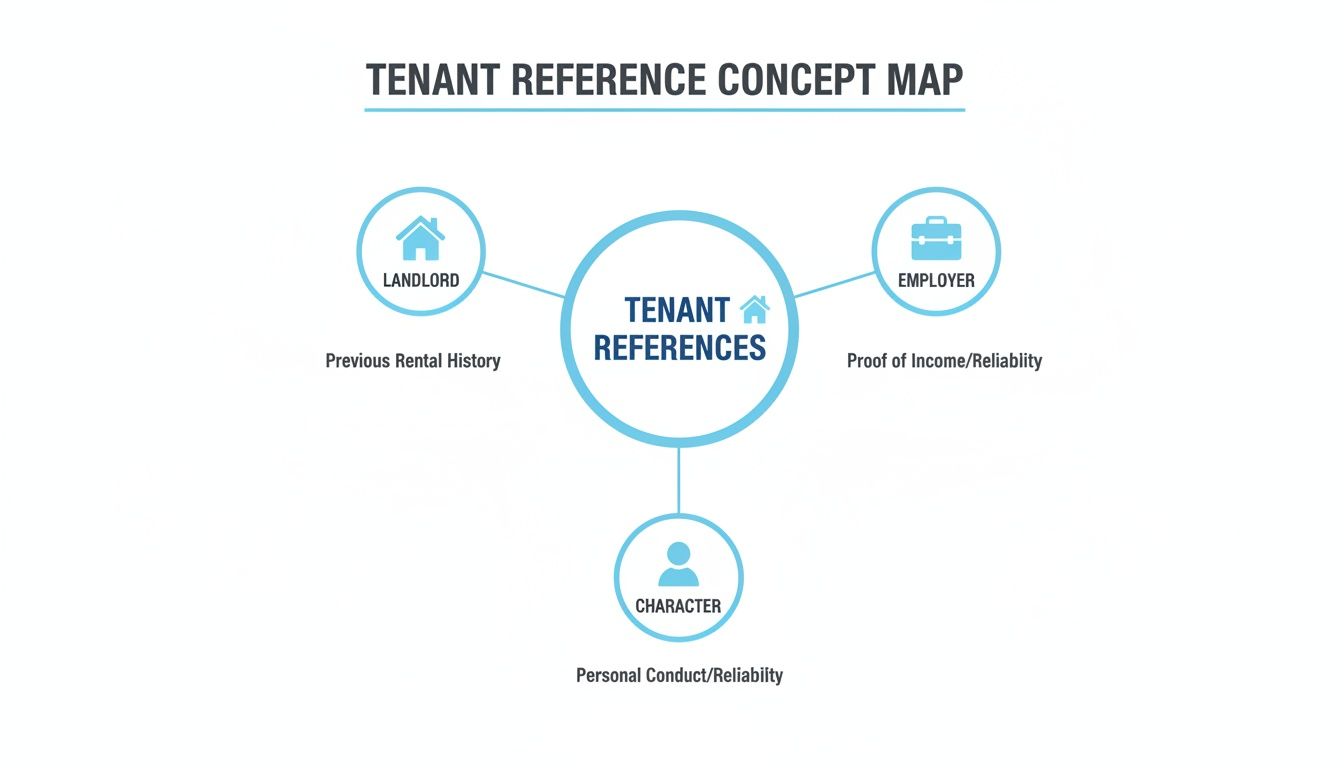
As you can see, a complete profile is built from landlord, employer, and character insights, with each one offering a unique and valuable perspective. Getting to grips with all three is the key to a robust screening process.
Here’s a quick breakdown of the main types you'll encounter.
A Quick Guide to Tenant Reference Types
This table breaks down the three core reference types, showing who provides them and what they're meant to achieve.
| Reference Type | Written By | Primary Purpose | Key Information |
|---|---|---|---|
| Landlord Reference | Previous or current landlord | To verify a tenant's rental history and conduct. | Timeliness of rent payments, property condition, adherence to tenancy terms. |
| Employer Reference | Current employer | To confirm financial stability and affordability. | Job title, employment status (full-time, contract), annual salary. |
| Character Reference | A person of good standing (not family) | To speak to the applicant's reliability and personal character. | Trustworthiness, responsibility, general conduct. |
Understanding these distinctions helps you know exactly what information to ask for—or provide—to build a complete and trustworthy picture of a potential tenant.
For landlords juggling multiple properties, using dedicated software for property managers can make a world of difference, helping to organise everything from the initial application right through to the final reference checks.
Key Takeaway: A tenant reference isn't just a box-ticking exercise; it’s a fundamental part of your due diligence. It helps landlords make informed, evidence-based decisions, massively reducing the risk of late rent, property damage, and the headache of potential eviction proceedings down the line.
The Legal and Practical Side of Things
While there's no strict legal duty for a private landlord in the UK to provide a tenant reference, refusing to do so can have serious practical consequences. In today's market, most letting agents and landlords see the absence of a reference as a major red flag, and it can stop a perfectly good tenant from securing a new home.
Ultimately, a well-written reference protects everyone involved. It helps landlords find reliable tenants and gives applicants a fair chance to prove they're a great choice. It sets the stage for a positive and successful tenancy from day one.
For more insights and practical advice, feel free to explore the other guides and articles on our blog.
Writing a Landlord Reference Letter That Gets It Right
When a good tenant asks you for a reference, you have a chance to help them secure their next home. But what does a new landlord actually want to see? They're not looking for vague praise; they need concrete facts that paint a clear picture of the tenancy.
This section will walk you through exactly how to write a reference that's helpful, professional, and legally sound. We’ll start with a ready-to-use template and then break down why each part matters, so you can provide a reference that works for everyone.
Your Ready-to-Use Landlord Reference Template
Here’s a clear, professional, and concise tenant reference letter template designed specifically for UK landlords. Just copy and paste it into a document and fill in the details in the brackets.
[Your Full Name]
[Your Address]
[Your Town/City, Postcode]
[Your Email Address]
[Your Phone Number]
[Date]
[Prospective Landlord's Name/Letting Agency Name]
[Prospective Landlord's/Agency's Address]
[Town/City, Postcode]
Subject: Tenancy Reference for [Tenant's Full Name]
To Whom It May Concern,
This letter is to provide a tenancy reference for [Tenant's Full Name], who resided at my property located at [Full Rental Property Address].
The tenancy commenced on [Start Date of Tenancy] and concluded on [End Date of Tenancy]. The monthly rent throughout this period was £[Amount].
During their tenancy, all rent payments were made promptly and in full. There is no outstanding balance on their account.
The property was returned in good condition at the end of the tenancy, with allowances for fair wear and tear. [Tenant's Full Name] was communicative regarding any minor maintenance issues that arose and adhered to all terms of the tenancy agreement.
Based on my experience, I would have no hesitation in recommending them as a tenant and would willingly rent to them again.
Should you require any further factual information, please do not hesitate to contact me using the details provided above.
Sincerely,
[Your Signature (if sending a hard copy)]
[Your Printed Name]
Landlord
Breaking Down the Template Section by Section
A strong reference is built on clarity and hard facts. Let’s look at why each part of that template is so important and how to fill it out effectively.
Your Contact Details and the Date
This might seem basic, but it’s the first step in establishing your credibility. A new landlord or agent may want to give you a quick call or drop you an email to verify the reference is genuine. Making sure your name, address, and contact info are all correct is essential.
The Subject Line
Letting agents are often juggling hundreds of applications at once. A simple, direct subject line like "Tenancy Reference for [Tenant's Full Name]" immediately tells them what the document is and who it's for, helping them process it quickly and efficiently.
Opening Statement and Tenancy Details
Your first paragraph needs to lock in three key facts right away:
- The tenant's full name.
- The full address of the property they rented.
- The exact start and end dates of their tenancy.
These details form the factual bedrock of your letter and confirm the specific period you’re qualified to comment on.
Rent Payment History
This is the big one. For any landlord, the main concern is financial risk. Is this applicant going to pay their rent on time? Your job is to answer that with clear, unambiguous language.
Pro Tip: Stick to the facts. A statement like, "Rent was consistently paid on time," is far more powerful than a vague opinion. If there were a couple of minor issues that were sorted quickly, be honest. You could say, "While there were two late payments, these were communicated in advance and settled promptly." Honesty is always the best policy.
Property Condition and Conduct
How a tenant looks after a property is another major worry for a landlord. Base your comments here on what you saw at your final check-out inspection. A standard but reassuring line is that they left the place in good condition, allowing for fair wear and tear. Mentioning they followed the rules of the tenancy agreement also adds serious weight to your reference.
The Final Recommendation
This is where you wrap it all up. A simple, conclusive statement like, "I would willingly rent to them again," is the strongest endorsement you can possibly give. It summarises your entire positive experience in one impactful sentence and can often be the final nudge a new landlord needs.
For landlords looking to streamline their processes, from finding tenants to managing paperwork, you can find a whole host of tools and tips when you register as a landlord with Rooms for Let.
While a landlord’s reference tells a story about a tenant's past, an employer’s reference is all about their present financial stability. For any landlord or letting agent, this letter is a critical piece of the affordability puzzle. It's the objective, verifiable proof that an applicant has a steady income and can comfortably cover the rent, month in, month out.

Unlike other types of references, this one needs to be completely free of personal opinion. Think of it as a simple statement of fact, usually from an HR manager or direct supervisor, that confirms the key details of someone's employment. The aim here is to be clear, concise, and professional, giving the landlord only what they need for the application.
Key Components of an Employer Reference
When you're putting this letter together, the focus is purely on the facts of employment. Anything more is not only unnecessary but could potentially complicate things.
A solid employer reference should always include these five points:
- Employee's Full Name: To clearly identify who the reference is for.
- Job Title: Confirms their role within the company.
- Employment Start Date: Establishes how long they've been with you, which indicates stability.
- Contract Type: Clarifies if the role is permanent, temporary, or a fixed-term contract.
- Annual Salary: This is the headline act – the single most important bit of information for affordability checks.
Stick to these basics, and you’ll provide exactly what’s needed without accidentally sharing sensitive or irrelevant personal data.
Important Note for Employers: Your role here is to confirm employment and income, that's it. Steer clear of commenting on the employee's character, their reliability outside of work, or whether you think they'd make a good tenant. Stick strictly to the verifiable facts of their employment with your company.
A Practical Employer Reference Letter Template
For busy HR managers and supervisors, this straightforward tenant reference letter template gets the job done efficiently. Just copy it onto official company letterhead and fill in the bracketed details.
[Your Company's Letterhead]
[Date]
[Letting Agency/Landlord Name] [Letting Agency/Landlord Address] [Town/City, Postcode]
Subject: Employment Reference for [Employee's Full Name]
To Whom It May Concern,
This letter is to confirm the employment details of [Employee's Full Name], who has been an employee at [Company Name] since [Employment Start Date].
We can confirm that their current job title is [Job Title]. Their employment contract is [Permanent / Fixed-Term / Temporary], and their current gross annual salary is £[Annual Salary].
This reference is provided at the request of the individual named above. The information is accurate to the best of our knowledge at the date of this letter.
If you require any further verification of these details, please do not hesitate to contact our HR department.
Sincerely,
[Your Signature]
[Your Printed Name] [Your Job Title] [Company Name]
Tips for Tenants Requesting an Employer Reference
How you ask for a reference can make all the difference to getting it quickly. To keep the process smooth, just follow these simple steps:
- Ask in Advance: Give your employer plenty of notice. HR departments are always juggling tasks, so a last-minute request is likely to cause delays. A week's notice is a good rule of thumb.
- Provide Clear Details: When you ask, be specific. Tell them exactly who the letter should be addressed to (the letting agent or landlord) and where it needs to be sent. This saves your employer a job and reduces the risk of mistakes.
- Explain What's Needed: It helps to politely mention that the reference just needs to confirm your job title, start date, contract type, and salary. This guides them to write a letter that’s fit for purpose.
Tenant referencing in the UK has moved on quite a bit, with digital tools like Open Banking now a common feature. The process will often involve your last three months of payslips alongside an employer’s letter to confirm everything. Open Banking can offer a much faster route, allowing tenants to securely share their income data directly from their bank. This simple step can cut down the paperwork by up to 50% and seriously speed up the whole timeline. You can explore more about how modern tenant referencing works and see how technology is changing the rental landscape.
Crafting a Powerful Character Reference Letter
Not every tenant can pull a reference from a previous landlord out of a hat. It’s a common scenario for students, recent graduates, or anyone renting for the first time in the UK. A landlord reference just isn't an option. This is exactly where a character reference steps in, bridging the gap by offering a personal testament to an applicant's reliability and good nature.

Unlike landlord or employer references that stick to rental history and financial facts, a character reference is all about personality, trustworthiness, and responsibility. It needs to come from someone who knows the applicant well—usually in a professional or academic setting—and can vouch for the qualities that make someone a dependable tenant.
Choosing the Right Person to Write Your Reference
The credibility of a character reference hangs entirely on who writes it. A letting agent will give far more weight to a letter from a respected professional than one from a close relative. The whole point is to find someone who can offer an objective, authoritative perspective.
So, who makes a good referee?
- A University Tutor or Professor: Absolutely ideal for students. They can comment on diligence, responsibility, and the all-important ability to meet deadlines.
- A Long-standing Colleague or Line Manager: Perfect for professionals, even if they aren't the official signatory for the company. They've seen the applicant's professionalism and reliability first-hand.
- A Mentor or Coach: This is anyone who has known the applicant in a structured, goal-oriented environment and can speak to their character.
On the other hand, some people should be avoided. Family members and close friends are almost always a poor choice. Their opinions are seen as inherently biased and just don't carry any professional weight.
Key Insight: The goal is to prove the applicant is a responsible adult, even if they don't have a rental history. A letter from a university tutor confirming a student was reliable and organised speaks volumes to a landlord.
What to Include in a Character Reference Letter
A truly compelling character reference does more than just throw around generic praise. It uses specific examples to paint a clear picture of a trustworthy individual. Instead of just saying someone is "responsible," a great reference shows how they are responsible.
For instance, a tutor might write, "During their final year project, they consistently demonstrated excellent time management, coordinating with their peers and submitting high-quality work well ahead of schedule." That’s far more impactful than a simple compliment.
An effective letter should always cover these points:
- Your Relationship: State clearly how you know the applicant and for how long. (e.g., "I was Sarah's personal tutor at the University of Manchester for three years.")
- Key Character Traits: Focus on qualities that are relevant to being a good tenant—think reliability, cleanliness, and respectfulness.
- Specific Examples: This is the most crucial part. Provide brief, concrete examples that back up your claims.
- A Clear Recommendation: Finish with a confident statement recommending them for the tenancy.
A Versatile Character Reference Letter Template
This tenant reference letter template is designed for anyone providing a character reference, from a tutor to a colleague. It provides a solid, professional structure for a persuasive letter.
[Your Full Name] [Your Professional Title/Role] [Your Address] [Your Town/City, Postcode] [Your Email Address] [Your Phone Number]
[Date]
[Letting Agency/Landlord Name] [Address] [Town/City, Postcode]
Subject: Character Reference for [Applicant's Full Name]
To Whom It May Concern,
I am writing to provide a character reference for [Applicant's Full Name]. I have known them for [Number] years in my capacity as their [Your Role, e.g., University Tutor, Line Manager] at [Institution/Company Name].
During our time working together, I have always known [Applicant's First Name] to be an exceptionally responsible and diligent individual. For example, [Provide a specific, brief example of their reliability, e.g., 'they were instrumental in organising a team project, ensuring all deadlines were met and the work was of a high standard.']
They are a considerate and respectful person who communicates clearly and works well with others. Based on my experience of their character and work ethic, I am confident they would be a reliable and conscientious tenant who would take great care of any property.
I have no hesitation in recommending them for a tenancy. Please feel free to contact me if you require any further information.
Sincerely,
[Your Signature]
[Your Printed Name]
Getting to Grips with UK Legal and Data Protection Rules
Providing a reference for a tenant isn't just a friendly favour; it comes with some serious legal responsibilities. The moment you start writing a landlord, employer, or character reference, you're handling someone's personal information. This immediately brings you under the watchful eye of UK data protection and anti-discrimination laws.
Getting this wrong can land you in hot water, so it’s vital to understand the rules of the road before you put pen to paper.
The core principle is pretty simple: be factual, fair, and compliant. This means you need to stick to verifiable information and steer well clear of subjective opinions, especially any negative ones you can't prove. A casual, off-the-cuff comment could be seen as defamatory, while any remarks touching on protected characteristics are strictly illegal.

GDPR and Why You Must Get Consent
The General Data Protection Regulation (GDPR) is the cornerstone of data privacy in the UK, and it applies here. When you give a reference, you are effectively a data controller, which means you're responsible for how you handle that tenant's personal data.
Your first and most critical step is to get the tenant's explicit consent before sharing anything. Don’t just take their word for it; get it in writing. An email from the tenant that clearly authorises you to provide a reference to a specific landlord or letting agency is perfect. Never, ever give out information without this permission.
Recent legislation has been tightening up the rental process, which puts an even greater emphasis on proper referencing. As part of a broader push to formalise landlord-tenant relationships, landlords now have stricter obligations around providing written information. You can read more about the ongoing changes and the implementation roadmap for renters' rights to see how the landscape is shifting.
Sidestepping Discrimination Pitfalls
The Equality Act 2010 is designed to protect people from discrimination, and its rules absolutely apply to reference writing. You must ensure your language is completely neutral and doesn't mention, or even hint at, any "protected characteristics".
Here's a list of what you must avoid mentioning at all costs:
- Age
- Disability
- Gender reassignment
- Marital or civil partnership status
- Pregnancy and maternity
- Race (including colour, nationality, or ethnic origins)
- Religion or belief
- Sex
- Sexual orientation
A comment like, "They were surprisingly quiet for a young couple," might seem innocent, but you've just linked their behaviour to their age. That could be seen as discriminatory. Just stick to the facts of their tenancy.
Crucial Takeaway: Think of your reference letter as a professional, factual document, not a personal review. Focus only on what you can prove: their rent payment history, the condition they left the property in, and whether they followed the tenancy agreement. This factual approach is your best legal shield.
How to Verify Reference Requests
So, an email lands in your inbox asking for a reference. How do you know the person asking is who they say they are? It's always wise to take a moment to check the request is legitimate before you send anything back. This is especially true if the request comes from a private landlord rather than a well-known letting agency.
A quick check can prevent you from accidentally causing a data breach. Here are a few simple things you can do:
- Ask the tenant to forward you the original email they received from the landlord or agent.
- Look up the letting agency online and call their main office number to confirm the person works there and the request is genuine.
- If it's a private landlord, ask the tenant to confirm the name and contact details match what they were given.
This little bit of due diligence ensures you’re only sharing the tenant's data with the right person, keeping you compliant with GDPR and protecting everyone's privacy. It’s a simple step that helps the tenant out without putting you at risk.
Your Tenant Reference Questions Answered
Even with the best templates, you might still have a few nagging questions about the whole reference process. It’s not always straightforward. This final section tackles some of the most common queries and tricky situations we see, for both tenants and the people writing their references.
Navigating the unwritten rules of reference requests can be a challenge, especially when things don’t go perfectly to plan. Let’s dive into the questions that come up time and time again.
What Should I Do If My Last Landlord Won't Give a Reference?
It’s a frustrating—and surprisingly common—scenario. Your previous landlord is unresponsive, uncooperative, or just flat-out refuses to provide a reference. While it's not ideal, it absolutely doesn't have to be a deal-breaker for your rental application.
The key is to get on the front foot. Be proactive and transparent with the new landlord or letting agent. Explain the situation honestly, and then immediately offer some solid alternatives to build a compelling case for yourself.
- A Strong Character Reference: This should be your first port of call. A glowing letter from a line manager, university tutor, or a long-standing colleague can speak volumes about your reliability and character.
- Extra Financial Proof: Don't be afraid to go beyond the standard requirements. You could offer to provide a few extra bank statements or even use an Open Banking service to give a real-time, verified snapshot of your income and spending habits.
- A Guarantor: This is often the most powerful solution. A guarantor—usually a UK homeowner—is someone who agrees to cover your rent if you can't pay. For a landlord, this provides a huge financial safety net, often making them much more comfortable moving forward without that previous landlord's letter.
By presenting these solutions, you show you're resourceful and serious about being a great tenant.
How Long Is a Tenant Reference Letter Valid?
There’s no strict legal expiry date, but in the real world, a reference letter’s relevance fades fast. Most UK landlords and letting agents will only consider a reference to be current for about one to three months, tops.
Think about it: the rental market moves quickly, and a person’s circumstances can change a lot in a short time. A reference from six months ago just doesn’t provide the up-to-date reassurance a landlord needs today. They want to know about your most recent tenancy, not your situation last year.
Our Advice for Tenants: Always aim to get fresh references for each new application. If you know you'll be moving soon, give your current landlord and employer a friendly heads-up. This ensures the information is timely and relevant, making your application as strong as possible.
Can I Write a Reference for a Friend or Family Member?
This is a very tricky one, and the short answer is almost always no—with one specific exception.
Writing a landlord or employer reference for a friend or family member is a major conflict of interest. Any savvy letting agent will see it as biased and unreliable, which completely undermines the point of getting an objective, third-party assessment.
The only time it might be acceptable is for a character reference, but you absolutely must disclose your relationship. For example, you could write, "I have known Sarah for 15 years as a close family friend..." Honesty is crucial.
Generally, it’s best to steer clear. A reference from a family friend, however well-intentioned, just doesn't carry the professional weight of one from a manager or previous landlord.
If you need a hand or have more questions about the lettings process, don't hesitate to get in touch with our team.
At Rooms For Let, we're dedicated to making the process of finding or letting a room as simple and effective as possible. Whether you're a landlord with a spare room or a tenant searching for your next home, our platform connects you with the right people across the UK. Explore thousands of listings or advertise your room for free today at https://www.roomsforlet.co.uk.