When you're a landlord in the UK, getting your head around gas safety isn't just good practice—it's a fundamental legal duty. The absolute core of this is the annual gas safety check, which results in what's officially known as a CP12, or the Landlord Gas Safety Certificate.
Think of it like a car's annual MOT. It's a non-negotiable inspection that you must arrange every 12 months for all gas appliances, flues, and pipework in your rental property. This isn't a recommendation; it's a legal requirement under the Gas Safety (Installation and Use) Regulations 1998, designed to keep your tenants safe from serious dangers like carbon monoxide poisoning.
Understanding Your Core Gas Safety Obligations
This duty applies to any landlord renting out a property with any kind of gas appliance, whether it’s a boiler, a gas hob, or a fireplace. The law is crystal clear on your responsibilities and the timelines you need to follow. The entire system is built to ensure every gas installation is maintained in a safe condition throughout the tenancy.
To help you stay compliant, here is a quick summary of what the law expects from you.
Your Legal Duties at a Glance
This table breaks down the fundamental legal requirements you need to follow for gas safety compliance in your rental properties.
| Requirement | What It Means for You | Legal Deadline |
|---|---|---|
| Annual Safety Check | You must arrange for a Gas Safe registered engineer to check every gas appliance and flue. | At least every 12 months. |
| Maintenance | All gas pipework, appliances, and flues must be kept in a safe and well-maintained condition. | Ongoing. |
| Record Keeping | Keep a copy of the gas safety certificate for at least two years. | Always. |
| Provide Certificate | Give a copy of the certificate to your existing tenants. | Within 28 days of the check. |
| Provide to New Tenants | Give a copy of the current certificate to new tenants before they move in. | Before their tenancy begins. |
Sticking to these rules is the bedrock of responsible and legal letting.
The Three Pillars of Gas Safety Compliance
To make sure you've got all your bases covered, it helps to think of your duties in three key areas. Getting any of these wrong can have serious repercussions, so it’s vital to nail each one.
- Annual Safety Checks: This is the cornerstone. Every single gas appliance and flue needs a thorough safety inspection once every 12 months. No exceptions.
- Maintenance: Beyond the check, you have an ongoing duty to keep everything in safe working order. This includes the pipework, the appliances themselves, and the flues. A crucial part of this is getting an annual boiler service, which ensures the boiler is not just safe but also running efficiently.
- Record Keeping: You must hold on to the record of each safety check for a minimum of two years. You're also legally required to give a copy to your tenants within 28 days of the inspection. For brand new tenants, they must have a copy of the latest certificate before they even move in.
The Serious Consequences of Non-Compliance
Let's be clear: UK authorities do not take gas safety failures lightly. The penalties for cutting corners are severe and are designed to be a powerful deterrent against landlord negligence.
Non-compliance can lead to hefty fines, could completely invalidate your landlord insurance, and in the worst-case scenarios, result in criminal charges and even prison time. It can also block you from legally serving a Section 21 eviction notice, which seriously restricts your ability to regain possession of your property.
The financial risks alone are staggering. Fines can hit £6,000 per property for landlords who skip their gas safety duties. On top of that, local authorities have the power to issue prohibition notices, which stop you from letting the property entirely. It’s easy to see why treating gas safety as a top priority is essential for protecting your tenants, your investment, and your freedom. You can learn more about the legal framework governing these penalties and see additional gas safety insights from experts at Efficient Home Energy.
Finding and Verifying a Gas Safe Engineer
When it comes to your gas safety checks, the law is crystal clear: you can’t just call any old plumber. The work absolutely must be carried out by a Gas Safe registered engineer. This isn’t a friendly suggestion or a bit of best practice advice—it's a strict legal requirement.
Think of the Gas Safe Register as the DVLA for gas engineers. It’s the one and only official list of professionals in the UK who are qualified and legally allowed to work on gas appliances. Being on this register proves they have the right training and competence to do the job safely.
Hiring someone who isn't on the register is a massive mistake. It's illegal, incredibly dangerous for your tenants, and will almost certainly invalidate your landlord insurance. The whole system is there for a reason: to prevent the terrible consequences of dodgy gas work.
How to Find a Qualified Engineer
Thankfully, finding a certified professional in your area is pretty straightforward. The best and safest place to start is the official Gas Safe Register website.
Here’s the simple process to follow:
- Visit the Official Register: Head over to the Gas Safe Register website and look for their "Find an Engineer" tool.
- Pop in Your Postcode: Just type in the property’s postcode, and you'll get a list of registered engineers and companies nearby.
- Check Their Specific Qualifications: This part is crucial. Just because an engineer is Gas Safe registered doesn't mean they're qualified for every type of gas appliance. You have to make sure their credentials cover the specific appliances in your rental, whether that's a gas boiler, a hob, or a fireplace. The register lists these qualifications clearly for each engineer.
Verifying an Engineer's Credentials
Once you've booked someone, or when they arrive at your property, you need to check who they are. Every single registered engineer carries a Gas Safe ID card, and it's your job to ask to see it.
Crucial Tip: Always, always ask to see their Gas Safe ID card. It should have their photo, an expiry date, and a unique 7-digit licence number. Flip it over, and you'll see a list of the exact types of gas work they are qualified to do.
You can double-check their details in a couple of seconds:
- Online Check: Jump back on the Gas Safe Register website and use the "Check an Engineer" tool. You can enter their 7-digit licence number from the card to confirm everything is legitimate.
- Check the Card Itself: Does the photo on the card match the person standing in your property? Is the card still in date? Most importantly, does the list on the back cover the work you need them to do?
Taking these simple steps isn't just about ticking boxes; it's a non-negotiable part of fulfilling your landlord gas safety certificate requirements and keeping your tenants safe. If you ever need help managing compliance across your properties, our team at Rooms For Let is here to help. You can get in touch with us directly for guidance.
What Happens During a Gas Safety Inspection
Ever wondered what a Gas Safe engineer actually does when they visit your property for the annual check? It’s far more than a quick glance at the boiler. The inspection is a meticulous, systematic process designed to confirm every part of your property's gas system is safe, compliant, and not putting your tenants at risk.
Understanding what the engineer is looking for helps you appreciate the value behind the certificate and reinforces why it’s such a critical part of your legal duties as a landlord. The whole process can be broken down into three core areas of focus, with the engineer methodically working through each one to build a complete picture of your installation's health.
The stakes are higher than you might think. A shocking report from the Gas Safe Register revealed that an estimated 20% of UK homes would fail a gas safety inspection if one were carried out today. This statistic really hammers home the importance of these annual checks for any rental property with gas appliances. You can read the full findings on gas safety compliance to get a sense of the scale of the issue.
Checking All Gas Appliances
The first and most visible part of the inspection covers the appliances themselves. The engineer will carefully assess every single gas appliance you provide for your tenants, from the central heating boiler to the gas hob in the kitchen.
They’ll be checking several key things:
- Correct Installation and Positioning: Is the appliance fitted securely? Is it located somewhere that allows for proper ventilation and safe operation?
- Operating Pressure: The engineer will test the gas pressure to make sure it’s within the manufacturer's specified range. This is crucial for both safety and efficiency.
- Safe Gas Combustion: They’ll check that the gas is burning cleanly. You want to see a crisp, blue flame – a lazy, yellow, or orange one is a major red flag for danger.
- Functionality of Safety Devices: Modern appliances have built-in safety mechanisms, like flame failure devices. These are tested to confirm they’ll correctly cut off the gas supply if a flame goes out.
This part of the check is all about confirming that the appliances aren't just working, but are working safely and exactly as the manufacturer designed them to.
Hiring the right professional is the first, most crucial step. This simple guide shows you the correct process for finding and verifying a Gas Safe registered engineer.
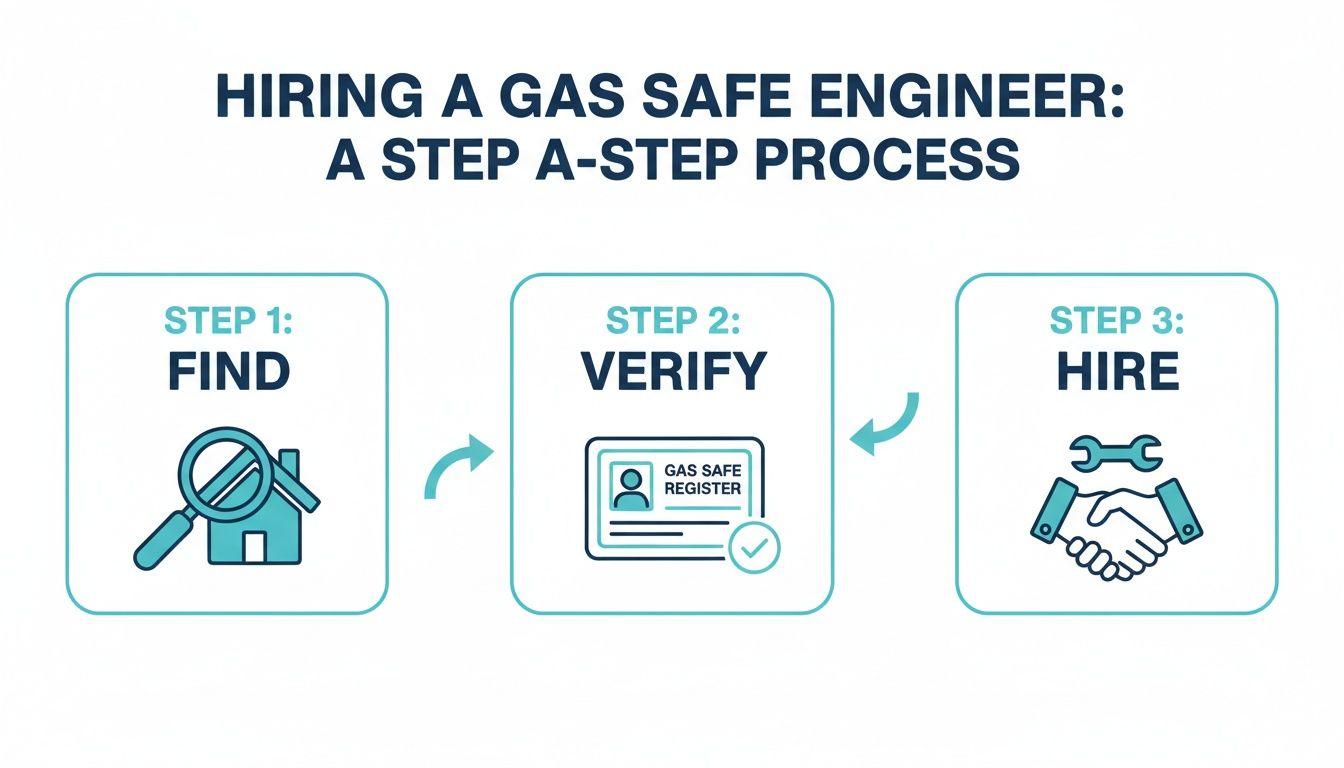
Following this sequence—Find, Verify, Hire—is a non-negotiable part of fulfilling your landlord gas safety certificate requirements.
Inspecting Flues and Chimneys
Just as vital as the appliance is how it gets rid of the waste fumes. A blocked or poorly installed flue is a silent killer, potentially leading to a deadly build-up of carbon monoxide inside the property.
During this stage, the engineer will:
- Visually Inspect the Flue: They’ll check the entire length of the flue or chimney for any blockages, physical damage, or general deterioration.
- Ensure Proper Ventilation: The engineer confirms there’s an adequate air supply for the appliance to burn gas safely and that essential air vents aren’t blocked.
- Conduct a Spillage Test: This clever test checks that harmful fumes are being safely drawn out to the outside world and not spilling back into the room.
An effective flue system is the silent protector of your property. It’s the escape route for invisible dangers, and its proper function is a non-negotiable part of the gas safety check.
Testing All Gas Pipework
Finally, the engineer will examine the integrity of the whole gas network. This involves checking all the accessible pipework for any potential leaks or defects.
To do this, they’ll perform a gas tightness test. This carefully controlled test pressurises the system to confirm there are absolutely no leaks anywhere, from the gas meter right through to each appliance.
Any drop in pressure during this test signals a leak, which must be pinpointed and repaired immediately. This final check ensures the entire gas installation within the property is secure and fit for purpose, giving both you and your tenants complete peace of mind.
Managing Your Gas Safety Records and Renewals
Getting that satisfactory Gas Safety Certificate is a great feeling, but your duties don't stop there. In fact, a huge part of the landlord gas safety certificate requirements is the ongoing management of these crucial records. It’s best to think of it not as a single task to tick off a list, but as a continuous cycle of keeping records, sharing them, and renewing them on time.
Staying organised isn't just good practice; it's essential for staying compliant and protecting yourself legally. The law is crystal clear about who gets a copy of the certificate and when. This is a non-negotiable part of being a responsible landlord and showing you take your tenants' safety seriously.
Record Keeping and Tenant Distribution Rules
Once the engineer has finished their inspection and handed you the certificate, you're legally required to manage it correctly. This boils down to two main jobs: storing it safely and making sure your tenants get a copy.
Here’s a simple breakdown of your obligations:
- Record Retention: You must hold onto a copy of every gas safety certificate for at least two years.
- Existing Tenants: For tenants already living in the property, you must give them a copy of the new certificate within 28 days of the check being done.
- New Tenants: Any new tenants moving in must be given a copy of the current, valid gas safety certificate before they officially move in.
Don't treat this as just admin. Failing to provide these documents on schedule can have some very real legal consequences. For example, you might find you're unable to legally serve a Section 21 eviction notice if you didn't sort this out right at the start of the tenancy.
To help you keep track, here is a simple checklist outlining the distribution and record-keeping rules.
Certificate Distribution and Record-Keeping Checklist
| Task | Who It Applies To | Mandatory Deadline |
|---|---|---|
| Provide Current Certificate | New Tenants | Before they move in |
| Provide New Certificate | Existing Tenants | Within 28 days of the gas safety check |
| Retain Certificate Copy | Landlord | Keep for a minimum of two years |
Following these timelines is a straightforward way to ensure you meet your legal duties and maintain a professional relationship with your tenants.
Staying on Top of Renewals
Missing a renewal date is one of the easiest traps for a landlord to fall into. Thankfully, the regulations have a bit of flexibility built in to help you stay compliant without causing a last-minute panic.
The system gives you a handy grace period. You can get a new gas safety check completed up to two months before your current one expires, without losing any time. It works just like getting your car's MOT done a little early. For instance, if your certificate is due to expire on 15th December, you can have the check done anytime from 16th October. The new certificate will still be valid until 15th December the following year.
This flexibility is incredibly useful. It gives you plenty of breathing room to schedule the inspection at a time that works for you, your engineer, and your tenants. For landlords looking to streamline their property management, you can register as a landlord with Rooms For Let to access more tools and resources.
To make sure you never miss those critical renewal dates, a legal deadline calculator can be a brilliant way to stay organised. Of course, many landlords also get by with simpler methods.
Consider these practical tips:
- Digital Calendar Alerts: Pop reminders in your digital calendar for each property. Set them for two months, one month, and two weeks before the expiry date.
- Property Management Software: If you're juggling multiple properties, specialised software often comes with automated reminders for all your compliance documents.
- Book in Advance: When your engineer finishes this year's check, ask them to pencil in next year's appointment on the spot. It's one less thing to worry about later.
The Real Risks of Non-Compliance
Failing to get your gas safety checks in order is one of the most serious missteps a landlord can make. The consequences aren't just a slap on the wrist; they pose a real threat to your tenants' lives, your financial health, and your future as a property investor.
Too many landlords still see the gas safety certificate as just another bit of admin. That’s a dangerous mistake. It’s a critical legal document, and not having one is treated with the utmost severity by the courts and local authorities—for very good reason.
The Heavy Financial and Legal Penalties
Let's talk numbers. Local authorities can hit you with fines of up to £6,000 for a single breach of the rules. Crucially, that’s per offence, not per property. If you have several issues across your portfolio, the costs can become catastrophic very quickly.
But the financial pain doesn't stop there. If your negligence leads to someone being injured, or worse, the Health and Safety Executive (HSE) can step in. We’re now talking about criminal prosecution, which could mean unlimited fines and, in the most serious cases, a prison sentence.
A landlord's duty of care isn't a passive tick-box exercise; it's an active, ongoing legal responsibility. Ignoring gas safety rules is seen by the courts as a profound failure of this duty, with consequences that can include imprisonment.
Suddenly, a simple compliance task has turned into a criminal matter that could change your life forever.
Invalidated Insurance and Personal Liability
Here’s a risk that often gets overlooked until it’s too late: your landlord insurance. Buried in the small print of virtually every policy is a clause stating that you must comply with all your legal obligations, including the Gas Safety (Installation and Use) Regulations 1998.
If a gas-related incident happens at your property—think a fire or an explosion—and you can't produce a valid, in-date gas safety certificate, your insurer will almost certainly refuse the claim.
You’d be left personally liable for everything. The full cost of repairs, damages to neighbouring properties, and compensation claims from injured tenants. This could easily run into hundreds of thousands of pounds, putting your entire investment and personal assets on the line.
Losing Your Right to Evict Tenants
Beyond the immediate financial and safety nightmare, getting this wrong can strip you of your fundamental rights as a landlord. One of the most critical is losing your ability to regain possession of your property using a Section 21 notice.
The rules are crystal clear: you must give new tenants a copy of the valid gas safety certificate at the very start of their tenancy. If you fail to do this, any Section 21 notice you serve later on could be ruled invalid.
This legal roadblock could leave you completely stuck, unable to evict a tenant even if you want to sell the property or move back in yourself. As the 2026 landlord compliance guide makes clear, failing to provide the CP12 and other essential documents before the tenancy begins can bring the eviction process to a grinding halt. You can read more about these crucial landlord compliance rules to get the full picture.
This ties compliance directly to your rights as a property owner, making it absolutely essential for protecting not just your tenants, but your investment too.
Gas Safety Rules for HMOs and Shared Homes
Managing a House in Multiple Occupation (HMO) or any shared rental property adds another layer of complexity to your standard landlord gas safety certificate requirements. While the core obligation for an annual check remains the same, the practicalities of getting it done can become a real headache. The presence of multiple, unrelated tenants means you have to be extra diligent.
The stakes are particularly high with HMOs. For many local authorities, a valid, current gas safety certificate is a non-negotiable condition for granting or renewing an HMO licence. A slip-up here doesn’t just put you in breach of gas safety regulations; it could lead to the council revoking your licence to operate, effectively shutting down your investment.
HMO Licence Conditions and Gas Safety
If you're a landlord of a licensable HMO, that gas safety certificate isn't just a piece of paper—it's a critical part of your permit to operate. When you apply for or renew an HMO licence, the local council will almost certainly ask to see your current gas safety record.
They need absolute assurance that the property is safe for a higher number of people living there. This means:
- Mandatory Submission: You'll very likely have to submit a copy of the certificate with your application.
- Ongoing Compliance: Your licence will come with a condition that you must maintain a valid gas safety record for the entire time the licence is active.
- Risk of Revocation: Failing to produce a certificate when asked or letting it expire can be grounds for the council to revoke your HMO licence. That's a severe penalty with serious long-term financial consequences.
Think of the gas safety certificate as the foundation of your HMO licence. If that foundation cracks, the whole structure is at risk.
The Practical Challenges of Shared Living
Beyond the licensing rules, managing gas safety in a shared home brings its own unique logistical hurdles. Trying to coordinate access with several tenants who all have different schedules can be tricky, but it's a challenge you simply have to meet to fulfil your legal duties.
Good communication is the key to navigating this. Just firing off a blanket email and hoping for the best probably won’t cut it. You need a clear strategy to ensure the inspection can go ahead smoothly without causing more disruption to your tenants than necessary.
A well-organised landlord sees these challenges coming. Proactive communication and clear scheduling turn a potential logistical nightmare into a smooth, professional process that shows tenants you respect their time and prioritise their safety.
Best Practices for HMO Compliance
To keep things running smoothly in a shared property, it pays to take a structured approach that puts clarity and organisation first. This helps prevent misunderstandings and ensures you have a clear paper trail if any issues ever pop up.
Effective Communication and Scheduling:
- Provide Ample Notice: Legally, you must give all tenants at least 24 hours' written notice of the inspection date and time. In practice, giving more notice—like a week—is always better and more considerate.
- Explain the 'Why': Briefly let them know that the check is a legal requirement for their own safety. This simple step helps get them on your side.
- Offer a Time Window: Work with your engineer to give a clear time slot (e.g., "between 1 pm and 3 pm") rather than a vague "sometime on Tuesday," which helps no one.
- Confirm Access Arrangements: Be crystal clear about how the engineer will get in. Will a tenant be home to let them in, or will you need to provide access with your management keys? Whatever you agree, get it documented in writing.
By treating the process with professionalism and clear communication, you can ensure your HMO remains a safe, compliant, and profitable investment.
Common Landlord Gas Safety Questions Answered
Even when you’ve got a good grip on the rules, real-world situations can throw up some tricky questions. Let's tackle some of the most common queries landlords have about their gas safety duties, so you can handle these scenarios with confidence.
What If a Tenant Refuses Access for a Safety Check?
This is a challenging spot to be in, but it happens more often than you might think. On one hand, your tenant has a right to the quiet enjoyment of their home. On the other, you have a non-negotiable legal duty to get that annual gas safety check done.
You can't legally force your way in, but you absolutely must show that you've made every reasonable effort to gain access.
Start by giving at least 24 hours' written notice for the inspection. If they refuse or don't respond, don't give up. Follow up with polite, written requests, perhaps offering a few different dates and times to show flexibility. The crucial part? Document everything. Keep a clear record of every letter, email, and text message sent. This paper trail is your legal defence, proving you did everything in your power to comply with the law.
Do I Need a Certificate If I Only Have One Lodger?
The rules around having a lodger (who is officially an 'excluded occupier') can sometimes feel a bit greyer than a formal tenancy. But while the specific regulations might be different, your fundamental duty of care isn't.
For your own peace of mind and the safety of everyone under your roof, you should absolutely get an annual gas safety check. It proves your appliances are safe and protects you from liability should the worst happen. Think of it less as a box-ticking exercise and more as essential best practice for any responsible homeowner sharing their space.
Is a Certificate Needed for Just a Gas Hob?
Yes, absolutely. This is a common point of confusion, but the law is crystal clear. The legal requirement for a landlord gas safety certificate is triggered if there is any gas appliance in the property that a tenant can use.
It makes no difference if your central heating is electric or oil-fired. That single gas hob means you have the full set of responsibilities under the regulations. The Gas Safe engineer will need to inspect the hob itself, all the pipework connected to it, and carry out a gas tightness test to make sure the entire installation is sound. There are no loopholes based on the number or type of appliances.
Key Takeaway: The presence of a single gas appliance makes the annual Gas Safety Certificate a mandatory legal requirement. The law does not distinguish between a single gas hob and a full gas central heating system.
How Much Does a Gas Safety Certificate Cost?
The cost for a Landlord Gas Safety Certificate isn't set in stone, but you can generally expect to pay somewhere in the region of £60 to £90.
Several things can influence the final price an engineer quotes you:
- Your Property's Location: As with many services, costs often vary between big cities and more rural parts of the country.
- Number of Appliances: It stands to reason that an engineer will charge more to inspect a boiler, a gas fire, and a hob than just a single appliance.
- Engineer's Rates: Independent engineers and larger national firms will naturally have different pricing.
It’s always a good idea to get a couple of quotes, but never let price be your only guide. Your first priority must be to verify their Gas Safe registration and make sure they’re qualified and reputable. After all, this is about safety, not just compliance. You can discover more helpful tips for landlords in our extensive blog section.
At Rooms For Let, we make it simple to find reliable tenants for your shared homes and HMOs. Advertise your spare room for free and connect with thousands of potential tenants across the UK by visiting Rooms For Let.