So, what exactly is a House in Multiple Occupation? You’ll see the term ‘HMO’ used a lot, and while it might sound like complicated legal jargon, the idea behind it is actually very simple.
Think of it as a professional house share. It’s a property rented out by at least three people who aren’t all from the same family but share common areas like the kitchen and bathroom. It’s an arrangement that comes with a specific set of legal rules landlords need to follow to keep everyone safe and comfortable.
Getting to Grips with the Term 'HMO'
At its heart, an HMO is just a property where a group of individuals who aren't related live together as their main home.
This type of housing is incredibly common all over the UK, especially in cities where students and young professionals need flexible and affordable places to live. They’re a vital part of the rental market. In fact, official statistics showed there were an estimated 472,823 HMO properties in England alone as of late 2025, which gives you an idea of just how widespread they are. You can dive deeper into the numbers by exploring more UK housing statistics.
The Two Simple Tests for an HMO
So, how do you know if a property is technically an HMO? It all comes down to two simple but crucial tests. It doesn’t matter if everyone is on one joint tenancy agreement or if each person has a separate contract for their own room.
- The Tenant Test: Are there at least three tenants living there?
- The Household Test: Do the tenants come from more than one 'household'?
That second point is the key. But what counts as a 'household'? Legally, it’s a broad definition. It covers members of the same family living together—parents, children, grandparents, siblings, aunts, uncles, cousins, and even step-relatives. A couple living together, whether they’re married or not, also counts as a single household.
Here’s an easy way to picture it: if three friends share a three-bedroom house, they are three separate households. That makes the property an HMO. But what if a couple and their friend live together? That’s two households, so the property is still an HMO.
Quick HMO Checklist: Does Your Property Qualify?
Not sure if your property fits the bill? Run through this quick checklist to see if it meets the basic definition of a House in Multiple Occupation.
| HMO Criteria | Yes/No | Explanation |
|---|---|---|
| Are there 3 or more tenants? | The property must be occupied by a minimum of three individuals. | |
| Do they form more than one 'household'? | Tenants must be from different family units (e.g., friends, not siblings). | |
| Do tenants share a kitchen, bathroom, or toilet? | The definition requires the sharing of one or more of these basic amenities. | |
| Is it the tenants' main residence? | The property must be their primary home, not temporary holiday accommodation. |
If you answered 'Yes' to all these questions, it's very likely you're dealing with an HMO. This means there are specific standards and potential licensing rules you'll need to get to grips with.
Navigating HMO Licensing Schemes Across the UK
Knowing what makes a property a House in Multiple Occupation (HMO) is the first step. The next, and arguably more complex, challenge is figuring out if it needs a licence. The UK’s system isn’t a simple, single set of rules; it’s a national framework with an extra layer of local council policies laid on top. For any landlord, getting this right isn’t just good practice—it's a legal necessity to avoid some truly eye-watering penalties.
The licensing world is split into two main camps. First, there’s Mandatory Licensing, which applies across the whole of England for larger properties. Then there’s Additional Licensing, a scheme that gives individual councils the authority to bring in stricter rules for their own patch. Which set of rules your property falls under depends entirely on its size, location, and the number of people living there.
Understanding Mandatory Licensing
Mandatory Licensing is the government's baseline requirement for large HMOs in England. It’s not something you can opt out of, and it applies no matter which council your property is in.
Your property needs a mandatory licence if it ticks all these boxes:
- It is occupied by five or more people.
- These occupants make up two or more separate households.
- They share facilities like a kitchen, bathroom, or toilet.
Think of it as the government's way of keeping a closer eye on bigger shared homes. A five-bedroom house shared by five unrelated professionals is the classic example of a property that falls squarely into this category. The landlord is legally required to apply to their local council for a licence, prove they are a 'fit and proper' person, and show the property meets all the necessary safety standards.
A mandatory licence is much more than just a certificate. It’s a legal stamp of approval from the council, confirming that a property is safe, well-managed, and suitable for the number of residents. Operating without one can lead to unlimited fines.
Demystifying Additional Licensing Schemes
This is where things can get a bit more confusing. Mandatory licensing has the big HMOs covered, but what about the smaller ones? That’s where Additional Licensing steps in. This scheme empowers local councils to demand that smaller HMOs—often those with just three or four tenants—also get a licence.
A council might decide to roll out an additional licensing scheme if it feels that a lot of smaller HMOs in a particular area are being poorly managed. For example, a town with a big university and lots of three-bed student houses might introduce one to keep living standards up for everyone.
Because these rules are set locally, they can vary wildly from one council to the next. One borough might have no additional scheme at all, while its next-door neighbour could require every single HMO, no matter the size, to be licensed.
This flowchart gives a simple visual guide to the basic questions that determine if your property is an HMO in the first place.
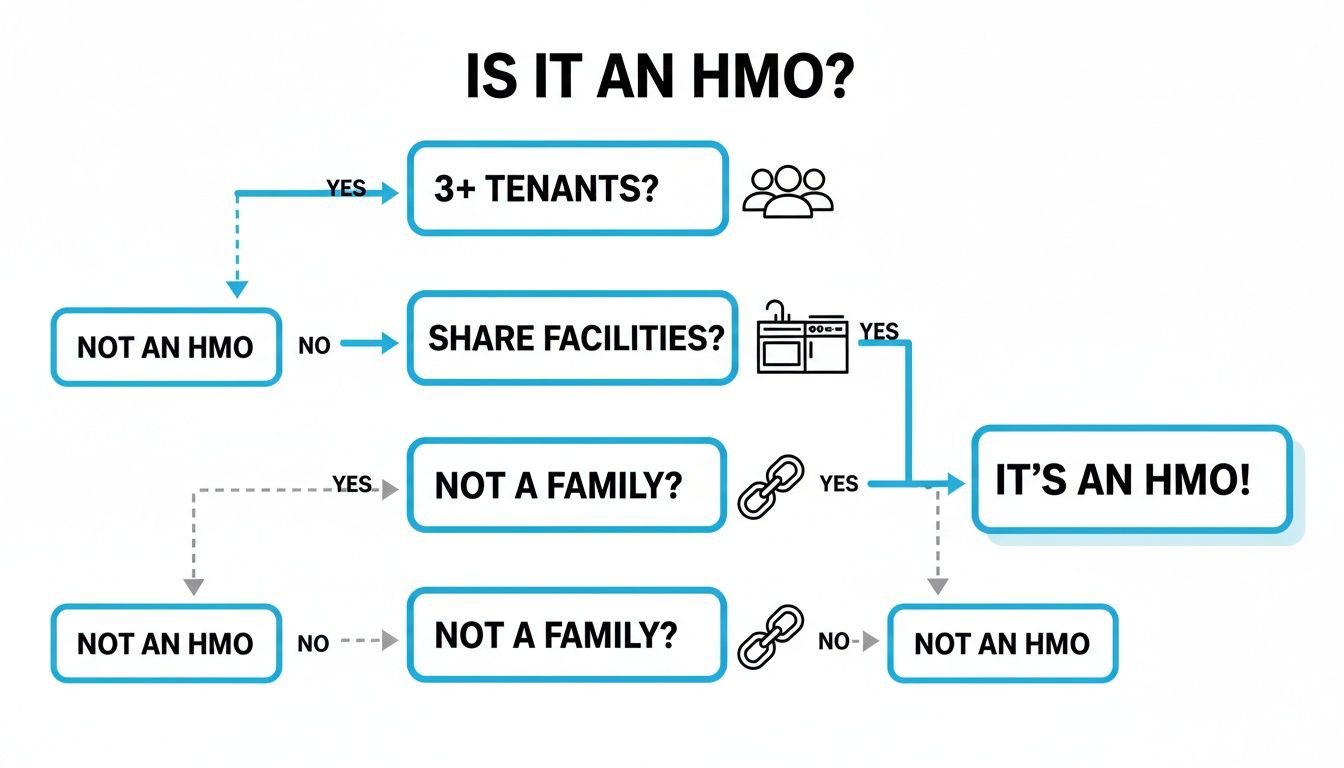 As you can see, the path to identifying an HMO starts with counting tenants and households, long before you even get to the licensing stage.
The critical takeaway here is never to make assumptions. Always check your local council's website to find out the specific rules for your property's postcode. For more insights on landlord responsibilities, you can explore further articles on our blog. This one simple check will give you a clear roadmap and help you stay compliant, protecting both your investment and your tenants.
Meeting Essential HMO Safety and Amenity Standards
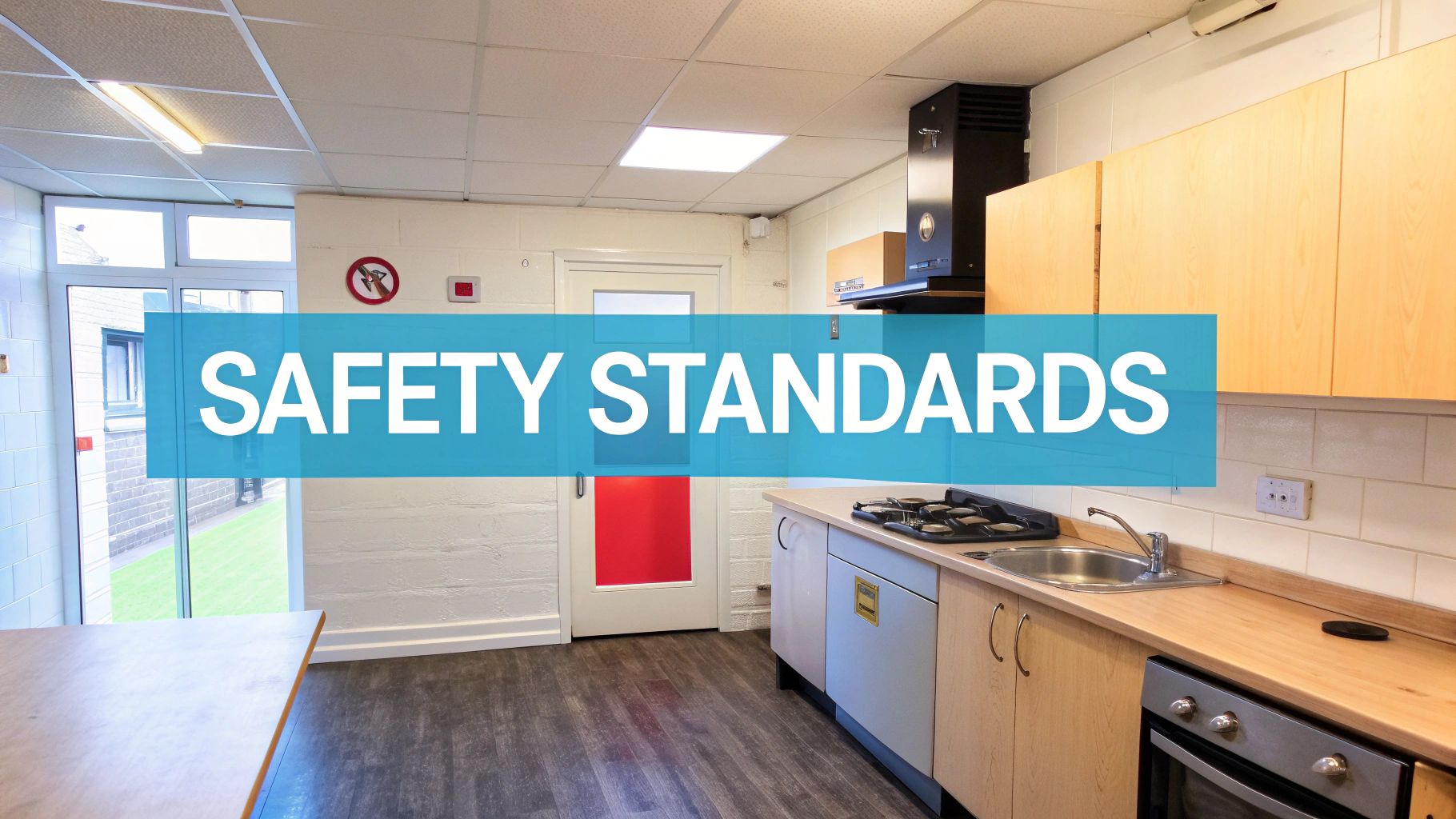
Running an HMO isn't just about collecting rent from multiple people; it comes with a much higher duty of care. The law is crystal clear on this: shared living spaces carry unique risks, and as the landlord, you're on the hook to meet a specific set of safety and amenity standards.
It's best to think of these rules not as bureaucratic hoops to jump through, but as the fundamental blueprint for providing a safe, comfortable home. Getting them right is completely non-negotiable. This framework protects your tenants from harm and your investment from the hefty penalties that come with cutting corners.
Fire Safety: Your Top Priority
In a house with several occupants, fire safety has to be your number one concern. The risk of a fire is naturally higher, and ensuring everyone can get out safely is absolutely critical. While your local council will have its own specific list of requirements, some standards are pretty much universal.
A solid grasp of fire safety is essential, and using a dedicated residential block fire risk assessment guide can be invaluable for making sure you've covered all the bases. At the very minimum, you'll need to have:
- Mains-Powered, Interconnected Smoke Alarms: These are a must. If one goes off, they all go off, giving everyone the earliest possible warning. They need to be fitted in hallways, kitchens, and other shared areas.
- Fire Doors: These aren't just regular doors. They're built to hold back a fire for a set time (usually 30 minutes), slowing its spread and buying precious time for escape. They are typically required for kitchens and any rooms that open onto an escape route.
- Clear Escape Routes: This one is simple but vital. All hallways, stairs, and landings must be kept completely free of clutter. That means no bikes, boxes, or furniture blocking the path to an exit.
- Emergency Lighting: For larger HMOs, you might need emergency lighting that kicks in during a power cut, making sure escape routes are always lit.
A quick word of warning: Failing to meet fire safety regulations is one of the most serious offences an HMO landlord can commit. The consequences, both legal and human, are devastating. This is one area where you absolutely cannot afford to take shortcuts.
Gas and Electrical Safety Checks
Beyond fire prevention, you have a fundamental duty to ensure the property’s core utilities are safe. These aren't just one-off checks, either; they require regular, certified inspections to keep your tenants safe from hidden dangers like carbon monoxide leaks or faulty wiring.
You must be able to produce the paperwork for both:
- Annual Gas Safety Certificate: Every 12 months, a Gas Safe registered engineer must check every gas appliance and all the pipework. You have to give a copy of this certificate to your tenants.
- Electrical Installation Condition Report (EICR): A qualified electrician must inspect the property's entire electrical system at least once every five years. This check confirms the wiring, sockets, and consumer unit are safe and meet current standards.
These certificates are your proof that you’re actively maintaining a safe environment for your tenants. If you need any advice on your specific obligations, feel free to get in touch with our team through our contact page.
Amenity Standards: Room Sizes and Facilities
Finally, an HMO has to be more than just safe—it has to be liveable. The law sets minimum standards for space and facilities to prevent overcrowding and ensure tenants have a decent quality of life. Think of it as ensuring everyone has enough elbow room.
Here’s a quick rundown of what you need to provide:
- Minimum Room Sizes: National rules in England dictate the minimum size for sleeping rooms in licensed HMOs. For one adult, a room must be at least 6.51 square metres. For two adults sharing, it must be at least 10.22 square metres.
- Sufficient Kitchens and Bathrooms: You have to provide enough kitchens, toilets, and bathrooms for the number of people living there. The exact ratio can vary by council, but a good rule of thumb is one full set of facilities for every five tenants.
- Waste Disposal: It's the landlord's job to make sure there are enough bins for both general and recycling waste for everyone in the house.
To make things simpler, we've broken down the key responsibilities into a table.
HMO Landlord Obligations At a Glance
| Obligation | Frequency/Requirement | Key Details |
|---|---|---|
| Gas Safety Certificate | Annually (every 12 months) | Must be carried out by a Gas Safe registered engineer. A copy must be provided to tenants. |
| Electrical Check (EICR) | At least every 5 years | A full inspection of the property's electrical wiring and installations by a qualified electrician. |
| Smoke & CO Alarms | Tested regularly | Mains-powered, interlinked smoke alarms on each storey. Carbon monoxide alarms in rooms with fuel-burning appliances. |
| Fire Doors | As required by council/risk assessment | Often required on kitchens and rooms along escape routes. Must be self-closing and properly maintained. |
| Clear Escape Routes | Always | Hallways, stairs, and landings must be kept free of obstructions at all times. |
| Minimum Room Sizes | On letting | Sleeping rooms must meet national minimums (e.g., 6.51m² for one adult). |
| Adequate Facilities | Based on number of occupants | Sufficient numbers of kitchens, bathrooms, and toilets for the number of tenants. |
| Waste Management | Ongoing | Provide enough bins for household waste and recycling. |
This table serves as a great checklist, but always remember to double-check the specific requirements set by your local council, as they can and do vary.
The Real Cost of Ignoring HMO Regulations
Ignoring the rules around what makes a house a House in Multiple Occupation isn't just a minor slip-up; it's a high-stakes gamble. These regulations aren't optional guidelines. They are legal duties put in place to protect tenants, and landlords who sidestep them can see their investment, reputation, and finances unravel with shocking speed.
Beyond the big-ticket safety checks for fire, gas, and electricity, landlords have a host of ongoing management duties. These responsibilities, laid out in The Management of Houses in Multiple Occupation (England) Regulations 2006, cover all HMOs—it doesn’t matter whether they need a licence or not.
This means you’re on the hook for keeping the property in good repair, ensuring common areas are clean and functional, and providing proper bins and waste disposal facilities. It's your job to make sure the property is a safe and pleasant place to live, not just on day one, but for the entire duration of every tenancy.
The Heavy Price of Non-Compliance
So, what happens if you drop the ball? The penalties are severe, designed to be a powerful deterrent against cutting corners. Local authorities have been given significant muscle to bring non-compliant landlords into line.
And we're not talking about a slap on the wrist. The consequences can be financially crippling:
- Civil Penalty Notices: Councils can hit you with fines of up to £30,000 per offence. That isn’t a single fine for the whole property; multiple breaches mean multiple penalties, and the total can escalate alarmingly fast.
- Prosecution and Unlimited Fines: For more serious issues, the council can take you to court. Here, magistrates have the power to impose an unlimited fine, a step usually reserved for cases where a tenant's safety has been put at serious risk.
- Banning Orders: If convicted of certain housing offences, a landlord can be slapped with a Banning Order. This stops you from letting out any property in England for a set period, effectively ending your career as a landlord overnight.
A criminal record is a very real possibility. Offences like running a licensable HMO without a licence or breaching management regulations can lead to prosecution, permanently damaging a landlord's ability to rent out property in the future.
Rent Repayment Orders: A Financial Nightmare
Perhaps the most financially devastating weapon in the council's arsenal is the Rent Repayment Order (RRO). This is a legal process that allows tenants (or the local authority) to claim back up to 12 months' rent from a landlord who has committed a relevant housing offence.
An RRO can be triggered if a landlord has:
- Failed to get a mandatory or additional HMO licence when one was required.
- Ignored an Improvement Notice served by the council.
- Illegally evicted or harassed a tenant.
Just imagine being forced to hand back a whole year's rental income from five different tenants. For most landlords, this would be a catastrophic financial blow, wiping out any savings made by dodging licence fees or putting off essential repairs.
This powerful tool shifts all the financial risk squarely onto the shoulders of non-compliant landlords. It makes proactive, responsible management the only sensible business decision. Protecting your investment always starts with protecting your tenants.
HMO vs House Share: Demystifying the Difference
It’s a common mix-up you hear all the time: people using ‘house share’ and ‘HMO’ as if they mean the same thing. But for landlords and tenants, this isn't just semantics—it's the difference between a casual living arrangement and a serious legal responsibility.
A house share is just what it sounds like. It’s a general term for any setup where people live together and share common areas like the kitchen or living room. This could be two friends renting a flat or a group of young professionals sharing a bigger house. Think of it as an informal label for a lifestyle, not a legal status.
An HMO, or House in Multiple Occupation, on the other hand, is a specific legal category defined by law. The moment a property meets the legal criteria—usually involving three or more people from different households—it automatically triggers a whole host of non-negotiable landlord duties.
When a House Share Becomes an HMO
Here’s the simplest way to think about it: every HMO is a type of house share, but not every house share is an HMO. The line is crossed the second the specific legal test is met.
- Two friends sharing a two-bedroom flat? That’s a house share, but not an HMO.
- Three unrelated students sharing a three-bedroom house? That’s both a house share and an HMO.
This distinction is absolutely crucial. As soon as that line is crossed, the property falls under a much stricter set of regulations. Suddenly, rules about fire safety, minimum room sizes, and potential licensing come into play that simply don't apply to a simple two-person share. This legal status is what separates a casual setup from a professionally regulated rental property.
What About Having a Lodger?
Taking in a lodger adds another layer to this. Under the government's 'Rent a Room' scheme, a homeowner can rent out a furnished room to one or two lodgers without the property becoming an HMO. This is because the law treats resident landlords differently.
But be careful. The moment you take on a third lodger, the property tips over the threshold. It is now legally an HMO, and you, as the resident landlord, have to comply with all the relevant management regulations.
Understanding this difference is the key to compliance. 'House share' describes a lifestyle; 'HMO' defines a legal obligation. Mistaking one for the other can leave landlords unknowingly breaking the law and tenants living in unregulated properties.
The private rented sector, which includes HMOs, is a massive part of the UK’s housing landscape. It represented 19% of all households in England as of 2024-25, making it the second-largest tenure right after owner-occupation. With around 38% of UK workers now in hybrid or remote work arrangements, the demand for well-managed shared living is only growing. This makes the role of compliant, safe HMOs more important than ever.
You can dive deeper into these housing trends by reading the latest English Housing Survey findings. Knowing exactly where your property stands legally is the first step to meeting these modern demands.
Finding Great Tenants For Your HMO Rooms
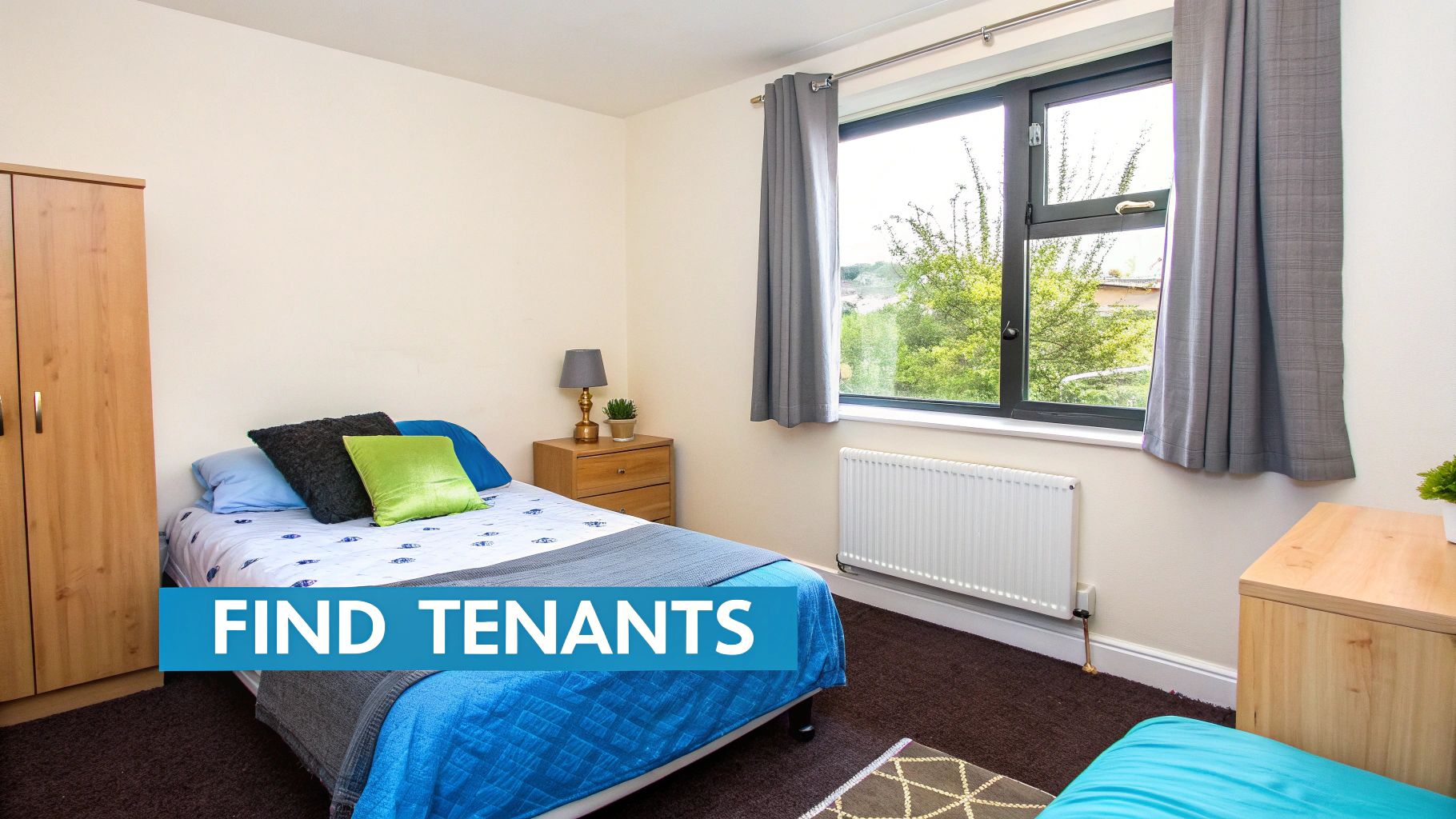
So, you’ve navigated the regulations and your HMO is fully compliant. What's next? The real work begins: filling those rooms with the right people. Getting your marketing spot-on is the secret to keeping your property occupied and fostering a positive, respectful home life for everyone inside.
A brilliant advert does more than just fill a vacancy. It acts as a filter, attracting the kind of tenant who will slot perfectly into the household dynamic you want to create.
To get this right, you’ll need to put on your marketing hat and implement some proven strategies for marketing rental properties. It all starts with creating an online listing that cuts through the noise and speaks directly to your ideal housemate.
Crafting A Standout Room Advert
Think of your online advert as the digital front door to your property. It's the very first impression a potential tenant will get, so making it clear, honest, and appealing is absolutely vital for attracting quality applicants.
First things first: photos. Don't just snap a quick picture of the empty bedroom. Take bright, tidy, and welcoming photos of all the shared areas—the kitchen, the living room, the bathroom. This helps people visualise their entire life in the property, not just their life in one room.
Next up is the description. This is your chance to sell the experience, not just the space. Go beyond the basics and paint a picture of what makes your HMO a fantastic place to live.
- Shout about the perks: Do you have a dishwasher, a tumble dryer, or blazing-fast broadband? These are huge selling points, so make sure they're front and centre.
- Describe the household vibe: Give a brief, honest snapshot of the current tenants. Are they quiet young professionals who keep to themselves, or sociable students who enjoy cooking together? This helps people self-select.
- Be crystal clear on bills: State exactly what’s included in the rent—council tax, utilities, Wi-Fi, even a cleaner. No one likes nasty surprises down the line.
- Set expectations with house rules: Be upfront about the big stuff. Mention your policy on overnight guests, cleaning rotas, or noise to make sure everyone is on the same page from day one.
Your aim is to give a potential tenant enough information to decide if they're a good fit before they even book a viewing. This kind of transparency saves a massive amount of time for both you and them, resulting in better-quality viewings and, ultimately, better tenants.
Understanding Your Local Market
The demand for HMO rooms isn't the same everywhere; it can swing wildly depending on your town or city. The HMO market in England has grown by 2.3% in the last year, but that figure hides some dramatic local differences.
For example, the West Midlands saw a huge 8.8% jump in HMO properties, while the East of England actually saw a 4% drop. These shifts often come down to local council policies, which can directly shape the supply of shared housing in an area.
Knowing what’s happening in your specific market helps you tailor your advert. If competition is fierce, highlighting your property’s unique features becomes even more critical.
By presenting your rooms professionally and honestly, you’re laying the foundations for a successful, harmonious tenancy. Once you’ve polished your advert, the final step is getting it in front of the right people. You can easily and effectively advertise your HMO room on Rooms For Let and reach thousands of potential tenants across the UK.
Frequently Asked Questions About HMOs
Navigating the world of shared housing can throw up plenty of questions for landlords and tenants alike. The rules around what makes a property a House in Multiple Occupation can seem a bit tangled, but getting to grips with the specifics is the key to staying compliant and knowing your rights.
We’ve pulled together some of the most common queries to give you clear, straightforward answers. Think of this as your go-to spot for clearing up any confusion.
Can a Landlord Live in Their Own HMO?
Yes, a landlord can absolutely live in their property, but doing so changes the legal setup quite a bit. If you’re a resident landlord renting out rooms to one or two people (lodgers), the property is typically not considered an HMO. This is the common arrangement covered by the government's 'Rent a Room' scheme.
However, the game changes the moment you take on a third lodger. At that point, the property usually crosses the line into becoming an HMO, and you, as the landlord living there, have to follow all the relevant management regulations. It's always a good idea to have a quick chat with your local council, as their specific rules on resident landlords can sometimes differ.
How Do I Check if a Property Has an HMO Licence?
Finding out if a property has the right licence is much easier than you might think. Most local councils across the UK are required to keep a public list of all the licensed HMOs in their area.
You can usually find this by heading over to your local authority’s website and searching for something like "HMO register" or "property licensing register." It's an invaluable tool for tenants wanting to double-check a landlord is above board, or for someone buying a property and doing their homework.
A public register is how councils keep everything transparent and enforce standards. If a property that needs a licence isn't on that list, it’s a massive red flag for both tenants and the local authority.
What Are My Rights as a Tenant in an HMO?
Living in an HMO gives you a higher level of legal protection compared to a standard rental. These extra rights are there to ensure you’re safe and comfortable in a shared home.
Your fundamental rights include:
- A Safe Home: Your landlord is legally responsible for making sure the property meets all fire, gas, and electrical safety standards. This includes things like fitting fire doors and interconnected smoke alarms where needed.
- Proper Facilities: You have the right to use kitchens and bathrooms that are adequate for the number of people living there. No queueing for an hour to use the shower!
- A Reputable Landlord: The landlord has to pass a 'fit and proper' person test with the council to even get an HMO licence.
- No Overcrowding: The property can't be overcrowded, and your bedroom must meet the legal minimum size requirements.
Do Student Houses Count as HMOs?
Almost always, yes. In fact, the vast majority of shared student houses are legally defined as HMOs. The test is pretty simple: if three or more students who aren't from the same family live together and share a kitchen or bathroom, the property is an HMO.
This means the landlord has a legal duty to follow all the HMO rules, from safety standards to their management duties. Depending on how many students are in the house and the local council's specific rules, the property will almost certainly need either a mandatory or an additional licence to operate legally.
Finding the right people to share a home with is the final piece of the puzzle. At Rooms For Let, we connect compliant landlords with thousands of tenants looking for quality shared homes across the UK. Advertise your spare room with us today and find your ideal housemate quickly and easily.